Category: Highlight

  • Bugatti bought back the first Veyron Grand Sport prototype and restored it

    Bugatti on Tuesday presented the first of its cars from the modern era to receive a restoration and certification via the automaker’s La Maison Pur Sang program.

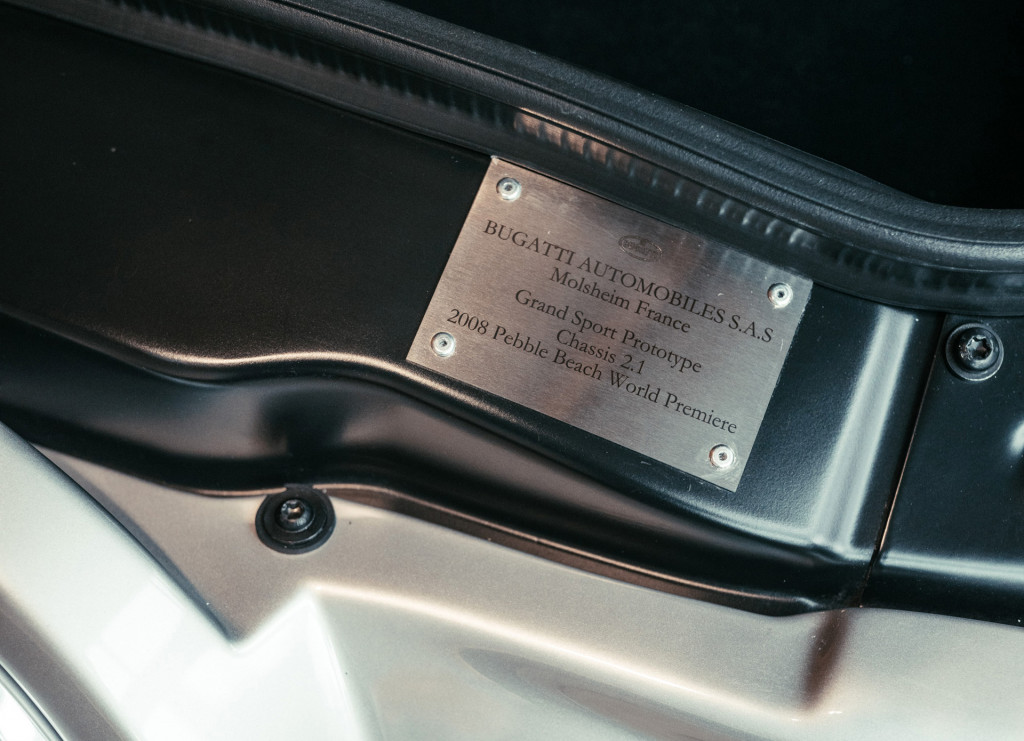
    The car is the first prototype example of the Bugatti Veyron Grand Sport, and the version used for the Veyron Grand Sport’s debut at the 2008 Pebble Beach Concours d’Elegance. It’s finished in white silver metallic paint and features a Cognac brown leather interior.

    The La Maison Pur Sang program, which operates out of Bugatti’s headquarters in Molsheim, France, and whose French name roughly translates to “The Thoroughbred House” in English, was launched in early 2020 with the aim of providing both existing owners and future potential owners with an official detailed history of its vehicles.

    Bugatti Veyron Grand Sport prototype #001

    Bugatti Veyron Grand Sport prototype #001

    This is particularly important in the world of collector cars, especially when those cars may have been used in competition or owned by famous individuals, which is the case for virtually all of Bugatti’s early models. According to Luigi Galli, the head of the program, he and his team are able to trace the history and determine the authenticity of any Bugatti model and its parts, regardless of age.

    The program also offers a full restoration service and an upgrade service where only official parts are used, ensuring that any modifications made will not impair the car’s certification.

    In the case of the Veyron Grand Sport prototype, which Bugatti only reacquired from an unnamed seller in 2020, a complete strip-down was undertaken to identify the parts used and restore any that were worn. Multiple body panels were repainted and leather and aluminum elements in the cabin were all replaced. With the work completed, the car was almost immediately snapped up by a new collector, according to Galli.

    Source

  • First Lewis Hamilton Formula One car up for grabs sells for millions at auction

    A race-winning McLaren Formula One car driven by Lewis Hamilton was sold at an RM Sotheby’s auction over the weekend, and the final bid came in at 4.73 million British pounds (approximately $6.45 million).

    It isn’t the highest price paid for a F1 car from the modern era. That honor goes to Michael Schumacher’s Ferrari F1 car from the 2021 season that sold in 2017 for $7.5 million. Of course, when it comes to the highest price paid for an F1 car, Juan Manual Fangio’s Mercedes-Benz from the 1954 season takes the prize, selling for almost $30 million back in 2013.

    Hamilton’s car is the McLaren MP4-25 from the 2010 season. It was driven that season by both Hamilton and his teammate at the time, Jenson Button, with its best finish being Hamilton’s win at the Turkish Grand Prix. It’s the first of Hamilton’s former F1 cars to hit an auction block.

    The car was put into storage at McLaren after the 2010 season and only brought out again in 2019 when it underwent a restoration in 2019. The work was performed by McLaren’s heritage department and included a complete teardown of the car, after which all safety-critical items were inspected, tested, and replaced as needed. The engine was also sent over to its original supplier, Mercedes, to have it brought back to factory standard.

    [embedded content]

    The car is fully certified by McLaren, and it can still be used for track driving, the listing claims, though even a decade-old F1 car is likely far too much for most drivers to handle. We should also add that you need multiple engineers just to start a modern F1 car, let alone see it run smoothly on a track.

    Powered by a naturally aspirated 2.4-liter V-8, the MP4-25 was notable for introducing the infamous “F-duct.” Named for the positioning of an outlet near the letter “f” in sponsor Vodafone’s name, the duct was activated by the driver covering up a small hole with his leg. This redirected airflow, reducing aerodynamic drag and adding up to 6 mph on straights, according to the listing.

    The F-duct was briefly a must-have feature in F1, allowing teams to keep downforce-generating aerodynamic appendages for corners while eliminating some of the drag penalty on straights. Most teams introduced their own versions, but the system was eventually banned.

    The MP4-25 also represents the end of an era for McLaren. The team began a decline after the 2010 season, in part because it had to play second fiddle to the Mercedes factory team. Hamilton joined Mercedes for the 2013 season, and has now won six of his seven championships with them. Meanwhile, McLaren is once again achieving solid results, and has gone back to Mercedes power after lackluster years with Honda and Renault power units.

    Source

  • The ZBF 7er was a hand-built concept that predicted BMW’s future

    BMW Group Classic has been showcasing long-hidden concept cars and prototypes on its YouTube channel. The latest is the BMW ZBF 7er, a hand-built concept from 1996 that made a few notable predictions of future BMW design and tech.

    “ZBF” is a German acronym for “future BMW family,” Joji Nagashima, a legendary BMW designer who worked on the project (as well as the E39 5-Series and E36 3-Series), explained. It was part of a group of concepts, which also included 5-Series and 3-Series designs, he said.

    The exterior hints at the E65-generation 7-Series, which launched in 2001, while the large vertical grille shows that BMW was toying with such a shape on a modern car long before today’s 4-Series. The ZBF 7er was also much larger than the contemporary E38 7-Series, Nagashima said, again predicting the direction BMW would go with the successor E65 model.

    BMW ZBF 7er concept

    BMW ZBF 7er concept

    The car rides on custom tires specially manufactured by Dunlop, Nagashima said, with hand-cut treads of his own design. The largest tire size commercially available at the time was 19 inches, and designers wanted something larger, he explained. The bodywork of this drivable concept is hand-made as well. The body panels are all hand-beaten aluminum, in the finest coachbuilding tradition.

    While it was built using techniques from the past, the ZBF 7er showcased future technology, including an early version of the now-ubiquitous iDrive rotary controller, and laptops for rear-seat passengers. The sedan also had cameras in place of exterior mirrors, something that has only recently entered production, and still isn’t available in the United States due to regulatory issues.

    BMW has quite a few interesting concept cars and prototypes in its collection. It recently revealed the ICE concept, an early crossover coupe design study, after 17 years, and it kept the E31 M8 prototype stashed away for a decade before showing the car publicly. We’re still waiting for the E34 M5 wagon prototype powered by a McLaren F1 V-12 to see the light of day.

    Source