Category: Highlight

  • Walter Röhrl and the Porsche 924 Carrera GTS Rally reunited after 40 years

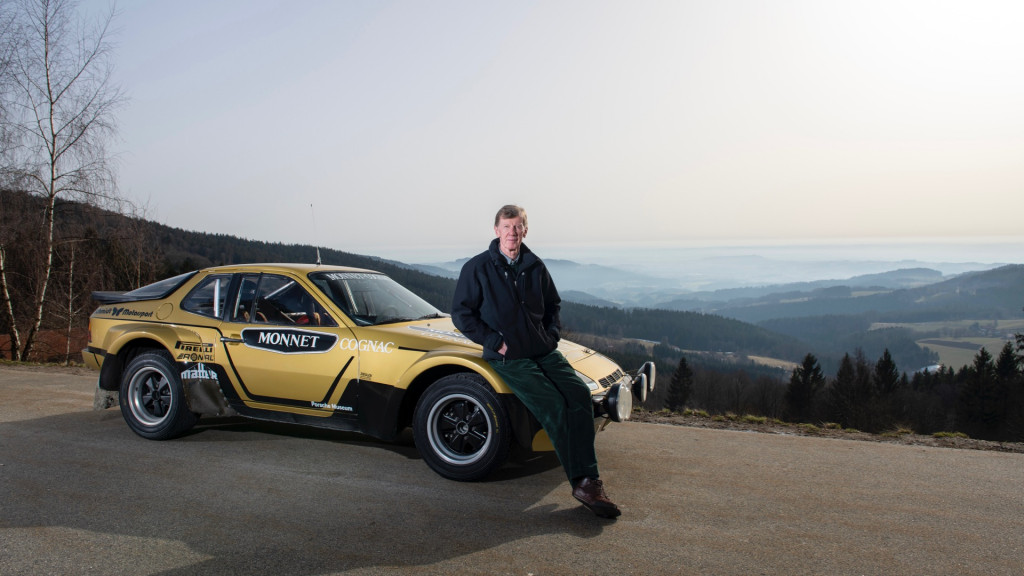
    Porsche recently reunited rally legend Walter Röhrl with the 924 Carrera GTS Rally he drove forty years ago.

    Röhrl and co-driver Christian Geistdörfer raced the 924 in the 1981 German Rally Championship, winning four of seven races. It was the only season that Röhrl competed in rallying with Porsche. He won the 1980 and 1982 World Rally Championship (WRC) Drivers’ titles rallying a Fiat and Opel, respectively, and helped secure the 1983 Constructors’ title for Lancia. He also set a Pikes Peak International Hill Climb record with Audi in 1987.

    While the 924 has a reputation as the bargain Porsche, the Carrera GTS version that formed the basis of the rally car was actually the most expensive car in the lineup in 1981, according to Porsche. That’s because it was a low-volume homologation special for motorsports. Just 50 production cars were built (all painted Guards Red), plus nine prototypes.

    The car that became the 924 Carrera GTS Rally started out as one of those prototypes (the fifth one, specifically). It was fitted with massive fender flares and a prototype 2.0-liter turbocharged four-cylinder without a serial number. That engine survived the entire 1981 rally season and is still in the car today, Porsche noted.

    Walter Röhrl and the Porsche 924 Carrera GTS Rally

    Walter Röhrl and the Porsche 924 Carrera GTS Rally

    Other rally-specific modifications included rear-axle links laminated in fiberglass to protect against damage, skid plates for the oil and transmission, rear-mounted dry-sump lubrication system, and a 928 fuel pump.

    In 1982, the car was given to the Porsche Museum where, aside from occasional outings, it remained for the next 40 years. The automaker decided to get the 924 running again to celebrate the 40th anniversary of the 1981 rally season, and Röhrl’s 74th birthday.

    This was a recommissioning, not a restoration, Porsche noted. The goal was to get the 924 running without destroying any patina. Mechanical components were thoroughly checked (the engine and turbocharger got an endoscopy), but details like the sun-faded seat belt harnesses embroidered with Röhrl’s and Gesitdörfer’s initials, were left as-is. In a statement, Röhrl said the 924 was a bit of a handful in competition thanks to “enormous” turbo lag, but was still happy to be reunited with his old rally car.

    “This car opened the door to Porsche for me,” Röhrl, who has maintained a close relationship with the automaker throughout the years, said in a statement. “That is why I feel a particularly close bond to it. For me, it’s a journey back in time. I immediately feel 40 years younger.”

    Source

  • $3M Koenigsegg Jesko ready for production but already sold out

    Two years after it made its debut at the 2019 Geneva International Auto Show, the Koenigsegg Jesko is finally ready for production. To mark the event, Koenigsegg showed off a pre-production Jesko finished in a bright orange color that was offered on Koenigsegg’s CCR in the company’s early days.

    Customer deliveries of the Jesko are due to start in early 2022 and just 125 examples are destined to be built. All build slots are gone, despite the car starting at $3 million.

    Koenigsegg Jesko Absolut (left) and Koenigsegg Jesko

    Koenigsegg Jesko Absolut (left) and Koenigsegg Jesko

    For those readers wiping their tears on a blank check, there may still be a way to secure a Jesko. A handful of build slots for exotics like the Jesko are usually earmarked for dealer partners, so don’t be surprised if examples start showing up for sale—with huge markups—in the near future.

    Koenigsegg has two versions of the Jesko. The standard version designed for top track times and a low-downforce version designed for top speed runs. The latter, known as the Jesko Absolut, can be identified by its missing rear wing. The Jesko Absolut should be able to crack the 300-mph barrier, and Koenigsegg has stated that it will never attempt to build a faster car. Buyers that opt for the standard version will be treated to more than 3,000 pounds of downforce through numerous aerodynamic elements that adorn the car’s body.

    Koenigsegg Jesko

    Koenigsegg Jesko

    Both versions sport a 5.0-liter twin-turbocharged V-8. With E85 in the tank, the hypercar makes 1,600 hp. Filling the car up with gasoline drops the power rating to 1,280 hp. The engine pairs with a 9-speed automatic that Koenigsegg calls the Light Speed Transmission. Technology within the transmission allows the Jesko to skip gears, allowing it to drop seamlessly from, say, seventh to fourth. The transmission never sees fifth or sixth gear in this example.

    “Because of its seamless shifting, whether up or down, everything just happens much faster,” Markus Lundh, a Koenigsegg test driver, said in a statement. “There are no delays, it is very responsive and behaves exactly the way you want it to.”

    Koenigsegg Jesko pre-production model

    Koenigsegg Jesko pre-production model

    Unlike some of Koenigsegg’s earlier models, the Jesko has been homologated for roads around the world, which means that, yes, we will see at least one in the United States.

    Alongside the Jesko, Koenigsegg is building the Regera. The company is also continuing work on another model, the Gemera, its first four-seater. The Gemera combines a 2.0-liter turbocharged inline-3 with a sophisticated electric system to generate a combined 1,700 hp. Koenigsegg plans to build 300 Gemeras, though there’s no word on when production will start.

    Source

  • 2024 BMW 5-Series spy shots: Popular sedan slims down for next generation

    A prototype for BMW’s next-generation 5-Series has been spotted for the first time.

    The new mid-size sedan is still at an early stage of development but a number of details can already be identified.

    The proportions are reminiscent of the much-loved E39 generation, while the headlights look to be getting even slimmer than on the current generation. We can also see that the headlights taper back along the fender, much more than in recent generations.

    2024 BMW 5-Series spy shots - Photo credit: S. Baldauf/SB-Medien

    2024 BMW 5-Series spy shots – Photo credit: S. Baldauf/SB-Medien

    When it comes to what’s under the hood, BMW is keen to give customers their powertrain of choice, at least until it makes the eventual switch to a full-electric lineup. As a result, powertrains will include mild-hybrid, plug-in hybrid and battery-electric options.

    This flexibility is made possible by the latest version of BMW Group’s CLAR modular platform which supports conventional powertrains in addition to hybrid and battery-electric options. There are reports that even the future M5 variant will offer the choice of plug-in hybrid or battery-electric power, which would be the first time there’s more than one powertrain choice for the super sedan.

    Look for the redesigned 5-Series to debut in 2023 as a 2024 model. The M5 variant should arrive about six months to a year later. But before they arrive, BMW fans can look forward to new generations of the X1 and 7-Series, as well as a new X8 flagship crossover.

    Source