With the redesigned 2021 S-Class, Mercedes-Benz moves all its safety and infotainment pieces forward on the chess board where it plays against the BMW 7-Series, along with the Audi A8 and Porsche Panamera.
Arriving next spring with a starting price of $110,850, including destination, the 2021 S-Class will also adapt new mild-hybrid powertrains as well as a fusillade of driver-assistance improvements, not to mention an array of portrait-style touchscreens and digital displays.
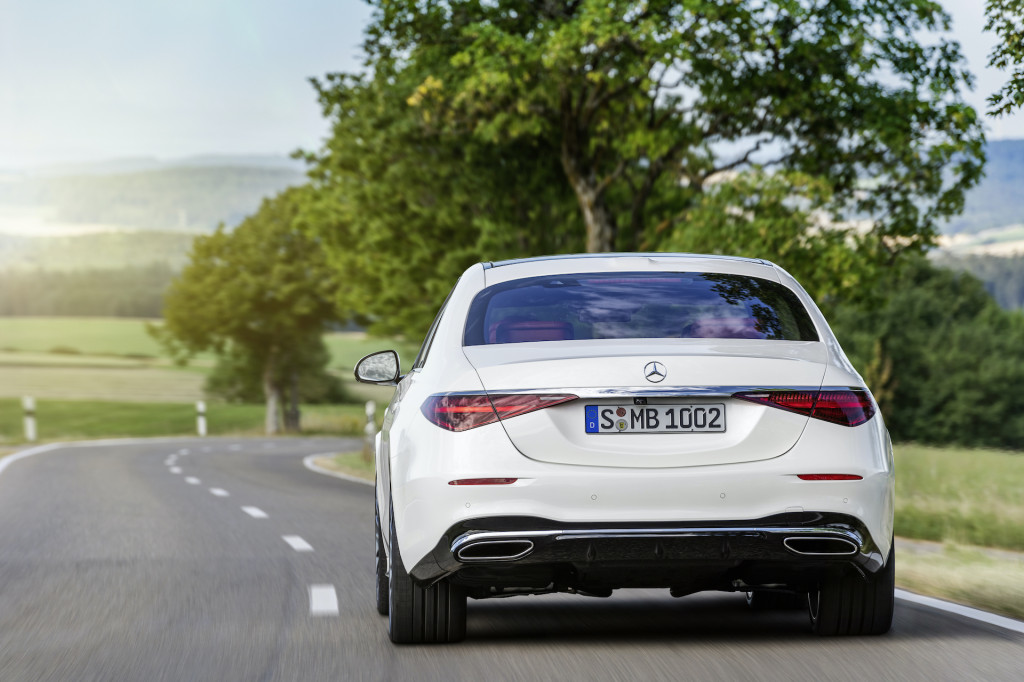
The new S-Class’ styling carefully modulates its look with more subtle strakes and lines all around its body. The grille flows into the hood more gradually, from between slimmer headlights. The roofline is strikingly similar, but the surfaces down the S-Class’ side have more muted creases and curves. Hidden door handles extend from the body; the Aston Martin technology exchange goes both ways after all. Shallower diamond-framed taillights replace blocky, tall units on the prior version of the big Benz. It’s a preview of sorts of the upcoming electric Mercedes EQS sedan.
Buyers looking for a sportier look can add a Mercedes-Benz AMG styling pack with blacked-out trim and sports wheels for an additional $4,300. AMG is also working on its own version of the new S-Class, due in about a year.
[embedded content]
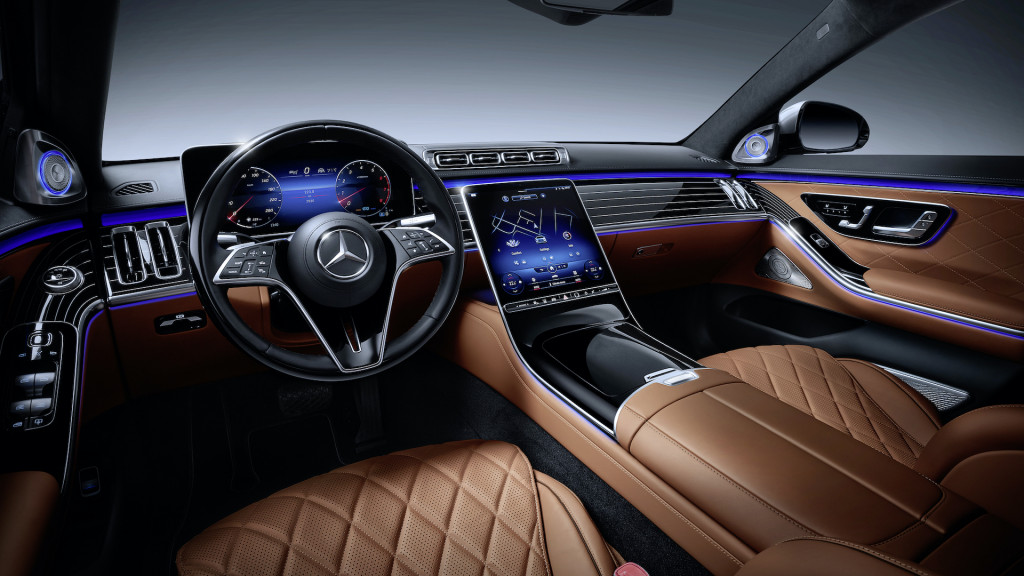
For radical change, the S-Class welcomes passengers inside. The wavelike forms and undulating surfaces have been ironed flat and squared off, to build a new environment for the driver and front passenger. It’s an interior dominated by cool surfaces and digital displays, composed of rectangular screens and vents that play off the dramatically simplified dash shape. Those screens warm up the cabin or cool it down visually; they can cycle through a range of color schemes and schemas including “Discreet,” which gives a choice of seven colors, or “Sporty” which is of course red, or “Exclusive” pearl and “Classic” white.
Two models will be available at launch, both of them with standard all-wheel drive. The base model is an S500 4Matic with a 3.0-liter turbo-6, an inline engine with mild-hybrid 21-hp and 184-pound-feet boost applied to the gas engine’s 429 hp and 384 lb-ft. The power issues from a 9-speed automatic. No 0-60 mph acceleration times have been released, but the S500 will reach a 130-mph top speed.
Above this is an S580 4Matic which adopts a twin-turbo V-8 with 496 hp and 516 lb-ft of torque, and the same boost of mild-hybrid power. No 0-60 mph times are yet published either, but the same 130-mph top end has been confirmed.
Drive modes enable powertrain personalities from Eco to Comfort, Sport, Sport+, and Individual, and those modes select suspension behavior, too. In addition to its new mild-hybrid powertrains, the 2021 S-Class gets a revamped chassis with a wider track—by as much as two inches—for better stability. It’s fitted with standard rear-axle steering that cuts turning radius up to 7.0 feet, by canting wheels in the opposite direction of the fronts by up to 4.5 degrees or by up to 10 degrees, depending on the model. An air suspension is standard, and can lower the car up to 0.7 inches for lower drag and raise it by 1.2 inches for slightly better clearance.
2021 Mercedes-Benz S-Class
Coming soon: an active suspension system that will enable a degree of individual wheel control for damping in corners and over obstacles. It’s accomplished with hydraulic dampers and enabled by the 48-volt mild-hybrid system.
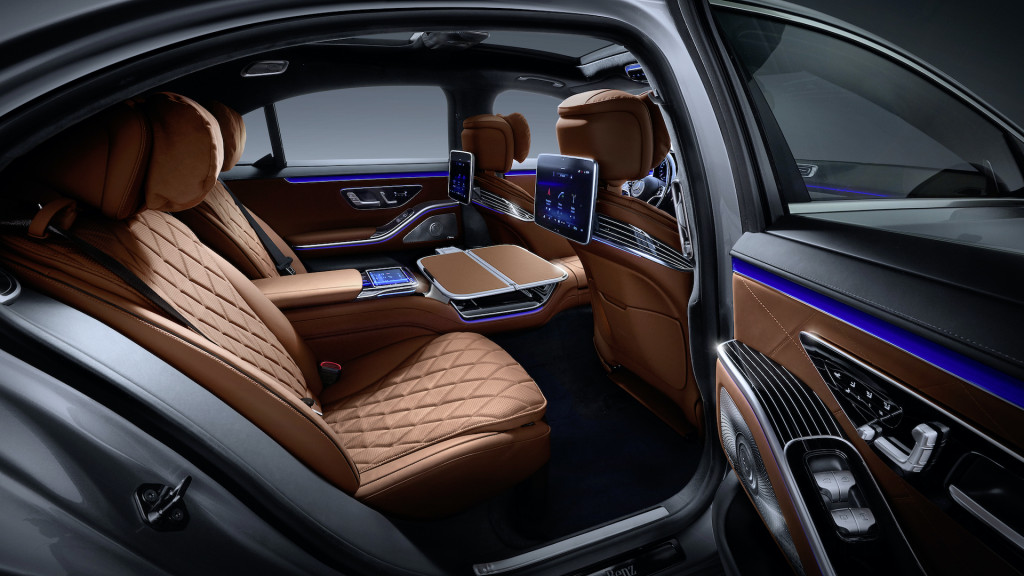
The S-Class arrives stretched a bit in almost all directions. It’s 208.3 inches long (up from 206.9 inches), 59.2 inches tall (up from 58.8 inches), and has a 126.6-inch wheelbase (versus 124.6 inches). That translates into 0.6 inches more front-seat head room, an inch more in rear-seat leg room, and a larger trunk that’s up to 19.0 cubic feet. Seating ranges from plush to lavish, with multi-contour massaging seats available in four seating positions, with all kinds of shiatsu and Swedish and other modalities, heating, cooling, reclining, etc. It’s a car that can do hot yoga or cool-down laps while you drive.
A set of speedy new processors enables more sophisticated driver-assistance systems. The gamut of S-Class technology bundles adaptive cruise control with speed limiting based on route; stop and go functionality up to 35 mph; active lane control with emergency-stop and lane-change assist; active brake assistance that can prevent turning into oncoming traffic; active blind-spot monitors with brake support and vehicle-exit support; active park assistance; and warnings for approaching stop signs and traffic lights. There’s also an available rear-seat airbag system.
Mercedes says it will begin to implement Level 3 autonomous driving in Germany soon, and that the new S-Class comes with the hardware to enable Level 4 autonomy—but all implementation is subject to local law. In the U.S., where mounting even a minimally effective public-health campaign is next to impossible, Level 4 autonomy is at least one Presidential administration away from becoming reality.
2021 Mercedes-Benz S-Class
The extra brain power enables more complex infotainment offerings as well. The S-Class sports a 12.3-inch digital display for gauges, and a 12.8-inch portrait-style touchscreen for the center display. Up to five screens can be fitted to the car, including twin rear-seat tablets for entertainment and a 7.0-inch rear screen for vehicle functions, intertwined with the MBUX infotainment system. Fingerprint sensors can authenticate a driver’s user profile and enable digital payments from inside the car, all of which can be set by Mercedes’ app and used to reset vehicle settings before entering the car. Voice commands are recognized more easily, Mercedes promises, and LED lighting in the cabin can respond to those commands to signal acceptance.
On a purer note of pleasure, the S-Class’ new Burmester surround-sound system can pump jams through 30 speakers with up to 1,750 watts of power. Speakers can be tuned to the needs of different passengers; one can whisper navigation commands in the driver’s ear while another can amplify a deep bass groove for another through the seat cushions.
When the S-Class shows up in showrooms next year, it will come standard with all-wheel drive. The 2021 S500 gets standard navigation, keyless start, LED adaptive headlights, multi-contour front seats, leather upholstery, wireless smartphone charging, Apple CarPlay and Android auto wireless compatibility, an air ionizer with fragrance dispenser, a surround-view camera system with a 3D view for parking, soft-close doors, six USB-C ports, a Burmester surround sound, a panoramic sunroof, rear-wheel steering, and 19-inch wheels.
Options include a heated steering wheel, heated armrests, nappa leather, 20-inch wheels, an augmented-reality head-up display. An executive package on the S580 includes multi-contour rear seats, rear-seat airbags and belt airbags, rear-seat tablet, rear-seat wireless smartphone charging, twin 11.6-inch screens, and higher-capacity rear-wheel steering. This option alone costs a hefty $15,150.
2021 Mercedes-Benz S-Class
Bookmark this URL as we’ll soon bring you our first drive review of the 2021 S-Class. You can also head to The Car Connection for in-depth reviews on the S-Class.