Category: Highlight

  • Review update: 2020 Porsche 911 S flirts with perfection

    The idea isn’t perfect. Build a sports car with the engine hanging off the tail behind the rear axle. Sure, that weight gives the rear tires lots of grip, but it creates a moment of inertia that can send the tail skittering if corners aren’t taken with care. Not exactly the recipe for stability in a car that will be driven hard on racetracks and canyon roads.

    Apply almost 60 years of engineering to that concept, though, and you have the 2020 Porsche 911, a sports car that’s as close to perfect as I’ve ever driven.

    I spent a day during the pandemic driving a 2020 Porsche 911 S instead of slaving away at the office and experienced the ways the car is perfect and imperfect. Here’s what I learned.

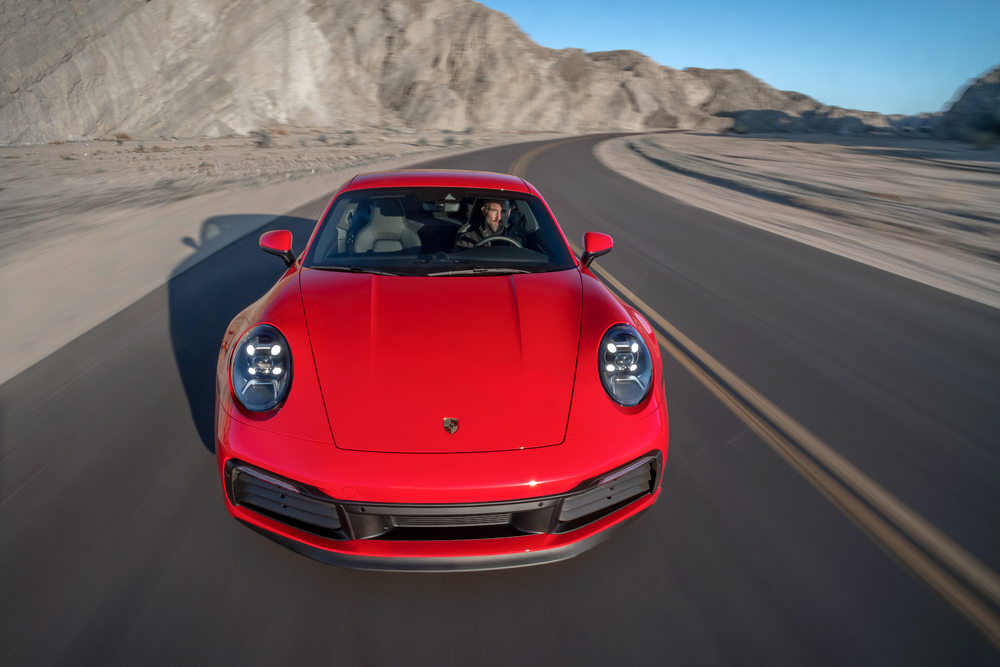
    2020 Porsche 911 S

    2020 Porsche 911 S

    Hit: Perfect seating position

    The 911 offers a low-slung seating position that makes you feel as cool as the blown away rocker in the 1970s Maxell ad. The difference is the Porsche sport bucket seat, which certainly offers more support than that Le Corbusier chair. Even with just 6-way adjustments (4-way power), the seat offers an ideal driver’s position for any body type thanks to a generous range of travel. The gearshift for the 7-speed manual transmission sits slightly high, but it’s in perfect alignment to rest your arm on the center console as you rifle through the gears. The steering wheel telescopes forward and back to set the right arm angle for best control, and the tachometer sits front and center to easily monitor the revs and shift points when sending it on the track.

    Miss: Bathtub feel

    The only complaint I have about the seating position is more of a complaint about modern design. Beltlines started rising almost two decades ago to create a lower, chopped-roof look, but that meant hanging an elbow out the window became uncomfortable. The feeling is particularly noticeable in the 911 as the door panels rise high and the car wraps around you. The doors rise so high that it feels like you’re sitting in a bathtub.

    Hit: Perfect steering

    That perfect steering-wheel position is accompanied by perfect steering feel. Porsche is one of just a handful of automakers that do electric-assist power steering well. It’s rock-steady on center, quick to react, predictable, and it tells you what those low-profile 20-inch front tires are doing. This is how steering should feel.


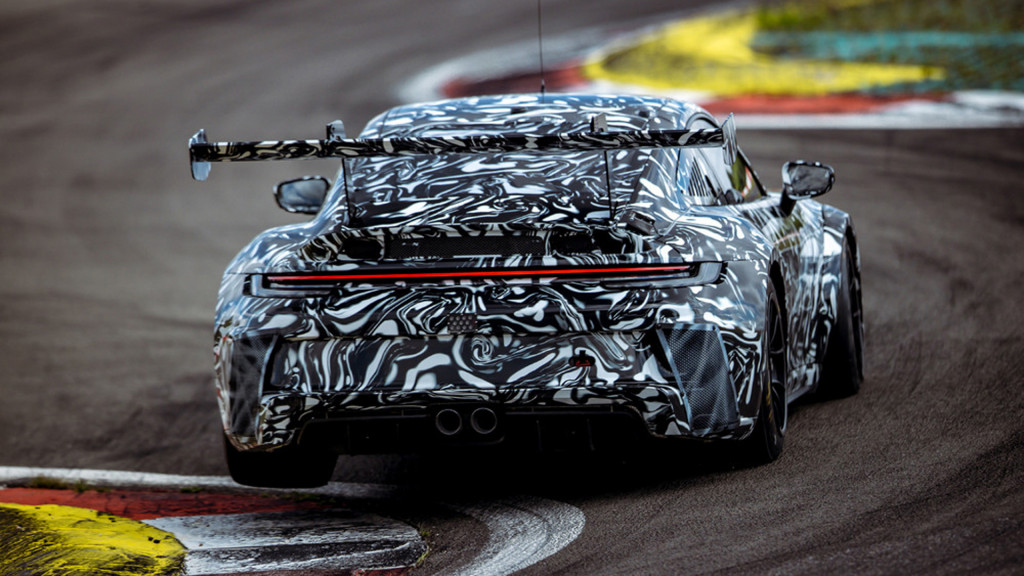
    2020 Porsche 911 Carrera S, Circuit Ricardo Tormo, Valencia, Spain, January 2019

    2020 Porsche 911 Carrera S, Circuit Ricardo Tormo, Valencia, Spain, January 2019

    Hit: Perfect stability

    Part of the reason for the fantastic steering is the suspension is just so dialed in. On the road or the track (as we learned during last year’s Best Car To Buy testing), the 911 is unflappable. It always feels hunkered down. It feels as stable and serene going 70 mph through a sweeping bend as it does cruising down the highway. That 62 percent rear weight bias is exceptionally well controlled, without a hint of a tendency toward oversteer. The 911 is so solidly planted that it takes extraordinary measures to get it out of sorts

    Hit and miss: Ride quality

    Given the 911’s extra-sensory handling, it rides as well as could be reasonably expected. It never beats up passengers, even in Sport+ mode, and would make a comfortable companion for a cross-country trip. However, some high-end sports cars ride better, like the Aston Martin DB11 and Lexus LC 500. I’ll take the minor tradeoff for the 911’s sharper moves.

    Hit: Prodigious power

    I’ll stop short of calling the Porsche 911 S model’s 443 horsepower and 390 pound-feet of torque perfect, but it’s certainly prodigious and better than advertised. Power arrives low in the rev range, the big 305-mm rear wheels hook up efficiently, and the 911 blasts from 0-60 mph in just 3.3 seconds and tops out at 191 mph. If Porsche told me it had 550 hp I’d believe it. The twin-turbo 3.0-liter flat-6 also makes the right throaty sounds that help define the 911.

    2020 Porsche 911 - Best Car To Buy 2020

    2020 Porsche 911 – Best Car To Buy 2020

    Miss: Infotainment

    Porsche is getting closer with its infotainment systems, but they still need some work. The touchscreen is nicely sized, close at hand, and quick to react. It has a clean design, and additional control icons “wake up” as your hand approaches the screen. I take issue with the size of the icons, some of the control menus, and the ease with which some functions can be performed. Apple CarPlay exacerbates the icon size issue because its interface uses only part of the screen. A Silicon Valley approach would help here instead of the logical German mind.

    Hit and Miss: Too expensive and not expensive enough

    The car I drove had a $114,650 starting price, including $1,350 for destination. With a smart smattering of options that included a sport exhaust system and a Sport package with adjustable dampers, it stickered at $121,950. That’s too rich for my blood but worth every penny. The 911 S offers performance unmatched by sports cars at twice the price like the DB11 and Bentley Continental, but the cost of entry means it’s for the elite.

    ––––––––––––––––––––––––––––––––––––––––––

    2020 Porsche 911 Carrera S

    Base price: $114,650

    Price as tested: $121,950

    EPA fuel economy: 17/25/20 mpg

    The hits: Perfect seating position, perfect steering, perfect stability, prodigious power.

    The misses: Infotainment, bathtub feel, expensive.

    Source

  • 3D-printed body kits: Could it become a thing?

    Aftermarket company 1016 Industries is looking to pioneer 3D printing of body kits.

    The company, based in Miami, Florida, specializes in carbon fiber body parts for exotic cars and offers everything from individual parts to full body kits. It’s now looking to incorporate 3D printing into the manufacturing of its kits and is testing a prototype kit developed for the McLaren 720S.

    1016 Industries describes the kit as a full body replacement made from carbon. The company said the kit also adds 110 millimeters to the width of the 720S.

    It’s still early days as 1016 Industries is yet to determine whether 3D-printed body kits are durable enough to match the performance of traditionally formed kits, i.e. cured in molds. More advanced prototype kits should have better fit and finish than the one shown here.

    1016 Industries developing 3D-printed body kit for the McLaren 720S

    1016 Industries developing 3D-printed body kit for the McLaren 720S

    “Incorporating 3D printing into our production processes has been a steep learning curve,” Peter Northrop, CEO of 1016 Industries, told Motor1 in an interview published Wednesday. “While the material hasn’t proven yet that it would be the right fit for a long-term prototype, our testing has proven that a car can use 3D-printed technologies and be drivable.”

    According to Motor1, 1016 Industries will have a 3D-printed body kit for sale in 2021. It will be limited to 30 units and pricing information is yet to be announced. As a guide, 1016 Industries’ current kits for the McLaren 720S start at $22,000.

    Performance wheel manufacturer HRE has also shown off a 3D-printed wheel and the startup Czinger has shown a whole car where most of the parts are made using 3D printing.

    3D printing technology has also proven a boon for the major automakers whenever they need to produce complex parts in low volumes, for instance when building a prototype vehicle or adding a specialized part to a vehicle line. The technology has also proven useful for making parts for restoration of classic cars.

    Source

  • Lunaz returns with EV conversion for first-gen Range Rover

    A number of companies have started offering restored versions of the original Land Rover Range Rover, including Land Rover itself. The latest comes from a company called Lunaz, albeit with a twist.

    Based in Silverstone, United Kingdom, Lunaz specializes in converting classic British cars to run on battery-electric power. In its portfolio already are the 1953 Jaguar XK120, 1961 Bentley S3 Continental Flying Spur, and 1961 Rolls-Royce Phantom and Silver Cloud. Now we can add the original Range Rover to the list.

    The original Range Rover, often referred to as a Range Rover Classic, was built from 1969 right up until the mid-1990s. For its EV conversion, Lunaz starts with an exhaustive inspection that includes weighing each corner of the vehicle to understand the original weight distribution right down to the gram. This information is then used to determine powertrain packaging and chassis setup so that the EV conversion is as dynamically similar to the original as possible.

    Lunaz hasn’t revealed any specifics on the powertrain it uses, but we can imagine the Range Rover’s boxy shape won’t be good for range.

    Land Rover Range Rover Classic EV conversion by Lunaz

    Land Rover Range Rover Classic EV conversion by Lunaz

    Beyond the mechanical bits, Lunaz also fully restores the Range Rover and adds modern niceties like GPS, WiFi, and climate control. All the new features are integrated with the original interior details to keep things looking original.

    Buyers will be able to choose between Town and Country specifications. For the Town specification, the focus is more on increased comfort, especially for rear-seat occupants. The Country specification is for those owners who enjoy heading off-road. In this case, the vehicle is equipped with four-wheel drive and modern suspension.

    Lunaz is also offering an open-top body style just like the Range Rover that featured in 1983 James Bond film “Octopussy.” At least one customer in Europe has already ordered this option.

    Pricing for the electric Range Rover from Lunaz starts at 245,000 British pounds (approximately $329,000). While that’s certainly steep for an old Range Rover, even one running on electricity, Lunaz has a long list of customers lined up. The company said the initial run is for 50 vehicles and the first of these will be delivered next summer. As a result of all the demand, Lunaz needed to double its number of engineers, designers and technicians in 2020 and expects a further doubling in 2021.

    Source