
Category: Highlight

  • Deep dive: Porsche 959 Paris-Dakar

    It’s hard to imagine a modern supercar competing in the Paris-Dakar Rally, but that’s exactly what the Porsche 959 did back in the 1980s. This video from Porsche’s “Top Five” YouTube series explains how the 959 morphed from supercar to rally car.

    The all-wheel-drive 959 was designed with an eye toward Group B rallying, but the category was eliminated before the car was ready. Instead, Porsche shifted focus to the grueling Dakar Rally.

    After some success with all-wheel-drive versions of the 911 in the Dakar Rally, Porsche entered three prototype 959s in the 1985 running. These cars had similar bodywork to the road car (which didn’t start production until 1986), and a simplified version of its all-wheel-drive system, but with 911-spec engines. All three failed to finish.

    In 1986, Porsche returned to the Dakar with upgraded 959 rally cars. They sported a more sophisticated all-wheel-drive system with multiple modes, while a 2.8-liter twin-turbocharged flat-6 similar to the 959 road-car engine replaced the previous naturally aspirated 3.2-liter flat-6.
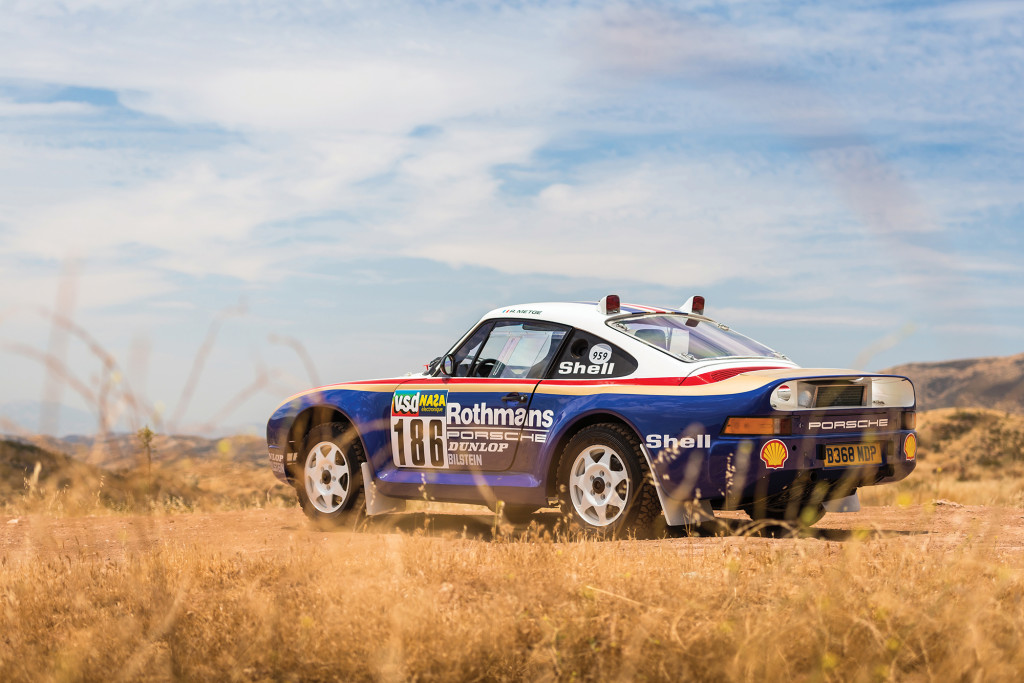
    1985 Paris-Dakar Porsche 959 to be sold at auction

    1985 Paris-Dakar Porsche 959 to be sold at auction

    The Dakar-spec engine made about 400 horsepower, down from the road car’s 444 hp. This was done to account for the unavailability of high-octane fuel along the desert race course, according to Porsche. The automaker also fitted larger fuel tanks, and reinforced suspension.

    Porsche once again entered three cars for the 1986 Paris-Dakar Rally, which finished first, second and sixth. That was enough for the automaker which decided to then retire from desert rallying.

    With its emphasis on electronics and lightweight materials, the 959 road car helped set the template for the modern supercar. Meanwhile, the Paris-Dakar rally cars are now likely too valuable to ever see dirt and sand again. Even one of the unsuccessful 1985 cars sold for nearly $6 million at auction in 2018.

    If you want to delve further into Porsche history, check out the automaker’s “Top Five” videos for rally cars and secret prototypes.
    Source

  • 2020 McLaren Speedtail headed to auction

    When the McLaren Speedtail was unveiled two years ago, the entire 106-unit production run had already sold out despite a near-$2 million price. Now one of those supercars is scheduled to cross the block at an RM Sotheby’s auction on Jan. 22.

    That car is Speedtail number 36, which was ordered on July 20, 2020, and delivered to McLaren Philadelphia (despite not being street legal in the U.S.) a few months later, according to the listing. It’s still virtually brand new, with just 30 miles on the odometer.

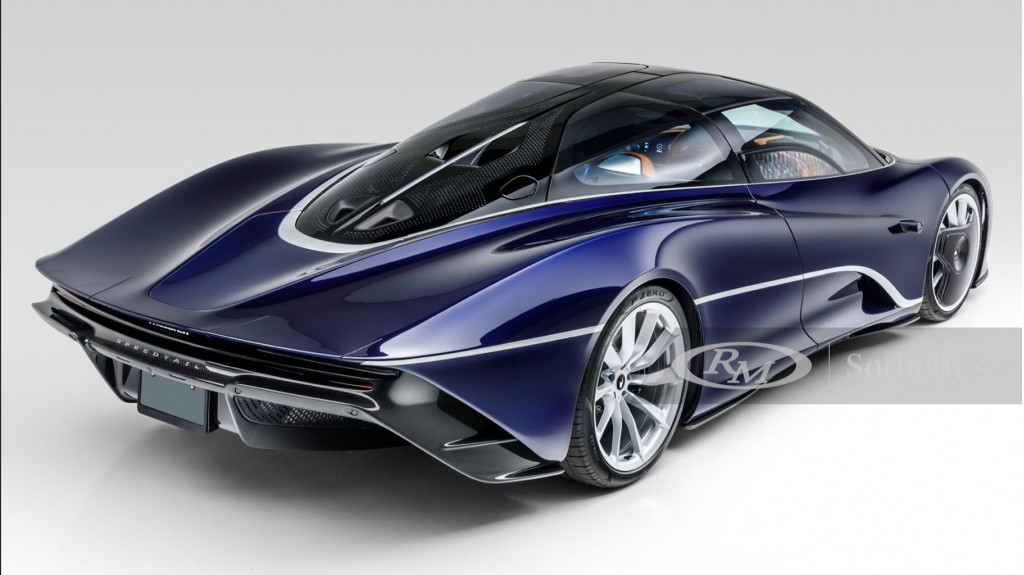
    The car has over $170,000 worth of options, according to its build documents. It’s painted in MSO Heritage Atlantic Blue, with white stripes and wheels, and a gloss carbon-fiber front wheel cover. The interior features a mix of satin carbon-fiber and Alcantara trim, with vintage tan aniline leather upholstery and contrast stitching. A suitcase designed to fit the front trunk and a gold-colored titanium tool set are included with the sale.

    McLaren Speedtail number 36 (photo by RM Sotheby's)

    McLaren Speedtail number 36 (photo by RM Sotheby’s)

    McLaren envisioned the Speedtail as a successor to the legendary F1, reflected by its three-abreast seating layout and 106-unit production run (matching the F1). Its focus on road rather than track use also echoes the F1, which was designed as a road car first, and only modified for racing after owners requested it.

    The Speedtail has a hybrid powertrain built around a twin-turbocharged 4.0-liter V-8, producing a total of 1,055 horsepower and 848 pound-feet of torque. McLaren previously quoted 0-186 mph in 12.8 seconds, and a 250-mph top speed.

    McLaren may not launch a supercar that surpasses the Speedtail for at least a few years. The automaker is reportedly dialing back its range-topping Ultimate Series, with the next model—a successor to the P1 plug-in hybrid—due in 2025.

    Source

  • SSC Tuatara falls short in new land-speed record attempt, will run again

    SSC claimed to set a new land-speed record for a production car in October with its Tuatara supercar hitting a two-way average of 316.11 mph. Issues with the run and how it was measured prompted company CEO Jerod Shelby to abandon that claim soon thereafter, but he promised to make the run again. Now, that’s happened, but it didn’t go as planned, and no land-speed record was set.

    Last Wednesday, Nürburgring taxi driver Robert Mitchell posted a video to YouTube detailing the SSC Tuatara’s Dec. 12-13 record attempt.

    [embedded content]

    The SSC team ran the new record attempt at the NASA runway in Florida, the same runway where Hennessey Performance Engineering set its record in the Venom GT Spyder.

    During the first attempt in October, the SSC team used a Dewetron TRIONet chassis with a GPS card and a laptop computer to process the satellite tracking data. For this new record attempt, the SSC team put redundancies in place for satellite tracking with two Racelogic systems including a VBox and an OEM system, a Life Racing tracking system, and three Garmin systems all installed in the Tuatara. Some were installed on the roof of the car and some were placed in the frunk. The latter posed an issue due to wires running out of the hood into the car, which caused the hood to keep popping open during high-speed runs at over 200 mph, according to Mitchell.

    The first record attempt placed professional race car driver Oliver Webb behind the wheel, but for the second attempt the owner, Larry Caplin, raised his hand and said, “I’m driving, I’m the owner of the car, this is my car,” according to Mitchell.

    Since Caplin had minimal seat time in the car, SSC decided to reduce turbo boost and slow down the engine timing, then build things back as Caplin became more comfortable.

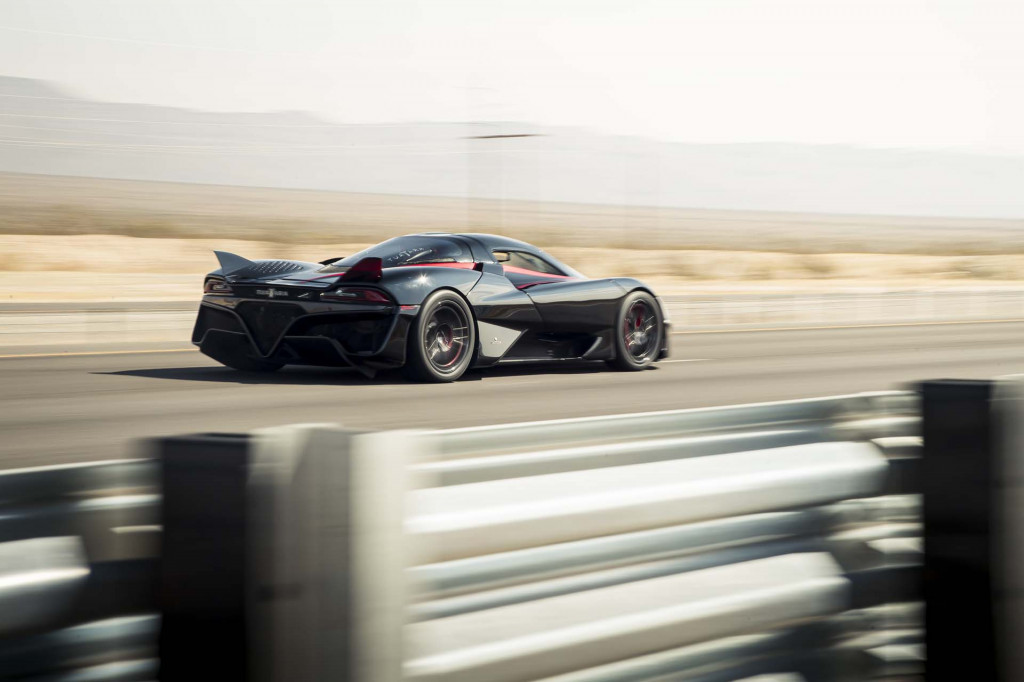
    SSC Tuatara record run

    SSC Tuatara record run

    During Caplin’s second-to-last run, the Tuatara hit 244 mph in 6th gear at the runway’s halfway point. At that point, the car became so hot that the engine software began to pull the timing to save the engine. The issue affected two spark plugs, though nobody checked the plugs and didn’t realize the issue existed.

    A chill box was installed to cool the intercooler and the entire engine for nearly two hours to restore a proper temperature. The boost was increased to within 3 pounds of full power, and Caplin went out for one more run.

    This time the Tuatara hit 251.2 mph before the halfway point when Caplin aborted as he felt the car wasn’t building speed as it should. At this point, the SSC team realized two cylinders had lost power, and the record attempt was over. The 251.2 mph run was done with two cylinders not firing properly.

    Motor Authority reached out to Shelby to confirm Mitchell’s story on the record attempt and has not heard back as of the time of publication.

    SSC plans to run the record attempt again at the NASA runway in January, according to Mitchell. Click on the video above for a deeper explanation of the run.

    Source