Category: Highlight

  • Modified VW ID.4 is running the NORRA Mexican 1000

    A modified Volkswagen ID.4 is racing in the NORRA Mexican 1000 this week. VW claims it’s the first production-based EV to compete in the off-road race, which started April 25 and wraps up April 29.

    VW sent a stock ID.4 First Edition to Rhys Millen Racing, which modified the suspension with rally-style coilovers, tubular lower control arms in front, and boxed lower links in the rear. The ride height was raised by 2.0 inches, skid plates were added, and the radiator was moved to improve approach angles and cooling capacity, a VW press release said. The stock 19-inch wheels were swapped for 18-inch rims, with Yokohama Geolander A/T 255/70R18 tires.

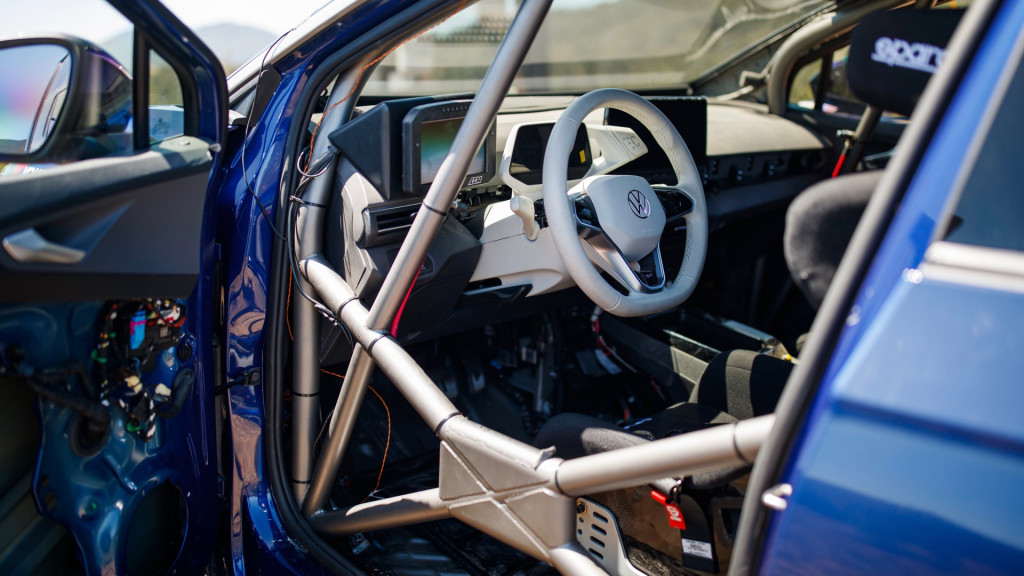
    Typical for a racing conversion, the interior was stripped of all convenience features and fitted with a roll cage and racing seats. VW kept the 1st Edition’s white steering wheel however, which will probably be different a color at the end of the race.

    Volkswagen ID.4 NORRA Mexican 1000 off-road racer

    Volkswagen ID.4 NORRA Mexican 1000 off-road racer

    No powertrain modifications were made, so the ID.4 off-road racer still uses an 82-kwh battery pack, with a single 201-hp electric motor. That motor is mounted in the back of the vehicle and drives the rear wheels, not unlike the Beetles and Meyers Manx dune buggies that have been a fixture of off-road racing for decades. A Manx won the inaugural Mexican 1000 in 1967.

    While the name suggests a 1,000-mile race, the 2021 NORRA Mexican 1000 is actually 1,141 miles long, with 893 miles off-road, according to VW. To charge the ID.4, the race team is using a portable 50-kw DC fast-charging station, powered by a biofuel generator. The race will also be run in loops, rather than point-to-point, due to coronavirus restrictions, and the team will attempt to complete about 98% of the stages in each loop without charging, according to VW.

    Source

  • 2021 Ford Mustang Mach-E GT and GT Performance priced from $61,000

    Ford on Monday released final specifications and pricing for the Mach-E GT and Mach-E GT Performance Edition, the sportiest versions of its electric SUV. The GT starts at $61,000, while the GT Performance Edition starts at $66,000 (both prices include destination), and both are available to order now.

    Both versions have dual-motor all-wheel-drive powertrains producing 480 hp. Torque output is pegged at 600 lb-ft for the GT, and 634 lb-ft for the GT Performance Edition. Other all-wheel-drive Mach-E variants make 346 hp and 428 lb-ft, and Ford also offers rear-wheel-drive versions with a single motor.

    Ford quotes 0-60 mph times of 3.8 seconds for the GT and 3.5 seconds for the GT Performance Edition. The latter figure matches the Tesla Model Y Performance, which has a $61,190 base price.

    Ford Mustang Mach-E GT Performance Edition

    Ford Mustang Mach-E GT Performance Edition

    EPA range estimates are 250 miles for the GT and 235 miles for the Performance Edition. That’s substantially less than the longest-range Mach-E, the California Route 1, which can go 305 miles on a charge. The Tesla Model Y Performance as an EPA-estimated 303-mile range.

    The Mach-E GT Performance Edition also adds Brembo-branded brake calipers, magnetic dampers, and Pirelli summer tires in place of the Mach-E GT’s Continental all-season rubber. Both models are available with Ford’s BlueCruise driver-assist system, which can control steering, acceleration, and braking on certain stretches of highway. Unlike Tesla, Ford also uses a driver-monitoring system to guard against misuse.

    Ford plans to begin deliveries of the Mach-E GT and GT Performance Edition in early fall. They may not be the only performance versions of the Mach-E. We’ve heard that a Shelby version might be in the works as well.

    Source

  • Edd China starts work on a 1962 Alvis in “Workshop Diaries” episode 4

    “Edd China’s Workshop Diaries” has already seen the former “Wheeler Dealers” host tackle a Volkswagen T5 van and a Land Rover Range Rover, but for the fourth episode he’s starting a new project: a 1962 Alvis TD21.

    With the Range Rover giving him some issues, China decided to put it aside temporarily and shift focus to the Alvis. One of many defunct British automakers, Alvis dates back to 1919 and has since built a cult following with its sports cars and race cars. The company stopped making cars in 1967, but a continuation-car program was announced in 2019.

    This TD21 was originally owned by a Royal Navy rear admiral (typical of the Alvis owner demographic, according to China), but now has a long list of issues. China decided to start with the headlights, which randomly refused to work.

    Edd China works on a 1962 Alvis TD21

    Edd China works on a 1962 Alvis TD21

    Figuring out the problem required removing the headlight switch from the dashboard, and to do that, China first looked at a brand-new replacement switch for clues. There weren’t any useful clues to be found, unfortunately, so China ended up popping off the dashboard’s walnut fascia and digging around in the nest of wires behind it.

    Replacing the headlight switch solved the problem, but China also noted that one of the secondary lights was having some issues. He’s saving that for a future episode.

    China also continued telling the story of setting a Guinness World Record for world’s fastest electric ice cream van, begun in the previous episode. This time, he covers removing the diesel engine from a Mercedes-Benz Sprinter in preparation for the electric conversion, as well as sourcing the motor. He wanted to use that motor with the stock Mercedes transmission, so he scanned the two parts in order to design a custom adapter. Watch the full video to see how he did it.

    Source