
Author: Olly

  • FORD TRANSIT CONNECT RS: COMMERCIAL SUCCESS

    The MS-RT Transit Connect is pretty cool in stock form, but pretty cool was not enough for Jo Lawrence. Behold, the world’s first Ford Transit Connect RS.

    Feature from Fast Ford. Words: Dan Bevis. Photos: Ade Brannan

    Vans. They’re sensible and functional things, aren’t they. People buy them because they need to haul stuff about – they’re rugged, dependable, practical and versatile. What they aren’t, though, is exciting. At least, not usually.

    “I didn’t buy this Ford Transit Connect with the intention of doing what I’ve done to it,” says Jo Lawrence, gazing at his extraordinary van with the dazed expression of a man desperate to reconcile how he got from that point to this.

    He continues, “After all, it is still my daily-driver. I sleep in it, throw mountain bikes in the back, go to the tip, take my daughter to nursery; it’s still very much used as a van.”

    Perhaps we oughtn’t be totally surprised. Modifying cars – and Fords in particular – has been Jo’s modus operandi since he was a kid. The tuning adventures started when he became a mechanic at the age of 15; things got serious when he met like-minded enthusiast Will Robson, and the pair eventually formed WRTuning.

    Ford Transit Connect RS

    Jo fell in love with the idea of the Mk2 Focus RS when it was released, and he just had to have one; after owning and modifying that for eight years he levelled-up to a Nissan GT-R – only to find that it was actually a bit too PlayStation (“Fast, but no fun”), so he downsized to a Fiesta ST180, before moving back into Focus RSs with a vengeance.

    So when someone with this sort of background buys a van, it’s not just going to be any old van. Indeed, Jo went for a 2017 MS-RT Transit Connect – the rakish variant packing a full aggressive bodykit, chunky OZ Racing wheels and a quad-exit stainless exhaust. It was already modded from new, so that’s job jobbed, right?

    Ah, no, it doesn’t quite work like that. The MS-RT Connect may be very cool, but for people like Jo, any newly-acquired vehicle is a blank canvas. The mods started small with a gentle ‘I’ll just change this and upgrade that…’ mentality, before getting steadily sillier.

    Ford Transit Connect RS

    Some simple speaker upgrades came first, along with soundproofing and carpeting the rear, and then the thought occurred to make a custom roof-lining in the style of the starlight setup you find in Rolls-Royces. Having drilled 450 separate holes to feed through fibre-optics, Jo was starting to feeling quite connected to the Connect, and then the thing happened that so often transpires to push a build forward: Jo and his brother-in-law had a few drinks, and reality began to get distorted.

    Jo says, “The idea of fitting a bigger engine was just a silly thought at first. But after a few beers on the sofa, my brother-in-law happened across a damaged Mk3 Focus ST on Facebook that was complete but couldn’t go back on the road. It looked like the perfect donor, and suddenly that silly thought became a reality; a few messages later, the deal was done.

    Ford Transit Connect RS

    “The initial plan was a long-term project, but that quickly changed as Ford Live at Knockhill was only a week away, so it had to happen ASAP.”

    The game was afoot. Jo and Will dragged in the Focus, tore it to bits, then pushed out the empty shell and brought in the Transit. Now, it takes a certain strength of character to pull a perfectly good and functional vehicle to bits just for the sake of it, but Jo was focused on a higher purpose: big power, right now – and so within a few hours the Focus engine was in, and then the fun could really start.

    The gearbox, shafts, radiator and intercooler all bolted in largely without hassle, so then it was a case of modding the Focus fuel pump to fit the Transit tank and various other detail jobs.

    Ford Transit Connect RS

    He says, “After what felt like days, but was actually only hours, we fired it up. Basically nothing worked – the airbag light, ESP light, EML… The dash was like a Christmas tree!. But after some fiddling with Forscan and UCDS software, we managed to code the ABS module, get some lights gone, and then moved on to basically a full rewire of all electrics: wipers, speakers, windows, lights – you name it, we did it.”

    The van made the Knockhill deadline (as if there was ever any doubt); it even enjoyed a few laps of the track, and everything was looking rosy. But fast-forward six months and disaster struck: a misfire developed.

    Jo says, “It turned out that the block was scrap. And I thought instead of sourcing another 2.0 EcoBoost, it was time for the 2.3 from the Focus RS, so it was back into the workshop for me and Will.”

    Engine duly sourced, the game of swapsies commenced, with Jo opting to fit a Quaife LSD to the six-speed ’box. Having enjoyed such immediate success with the ST transplant, a few unexpected hurdles presented themselves owing to the fundamental differences between the ST and RS engines.

    Jo says, “The mechanical side of things was simple, but the van required a full engine loom, including engine bay loom, full rad pack, lambda sensors, modifications to the downpipe, another Airtec intercooler… And then I ran into ECU issues. The van would start, but ran horribly. After a few days of head-scratching and many phone calls, help came in the form of Peter Tranda, ECU god at TRS Performance.”

    With Peter working his magic, the Transit believed itself to be a Mk3 Focus RS. Jo ran it in for a few days to ensure all was well, then applied Revo Stage 2 software. And, just like that, he had a daily-driver Transit with somewhere north of 400bhp.

    Jo smiles, “Since the van thought it was an RS, I decided to go all-in and turn it into the world’s first Transit Connect RS. With the Mk3 RS leather Recaros, steering wheel, cluster and boost pod, it’s now complete.”

    It’s simple when he puts it like that. Like any van should be, the Ford Transit Connect RS is still practical and versatile. It’s just that now, with that RS DNA, those nursery runs and trips to the shops happen a lot more rapidly.

    Ford Transit Connect RS

    Tech Spec: Ford Transit Connect RS

    Engine:

    2261cc EcoBoost (Mk3 Focus RS), Revo Stage 2 software, Revo RS carbon intake, Revo sound suppressor, Milltek downpipe, custom cat-back exhaust system by Calum Hayes Fabrication (retaining MS-RT quad tails), Airtec RS intercooler

    Power:

    400bhp-plus (owner’s estimate)

    Transmission:

    Focus ST250 gearbox, Quaife LSD, RS clutch

    Suspension:

    Front: KW V3 coilovers; rear: custom coilovers; poly wishbone bushes

    Brakes:

    Mk3 Focus RS Brembo brakes

    Wheels & Tyres:

    8.5 x 19in Revo RV019 wheels, 245/40×19 Michelin Pilot Sport 4 tyres

    Exterior:

    Original MS-RT bodykit

    Interior:

    Mk3 Focus RS heated Recaro seats, Mk3 Focus RS steering wheel, Mk3 Focus RS Mountune gearknob, Focus centre console modified to fit, Focus gauge pod moulded into dash, fully carpeted and soundproofed rear, custom Rolls-Royce-style starlight roof, bulkhead removed, rear seat conversion
    Source

  • Audi RS Q E-Tron super SUV gets ready to rock at 2022 Dakar Rally

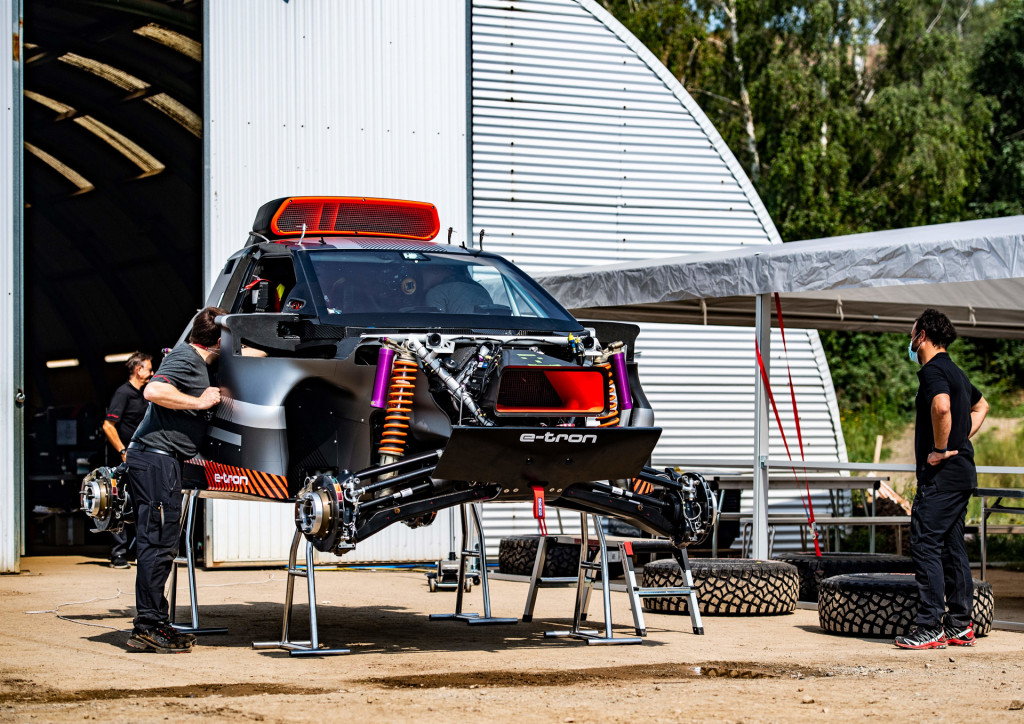
    It was less than a year ago that Audi announced its intention to enter the 2022 Dakar Rally with a bespoke SUV powered by electric motors, and on Friday we got our first look at the brand with the four rings’ contender.

    Called the RS Q E-Tron, the wild off-roader has been designed as a rally raid-style vehicle, much like Prodrive’s BRX Hunter which competed for the first time earlier this year in the 2021 Dakar Rally.

    The Audi is a much more sophisticated beast as it is powered by an extended-range electric powertrain that relies on a 2.0-liter turbocharged inline-4 mated to a generator to keep the battery on the boil. The battery is a 50-kilowatt-hour unit that alone weighs 815 pounds.

    [embedded content]

    The wheels are driven exclusively by a pair of electric motors, with a single motor at each axle to form an all-wheel-drive system and software controlling the torque distribution. The electric motors, which feature a single-speed transmission, can also act as generators under braking and help to top up the battery. Peak output is 670 hp, though this may be limited depending on the rules for the 2022 Dakar Rally.

    The electric motors are the same Audi uses in Formula E, a sport the automaker will quit after the current season. Audi said the motors needed only minor modifications for use in its Dakar contender. As for the range extender, it was lifted out of Audi’s former RS 5 DTM race car. It will operate between 4,500 and 6,000 rpm, which is the engine’s optimal band for efficiency, Audi said.

    Competing in the Dakar will allow Audi to stress test multiple components similar to what will feature in the automaker’s future electric road cars. Unlike Formula E, whose races last just 45 minutes, the Dakar Rally has multiple stages spanning two weeks, with some stages running close to 500 miles in length and lasting multiple hours. The 2022 rally will run through the deserts of Saudi Arabia next January.

    2022 Audi RS Q E-Tron Dakar Rally contender

    2022 Audi RS Q E-Tron Dakar Rally contender

    “What we are trying to do has never been done before,” Andreas Roos, head of Audi’s Dakar project, said in a statement. “This is the ultimate challenge for an electric drivetrain.”

    Audi has made a multi-year commitment to compete in the Dakar Rally. And while it has never competed in the event before, fellow Volkswagen Group brands Porsche and Volkswagen have experience to call on—especially VW which scored a hat track of wins between 2009 and 2011.

    Concurrent with the Dakar program, Audi plans to compete in the new LMDh class serving as the top class of the WeatherTech SportsCar Championship and World Endurance Championship. LMDh’s first season will be in 2023.

    Source

  • HYUNDAI I30N TUNING GUIDE

    The Hyundai i30N is the underestimated gem of the hot hatch crowd, but it’ll more than hold its own against the usual suspects, especially when tuned. We speak to expert tuners Courtenay Sport to give you a quick-fire Hyundai i30N tuning guide to heat up your motor.

    Engine

    The Hyundai i30N uses a 2.0-litre, 16v turbo G4KH Theta engine, which comes with either 250bhp in the N, or 271bhp in the N Performance. The block itself is essentially the same unit as found in the Mitsubishi Evo X, but has been strengthened by being of a closed deck design, which means it’s also a great base for tuning.

    First up for Hyundai i30N tuning is an option for those not wanting to get their hands dirty, and that’s a remap. A stage one map from Courtenay Sport is a simple plug and play affair that boosts power to around 305bhp and 332lb ft. But if that’s not enough for you, then there are hardware upgrades you can make too. The stock inlet is superb, featuring big bore pipe work and a cone filter in the stock airbox, so gains in this area are hard won, with an induction kit making more of an aural improvement that any noticeable power increase. To this end, a simple uprated filter for the stock air box is recommended, which allows you to save your money for the exhaust system. The OEM exhaust is a roarty unit with pop and bangs aplenty, but it is quite restrictive, especially in the flexipipe, so a bigger bore replacement here does reap around 10bhp alone for around £170. Combine this with a GPF delete or cat-back system from the likes of Milltek and you get a nice torque gain low down, plus an even better aural experience.

    An uprated tube and fin intercooler from Wagner will also be worthwhile, as it flows better and has improved cooling properties, allowing more boost to be run. Combine these with a stage two map and you’ll be seeing around 325bhp and 350lb ft. Finally, any more will require a hybrid turbo and uprated fuel pump, but combined with a stage three map, outputs of up to 400bhp and 385lb ft are to be expected, making for a seriously rapid hatch.

    Hyundai i30N Tuning

    Suspension

    The stock suspension is a properly sorted set up, with an excellent e-differential and electronic damper control via the steering wheel modes. If you want to retain this functionality, then simple lowering spring kits are available from Eibach and ST, but the ride does tend to suffer. A better, if pricier, option would be to upgrade to a full coilover system from the likes of KW. Their V3 kit with damper cancellation offers an excellent choice for lowered road driving, with superb handling and ride comfort, but you do lose the ability to adjust the damper settings from the driver’s seat. For those who want a more hardcore option or that want to do a lot of track work, the KW Clubsport kit is what Courtenay Sport  recommends, along with adjustable camber bolts from Powerflex.

    Brakes

    Unlike many other hot hatches, the i30N doesn’t use a swanky Brembo setup or similar and just makes do with its own braking system, lifted from a heavier model in the range. But far from a poor option, the stock brakes are immense, with excellent feel that gives plenty of confidence and power. Due to this, it’s worth limiting upgrades to a set of uprated pads from EBC for the road or some Pagid RS29s for the track, with a set of Tarox S2000 two piece discs a good option simply due to their lighter weight. Teamed up with some Goodridge braided hoses and your brake setup will be stunning!

    Hyundai i30N Tuning

    Interior

    The i30N’s interior is simple and stylish with supportive sports seats, a multifunction steering wheel and a multimedia screen dominating the centre of the dash. To be honest, there’s not a lot we’d change, but if you were looking to track your Hyundai, then Recaro do their excellent Pole Position bucket seats with i30N specific mounts and you can get a bolt-in rollcage from either Rollcages UK or JP Cages. It’s not recommended to fit an aftermarket steering wheel, as you would lose too much functionality, but you could always get the stock wheel customised with wither a flat bottom, some carbon-fibre, or retrimmed to your taste by companies such as Royal Steering Wheels or Control Customs who can tailor the wheel to your own spec.

    Style

    When it comes to styling the i30N, you’re pretty much limited to low-line kits including splitters, side skirts and diffusers from either Maxton Design or Zaero Design, but that’s no bad thing, as these make just enough impact to help the car stand out. Wheel wise, the N comes with 18in wheels from the factory, while the N Performance has 19in, so either size will fit no problem. Just ensure to select a lightweight option if you want to retain the car’s excellent handling, and it’s said that an 18in wheel with a quality 235/40/18 is the sweet spot for performance and ride, although the 19inchers definitely win in the looks department.

    Hyundai i30N Tuning

    Hyundai i30N tuning conclusion

    It may lack the kudos and brand heritage of the likes of Honda’s Type R, VW’s Golf GTi or RenaultSport and Ford’s RS monikers, but the Hyundai i30N relies on much more than its badge and is a better car as a result. In stock form it’s a belter, but with the potential to add 50% more power into the mix, plus make the already excellent handling and braking more focussed and potent and you’ve got a seriously impressive hot hatch for very reasonable money. So if you want to fly fast and under the radar, or you’re just not that bothered about the badge, you can pick up a three year old i30N for around £20k and have one of the finest hot hatches around.

    Hyundai i30N tuning contact:

    Courtenay Sport
    www.courtenaysport.co.uk
    01692 404313

    Source