
Category: Highlight

  • Ford’s new CEO races a 1966 Ford GT40 as his form of yoga

    Jim Farley, who replaced Jim Hackett as Ford CEO earlier this year, doesn’t just sell cars. He races them.

    Farley has been racing vintage cars for more than a decade, and he received permission from executive chairman Bill Ford to continue racing alongside his new responsibilities as CEO.

    It was probably the second conversation we had after we had talked about this leadership opportunity,” Farley said in a Ford-produced interview (via Autoblog). “I said, ‘You know, Bill, I just can’t stop racing. It’s just who I am. It’s my yoga. You’ve got to let me do this if I’m going to be a better CEO. He was very supportive.”

    Farley started racing in 2008 after buying a Shelby 427 Cobra, according to Automotive News. He currently races a 1966 Ford GT40 and a 1978 Lola T298. Other cars in his collection include a 1932 Ford roadster, a 1965 Shelby GT350 Mustang, and a 2012 Mustang Boss 302 Laguna Seca. He also reportedly owns a 1987 BMW 325i convertible purchased new by his wife.

    Senior Editor Kirk Bell rode with Farley in his 427 Cobra at a Ford event in 2014 and he can attest that Farley didn’t baby that car despite its collector value.
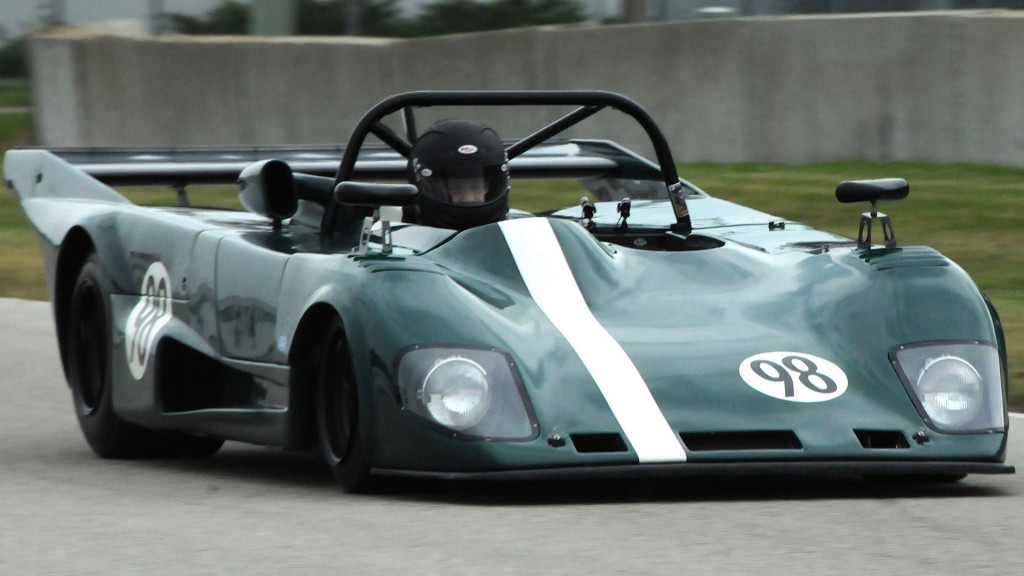
    Ford CEO Jim Farley racing his 1978 Lola T298

    Ford CEO Jim Farley racing his 1978 Lola T298

    The passion for cars started at a young age. As a teenager, Farley worked at a garage owned by Formula One champion Phil Hill, and once restored a 1966 Ford Mustang he paid $500 for, according to Top Gear.

    In the interview, Farley said racing keeps him grounded.

    “When I’m at the track, I’m just Jimmy Car-Car, nothing more. It’s a great way to stay humble and connected to the product, and it’s a great way for me to relax, because I love competing,” he said.

    Farley isn’t the only automotive executive to trade a suit and tie for a helmet and overalls. Toyota president Akio Toyoda, General Motors president Mark Reuss, and PSA Group CEO Carlos Tavares all race. Toyoda even took his firm’s latest World Endurance Championship race car for a test drive.
    Source

  • 225-mile R34 Nissan Skyline GT-R V-Spec II Nur for sale

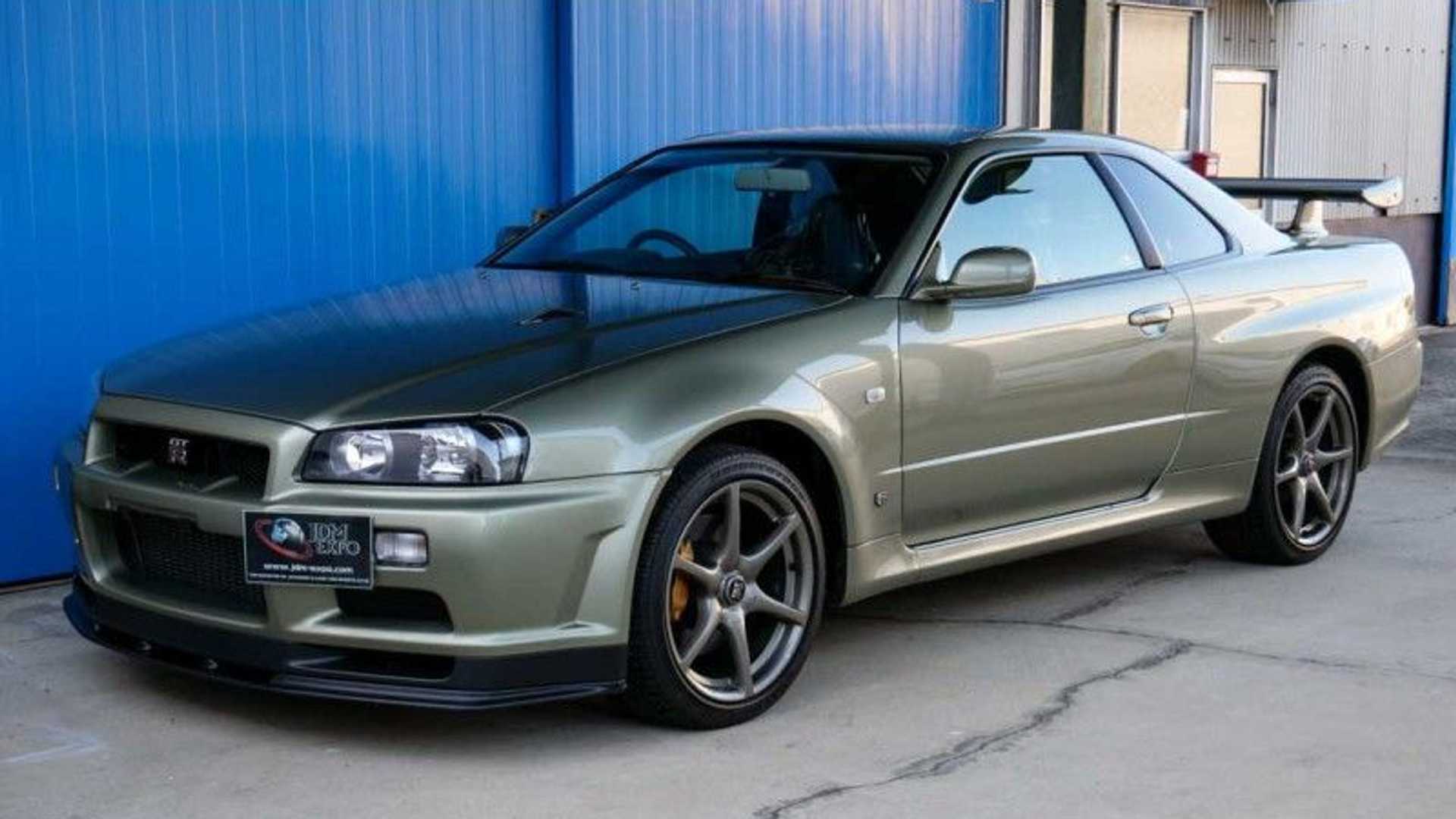
    The R34-generation Nissan Skyline GT-R, built from 1999 to 2002, spawned numerous variants, but the V-Spec II Nür is among the most coveted. A virtually new example of this very rare GT-R is for sale, with an asking price of $485,000.

    Offered through JDM Expo, a Japan-based import/export company, this GT-R is one of just 718 V-Spec II Nür models built, and one of just 156 finished in Millennium Jade. What makes this car so special, though, is that it has only 225 miles on its odometer, according to the seller.

    The V-Spec II Nür was the pinnacle of R34 GT-R development. Nissan introduced the V-Spec II version in 2000, with major changes that included stiffer suspension and a carbon-fiber hood with a NACA duct. 

    [embedded content]

    In 2002—the R34’s final year of production—Nissan upped the ante with the V-Spec II Nür model. Named in honor of the Nürburgring, the car featured an upgraded version of the RB26DETT engine with larger turbochargers on top of the V-Spec II upgrades. It made about 330 horsepower versus 276 hp for base models. Nissan also launched an M-Spec Nür model with different suspension tuning.

    This particular car has been for sale for quite awhile; a promotional YouTube video for it was posted last November. Buyers may be shying away due to the potential difficulty in registering this car for street use in the United States, as it doesn’t yet qualify for the 25-year exemption.

    The price could be another issue. It would smash the record GT-R selling price of $313,645 recently set by an M-Spec Nür model (per CarBuzz). Keep in mind that the previous record of $302,540 was set by another V-Spec II Nür with just 6 miles on the odometer. The asking price is also more than twice the $212,435 base price of a new 2021 Nissan GT-R Nismo, which offers far more performance but far less exclusivity.

    Source

  • Survey says: Millennials and Gen Z care about classic cars after all

    It’s a common assumption that Millennials and members of Generation Z are less interested in cars than previous generations. But according to Hagerty survey results released last week, these younger drivers are more likely—not less—to want to own a classic car than their parents or grandparents.

    Of the 10,000 United States drivers surveyed, Gen Z and Millennials were most likely to report currently owning a collectible or classic car. One quarter of Millennials surveyed said they owned a classic car, as did 22% of Gen Zers surveyed. They were followed by Gen X (19%), Baby Boomers (13%), and the so-called Silent Generation (11%).

    In addition, members of the Gen Z and Millennial generations who don’t already own a classic car expressed more interest in owning one than older generations. Of the Millennials surveyed, 57% expressed interest in owning a classic car, and so did 53% of the Gen Zers surveyed. About half of Gen Xers (49%) also showed interest in classic cars, while numbers for Boomers (33%) and the Silent Generation (19%) were much lower.

    Hagerty said these findings were consistent with previous data. Since 2017, Millennials and Gen Xers have sought classic-car insurance quotes and valuations at much higher rates than older generations, according to the company. Hagerty didn’t provide any details on what constitutes “classic” or “collectible” for the purposes of its surveys, but the past few years have seen cars from the 1990s and early 2000s—those most likely to trigger Millennial nostalgia—attract more attention from collectors.

    More broadly, the survey found continued enthusiasm for driving across all generations.

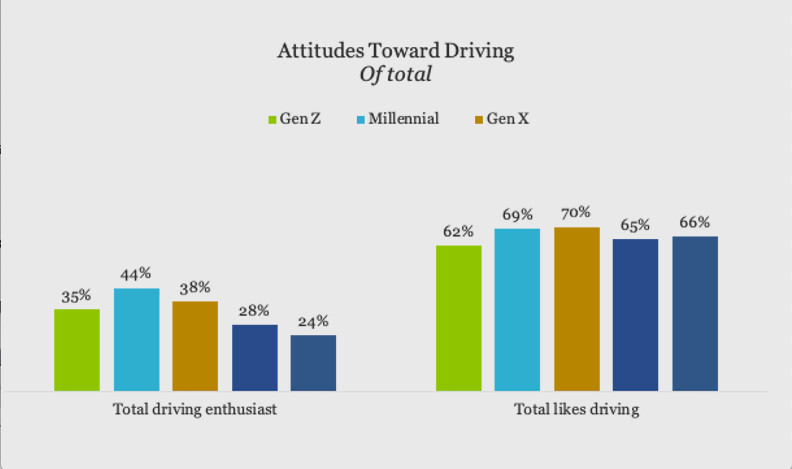
    Nearly three of four Americans (73%) surveyed said they enjoy driving, regardless of generation. In addition, 38% of survey respondents described themselves as active “driving enthusiasts,” defined by Hagerty as belonging to a car club, taking part in off-road or track driving, and attending car shows or auctions.

    Attitudes toward driving by generation (from Hagerty 2020 Why Driving Matters survey)

    Attitudes toward driving by generation (from Hagerty 2020 Why Driving Matters survey)

    “Much of the ‘death of driving’ handwringing by the media in the wake of the Great Recession was based on data showing younger generations were getting their licenses later, buying their first vehicles later, and buying fewer vehicles compared to previous generations at the same age. That conflated buying power with demand,” Ryan Tandler, the survey lead, said in a statement. “The recession hit younger generations harder and delayed a host of major purchases and life milestones.”

    Millennials are now catching up and, as the nation’s largest generation, they could become the collector-car hobby’s biggest group in the near future, Hagerty predicts. That is, if the economic fallout from the global coronavirus pandemic doesn’t put them right back where they were a decade ago.

    Source