Category: Highlight

  • One-off Bentley Flying Spur Reindeer Eight is Santa’s new sleigh

    Looks like Santa Claus is getting a new sleigh. According to Bentley, Santa has worked with the company’s Mulliner personalization division to order a one-off Christmas-themed Flying Spur dubbed “Reindeer Eight.”

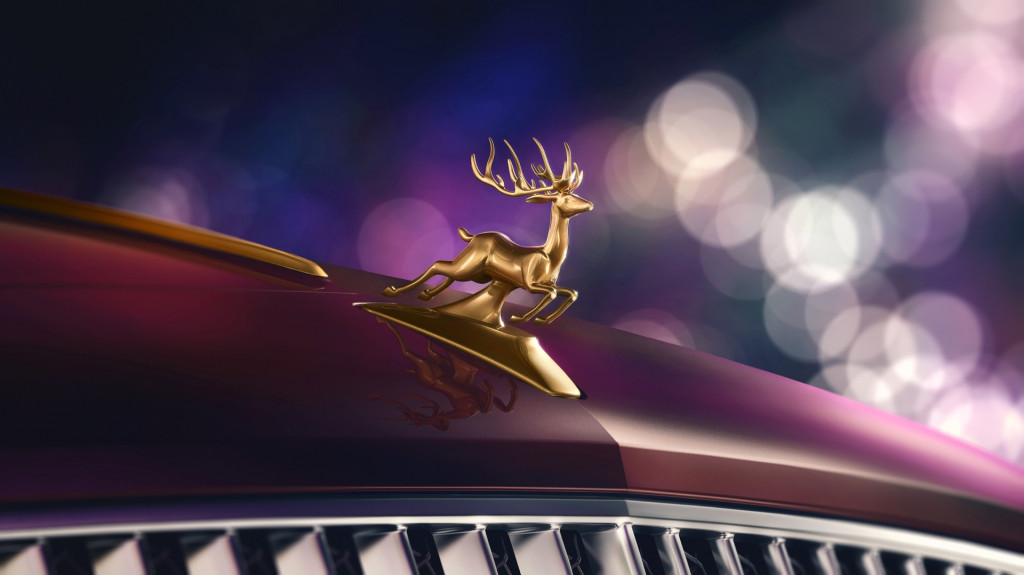
    Bentley revealed the customized Flying Spur V8 last Friday, complete with a 3D-printed reindeer hood ornament in place of the traditional “Flying B.” The paint color is called Cricket Bauble, a Christmas-themed play on Bentley’s Cricket Ball dark red paint. A diamond graphic running along the bottom of the car represents snow-covered mountains.

    To be clear, Bentley actually built the car for the fictional St. Nick.

    The sedan boasts a carbon diffuser, carbon side sills, and a trunk-lid spoiler for “maximum aerodynamic performance at cruising altitude,” Bentley said in a press release. The rest of the exterior brightwork is gold, along with the 22-inch wheels.

    Bentley Flying Spur Reindeer Eight

    Bentley Flying Spur Reindeer Eight

    Leather seats with hand-applied cross stitching get heating, ventilation, multi-mode massage, adjustable bolsters, and top tilt—a feature that should come in handy for Santa’s long one-night journey. The Bentley Rotating Display also has Santa’s “naughty and nice” list pre-loaded into the navigation system, while the wood veneer on the dashboard depicts the North Pole at night.

    Bentley didn’t mention any mechanical changes, so instead of eight reindeer, this sleigh gets eight cylinders. The twin-turbocharged 4.0-liter V-8 produces 542 horsepower and 568 pound-feet of torque. Bentley previously quoted 0-60 mph in 4.0 seconds and a top speed of 198 mph.

    “What fun it is to ride in a 542 horsepower sleigh. Plus, there’s space in the back for all my subordinate Clauses. I’m looking forward to putting 41 million miles on the clock before the end of the year,” read a quote Bentley attributed to Santa.

    The Flying Spur’s all-wheel drive should help Santa deal with winter weather, but with an EPA-estimated 15 mpg combined, he may lose a lot of time to fuel stops during his annual sojourn.

    Source

  • New documentary details Chevy’s development of the mid-engine Corvette

    It may seem like a lifetime ago, but the start of the 2020 model year saw the introduction of the C8 Chevrolet Corvette Stingray—the first mid-engine production Corvette in the nameplate’s history. Chevy now has the first installment of a two-part documentary detailing the car’s development.

    Chevy has teased the idea of a mid-engine Corvette for decades with various concept cars and prototypes, but it finally pulled the trigger on a production version because designers and engineers felt the existing front-engine design had reached its limits.

    The decision to go mid-engine wasn’t made abruptly. Design work on the C8 Corvette began in 2011, before the last front-engine Corvette had even launched, Corvette exterior design manager Kirk Bennion said in the documentary.

    2020 Chevrolet Corvette 2LT

    2020 Chevrolet Corvette 2LT

    As with any new car, designers went through many iterations before arriving at the final C8 shape, building multiple scale models and three full-size clay models as part of the process.

    The resulting design has the proportions of an Italian supercar, but with a good ‘ole small block 6.2-liter V-8 behind the seats. The naturally aspirated engine known as the LT2 produces 495 horsepower and 470 pound-feet of torque, giving the Stingray a quoted 0 to 60 mph time of 2.9 seconds. We were so impressed that we named the latest Corvette a Motor Authority Best Car To Buy 2021 nominee.

    Chevy isn’t done, either. We’re expecting new Z06 and ZR1 models, and possibly another variant named Zora, after Corvette godfather Zora Arkus-Duntov. That version will get a 1,000-hp hybrid powertrain, Hagerty reported earlier this year. It’s unclear when these more potent Corvette variants will show up, but in the meantime, part two of Chevy’s documentary premieres on YouTube January 4, 2021.

    Source

  • All 3 Alfa Romeo Berlina Aerodinamica Technica concepts by Bertone sold for $14.8M

    Yes, even with the coronavirus pandemic and the disruption it caused in the collector car auction space, there were outstanding vehicles offered and some sold at record prices. However, none of the cars offered at auction anywhere in 2020 were more interesting that the trio of Alfa Romeo B.A.T. cars that sold on October 28.

    One interesting note was that these cars were not offered at a collector car auction, but instead at the Sotheby’s annual Contemporary Art Evening Auction.

    Some may have found this a strange venue, but I have seen these cars a number of times in person and feel these phenomenal one-off Alfa Romeos transcend just being cars and are, indeed, works of artwork.

    My first exposure to these cars was as a freshman in high school when I stumbled upon them in Joe Benson’s book, Illustrated Alfa Romeo Buyers Guide. I was stunned at seeing the cars. Even the black-and-white pictures in the book showed cars that looked more like 1950s spaceship drawings than some earthly automobiles.

    For me, these immediately became for me some of the most important cars in the world, because of their out-of-this-world styling and their obvious rarity.

    The three Alfa Romeo B.A.T. concept cars were sold as a single lot | Darin Schnabel/RM Sotheby’s

    The three Alfa Romeo B.A.T. concept cars were sold as a single lot | Darin Schnabel/RM Sotheby’s

    The Berlina Aerodinamica Tecnica cars — B.A.T. 5, B.A.T. 7, and B.A.T. 9 — were concepts undertaken by Bertone and exhibited at the Turin Motor Show in 1953, 1954 and 1955. They were all designed by Franco Scaglione and were constructed on chassis from the Alfa Romeo.

    Scaglione designed the cars without the benefit of a wind tunnel, they simply were his ideas of what would be aerodynamically efficient. It was a seat of the pants and gut level styling exercise — and nothing short of breathtaking in execution.

    What is most amazing is that the coefficient of drag figures for these cars was as little as 0.19, a staggering figure since they were done by intuition, not with modern fluid dynamics technology.

    The three cars were part of a single owner’s collection for many years and many thought we would never see them on the market, so it was a surprise when Sotheby’s announced their inclusion in the contemporary art sale just a few days before that sale was scheduled.

    The gracefully sculpted tailfins of B.A.T. 7

    The gracefully sculpted tailfins of B.A.T. 7

    When I received the press release, I called every collector I knew and asked what they though the three cars, offered as a single lot, would bring at the auction. Those knowledgable estimates varied between $18 million and $25 million. I thought the set would sell somewhere around $20 million.

    Thus my surprise when the cars sold for $14,840,000. That might sound like a lot of money for a trio of vehicles based on the Alfa Romeo 1900 platform, but if you view them as art, this was a tremendous deal.

    These three extraordinary examples of art in motion were the best deal I have seen in years, the new owner should be thrilled with buying these iconic collector vehicles at such a reasonable price.

    Art that you can actually drive, how do you beat that?

    This article, written by Andy Reid, was originally published on ClassicCars.com, an editorial partner of Motor Authority.

    Source