
Category: Highlight

  • Dodge almost made an off-road version of the Caravan

    SUVs have decimated minivan sales in part because of their rugged appearance and the promise of off-road capability, but what if you could imbue a minivan with those same qualities? It almost happened with the Dodge Caravan in the 1990s.

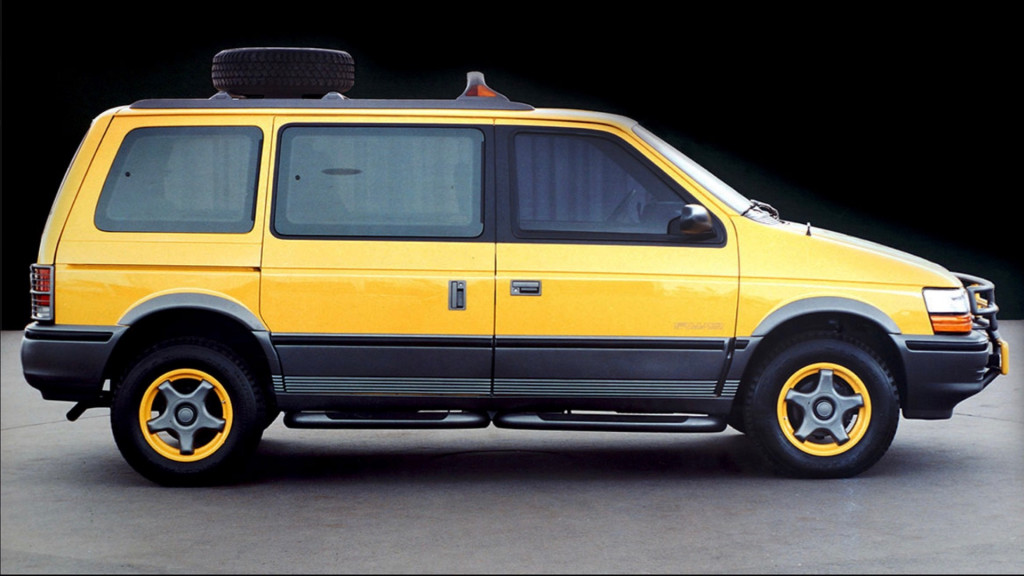
    First spotted by The Drive, this Dodge Caravan off-road concept was penned by Michael Santoro, who had just finished working on the Dodge Stratus and Chrysler Cirrus “cloud car” sedans at the time. Santoro would go on to work for doomed supercar maker Vector, and help hatch the Jeep Easter egg, but in the mid 1990s he was a minivan specialist.

    “One of the best parts about being in a studio that designs the best selling vehicle a company makes is, there is always interest from upper management in spin-offs and line extensions,” Santoro said of the off-road minivan’s genesis on his personal website.

    Dodge Caravan off-road concept (via Michael Santoro)

    Dodge Caravan off-road concept (via Michael Santoro)

    Tasked with creating a new Caravan variant “without spending any money,” Santoro added grille bars, side steps, a light bar, a roof rack, and blacked-out B-pillars. The design progressed far enough for a prototype to be built and shown to dealers.

    While Dodge dealers loved the concept, Jeep dealers didn’t. They were afraid a production version of the off-road minivan would cannibalize sales, Santoro said.

    Regardless, the prototype was “a step away” from debuting at the Chicago Auto Show, but “the plug was pulled at the last moment,” Santoro said. Adding off-road styling cues has helped boost the sales of other types of vehicles—just look at the Subaru Outback and Audi Allroad wagons—but could it have worked with a minivan? It seems we’ll never know.

    Source

  • First customized 2021 Ford GT Studio Collection car revealed

    Ford is adding new customization options for its GT supercar.

    On Monday, the automaker unveiled the first 2021 Ford GT Studio Collection car. Announced last year, the Studio Collection option allows buyers to customize the exterior and graphics, with seven standard colors, and an “extended palette” offering a wider range of options, Ford spokesperson Jiyan Cadiz said.

    The first completed Studio Collection car features a Shadow Black exterior with Competition Orange accents, including a single racing stripe and highlights around the side air intakes.

    2021 Ford GT Studio Collection

    2021 Ford GT Studio Collection

    Only 40 GT buyers will get the Studio Collection option, including 20 each for the 2021 and 2022 model years. That makes the Studio Collection the second most exclusive Ford GT limited edition offered, after the Liquid Carbon Edition, which was limited to 12 units.

    For 2021, Ford is also offering a new GT Heritage Edition. The latest in a series of Heritage Edition GTs, it pays tribute to the GT40 Mk II Ken Miles and Lloyd Ruby drove to victory at the 1966 Daytona 24 Hours. Like the winning Mk II, the 2021 Ford GT Heritage Edition wears white paint with red accents and the number 98 (a favorite number of Miles’ boss, Carroll Shelby). The Heritage Edition also sports exposed carbon fiber and gold 20-inch forged aluminum wheels. Production is limited to 50 units.

    Ford previously confirmed to Motor Authority that the run of 1,350 GTs will not increase with the addition of the Studio Collection or the latest Heritage Edition for 2021. The standard 2021 Ford GT starts from about $500,000, and you can expect the Studio Collection and Heritage Edition models to top that by considerable margins.

    Source

  • What’s the future of the internal-combustion engine?

    With stricter emission standards and the rise of electric powertrains, it might seem like the internal-combustion engine’s days are numbered. But Engineering Explained host Jason Fenske believes internal combustion will live on—thanks to new technologies.

    Fenske is pretty optimistic about the longevity of the internal-combustion engine, both because of the inherent energy-density advantage of gasoline over batteries, and because of efficiency-boosting technologies. In this video, he takes a closer look at some of those technologies.

    One option is homogeneous charge compression ignition (HCCI). An HCCI engine burns gasoline, but uses compression ignition—like a diesel engine—rather than a spark plug. In theory, that provides the efficiency of a diesel, without the soot and high levels of nitrogen-oxide (NOx) emissions. However, it requires much finer control of the intake temperature, as well as the timing of ignition.

    Ferrari 488 GT Modificata

    Ferrari 488 GT Modificata

    The next option is pre-mix charge compression ignition (PCCI). Fenske described it as a “middle ground” between diesel-engine compression ignition and HCCI, because it injects some fuel early to let it mix with air in the combustion chamber, and then injecting more fuel later. That provides more control over ignition timing than HCCI, but can also create pockets of unburned hydrocarbon byproducts, which is bad for emissions. PCCI engines also have a fairly narrow operating range, with high potential for knock under full throttle, Fenske said.

    Finally, we have reactivity-controlled compression ignition (RCCI). This uses two fuels: a low-reactivity fuel (like gasoline) that is port injected, and a high-reactivity fuel (like diesel) that is direct injected. “Reactivity” refers to a fuel’s tendency to ignite under compression. This method leads to big efficiency gains, but still with fairly high emissions, Fenske said. The complexity of using two fuels could also make it a non-starter commercially.

    These alternative internal-combustion engine designs may not be ready for prime time, but automakers are looking to squeeze every ounce of efficiency out of today’s gasoline engines using more mature technologies like direct injection. Fenske also covered another possible future internal-combustion technology—entry ignition—in another video, which is also worth checking out.

    Source