
Category: Highlight

  • Aston Martin DB5 Junior is a kid’s car that costs as much as a BMW 3-Series

    The Aston Martin DB5 is going back into production, and no, we don’t mean the limited run of “Goldfinger” continuation cars. Alongside the movie cars, Aston is launching a limited run of 2/3-scale DB5 Junior and DB5 Vantage Junior cars for kids. Production is scheduled to start in 2021.

    Both versions have an aluminum honeycomb chassis with composite bodywork, and they ride on double-wishbone suspension, just like the full-size DB5. The standard color is 007-spec Silver Birch, with a black leather interior. The dashboard features miniature versions of the Smiths clock and gauges in the full-size DB5.

    Power is provided by an electric motor with a maximum output of 6.7 horsepower. However, that’s only accessible in “Expert” mode; a “Novice” mode limits output to 1.3 hp. Top speed is 12 mph in Novice mode and 30 mph in Expert mode. The Vantage model gets a power-boost mode good for 13.4 hp, plus a limited-slip differential.

    Aston Martin DB5 Junior

    Aston Martin DB5 Junior

    Aston partnered with The Little Car Company on the DB5 Junior. The same company also developed the Bugatti Baby II. While that car is a modern replica of another miniature car, the DB5 Junior is a straightforward kid’s version of a full-size car.

    Production is limited to 1,059 units—the same as the original DB5 production run. Owners of original DB5s will be given first refusal, and will be able to match the Junior chassis number to the chassis number of the full-size car. In the United Kingdom, pricing starts at £35,000 (about $47,000 at current exchange rates) for the DB5 Junior and £40,000 ($53,000) for the DB5 Vantage Junior. Deliveries are scheduled to take place over two years following the start of production. Aston has not discussed availability in the U.S.

    Meanwhile, Aston recently started delivery of its DB5 “Goldfinger” continuation cars, equipped with the same gadgets as the original 1964 movie cars, including revolving license plates, oil slick makers, and (fake) machine guns. Unlike the original movie cars, the continuation cars can’t be registered and driven on public roads, as Aston can’t certify a new car based on a 50-year-old design.

    Source

  • 1949 Citroen Traction Avant featured on Jay Leno’s Garage

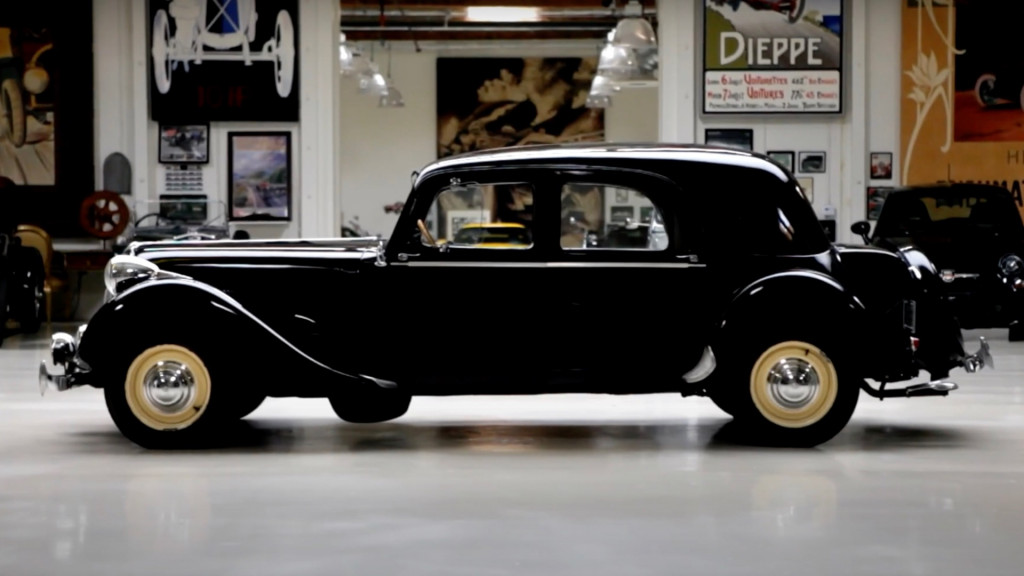
    With front-wheel drive and unibody construction, the Citroën Traction Avant helped set the template for modern cars. A 1949-built example of the groundbreaking French sedan was featured on a recent episode of Jay Leno’s Garage.

    Introduced in 1934, the Traction Avant wasn’t the first car with front-wheel drive, but it was the first to try to take front-wheel drive mainstream. Company founder André Citroën identified the benefits of front-wheel drive, including better traction from positioning the engine over the driven axle, and greater interior space due to the lack of a transmission tunnel. Unibody construction gave the Traction Avant greater structural rigidity than traditional body-on-frame cars, while independent suspension improved ride quality. These features are commonplace on cars today and they all existed when this car was introduced, but few if any others put them all together. Several of those features would take decades to catch on in the industry.

    For all of its innovation, the Traction Avant was a financial failure. André Citroën gambled big on the car, rebuilding his company’s factory in anticipation of production. But he couldn’t recoup that investment, and eight months after Traction Avant production started, the company went bankrupt. Michelin soon took control, and André Citroën died shortly thereafter. However, the Traction Avant stayed in production until 1957 (excluding the World War II years), with about 760,000 built.

    1949 Citroën Traction Avant on Jay Leno's Garage

    1949 Citroën Traction Avant on Jay Leno’s Garage

    Leno’s car is a later 1949 model with the larger 2.9-liter 6-cylinder engine. Leno said he prefers this version because he believes the earlier 4-cylinder engine was underpowered. The bigger engine allows the car to keep up with modern traffic, although the extra weight in the nose makes the steering a bit heavier, Leno said.

    This car is unrestored, as evidenced by scuff marks on the painted steel wheels, and currently shows 58,000 kilometers (36,000 miles) on its odometer. Leno, who is the third owner, said he made some mechanical repairs and updates, but has otherwise tried to keep the Citroën original.

    Watch the full video for more details on the Traction Avant, and to see Leno put that 6-cylinder engine to good use on the streets of Los Angeles.

    Source

  • How Gordon Murray’s T50 embarrasses every supercar on the planet

    Gordon Murray Automotive (GMA) recently unveiled the T50 supercar and, perhaps not surprisingly for the product of the man who designed the McLaren F1 and numerous winning race cars, it’s full of interesting technical details. Jason Fenske at Engineering Explained put together this deep dive, highlighting five elements that distinguish the T50 from other supercars.

    The T50 is not a numbers car. Murray calls it the “ultimate analog supercar,” and has said the focus was on creating the best driving experience, not breaking top speed or lap records. For example, the 3.9-liter naturally aspirated V-12 “only” develops 653 horsepower and 344 pound-feet of torque, which aren’t very impressive numbers for a supercar these days. But the Cosworth-developed engine can rev to 12,100 rpm and is coupled to a 6-speed manual transmission.

    That manual transmission is a rarity in modern exotics, most of which have gone to quicker-shifting (but less fun) dual-clutch gearboxes. The T50 transmission also has fairly high gearing for 1st, 2nd, and 3rd, which should make burnouts easy, Fenske noted.

    Gordon Murray Automotive T50

    Gordon Murray Automotive T50

    A 15.7-inch fan is mounted at the rear of the car as part of an active aero system. The fan is inspired by Murray’s Brabham BT46B Formula One car, but it serves a different purpose here. In the Brabham, the fan worked with side skirts to create an area of low air pressure under the car, creating downforce by sucking the car onto the track. In the T50, the fan works with active rear spoilers to reduce drag at high speeds by bleeding off downforce, or increasing downforce under braking. However, the effect is relatively small for such a complex feature, Fenske noted.

    The fan may be somewhat of a gimmick, but the T50 embarrasses other supercars when it comes to weight. The T50 weighs just 2,714 pounds—over 1,000 pounds less than a Ferrari LaFerrari, McLaren P1, and Porsche 918 Spyder, Fenske noted. All three cars have more power than the T50, thanks to complex hybrid powertrains, but none can match its weight-to-power ratio of 3.3 pounds per horsepower.

    Only 100 buyers will get to experience the brisk acceleration afforded by that weight-to-power ratio, and they won’t get their cars for awhile. Production is scheduled to start in January 2022. The car is priced at $3.08 million (at current exchange rates), and each owner will have a fitting session for positioning of the central driver’s seat, steering wheel, and pedals. GMA might also develop a track-only version, and a racing version that could potentially compete at Le Mans.

    Source