Category: Highlight

  • Nissan Z Proto previews next-generation sports car with twin-turbo V-6, retro-modern design

    The Nissan Z car has inspired generations of sports car fans since it was released in 1969. It has been an upstart, a disco-era style statement, an upscale sports car, and a long-in-the-tooth coupe just trying to hold on. All the while, it aimed for driver engagement and a sense of style. The Z Proto Nissan showed on Tuesday combines all of those elements, along with elements of design from the car’s six generations.

    The prototype appears to be a thinly disguised version of the Z35-generation production model due in the next 18 months to two years, at least from a design standpoint.

    Nissan provided sparse information, so let’s start with what we know. The Z Proto combines styling elements from past Zs with an eye toward the future.
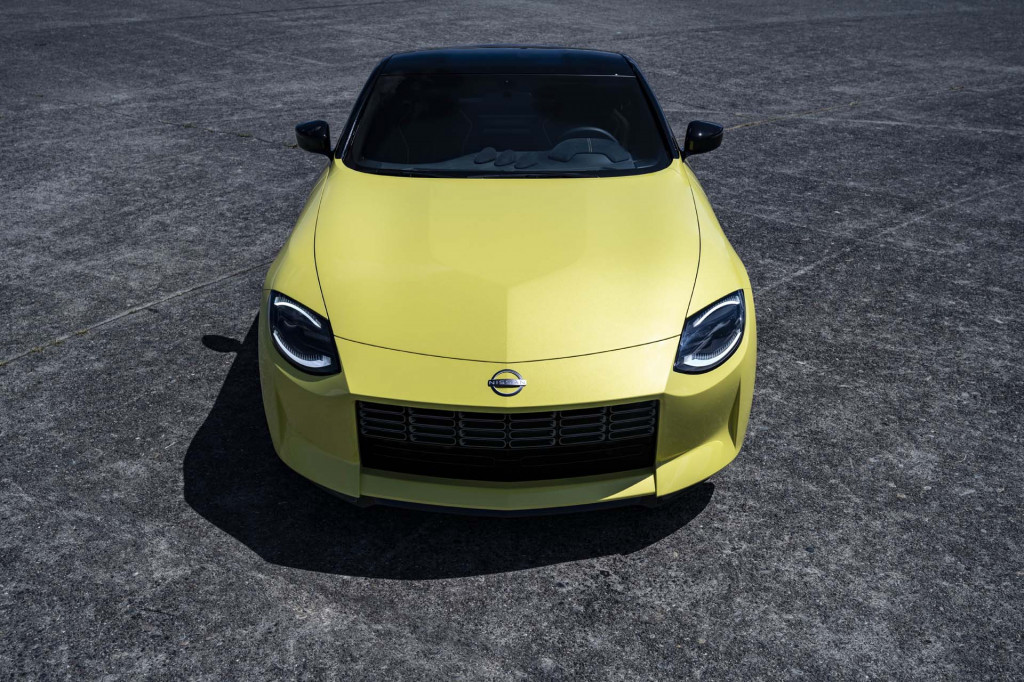
    Nissan Z Proto

    Nissan Z Proto

    “Our designers made countless studies and sketches as we researched each generation and what made them a success,” said Alfonso Albaisa, Nissan’s head of design. “Ultimately, we decided the Z Proto should travel between the decades, including the future.”

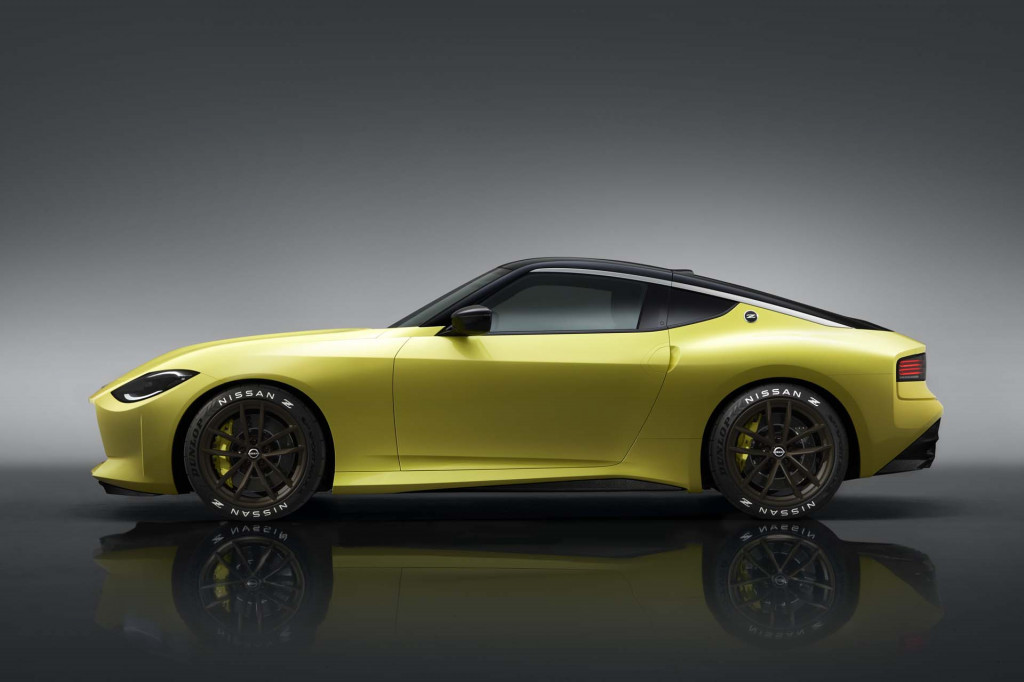
    The first-generation car, the 240Z, inspired the shape of the hood, the canted teardrop LED headlights, and the long-hood, short-deck profile with the cabin pushed back. The current model’s rectangular grille sits up front, and the Z32 300ZX of the 1990s can be seen in the taillights and the shape of the rear end, especially above the rear diffuser. The pearl yellow paint is a tribute to a popular color on both the 240Z and Z32 300ZX generations.
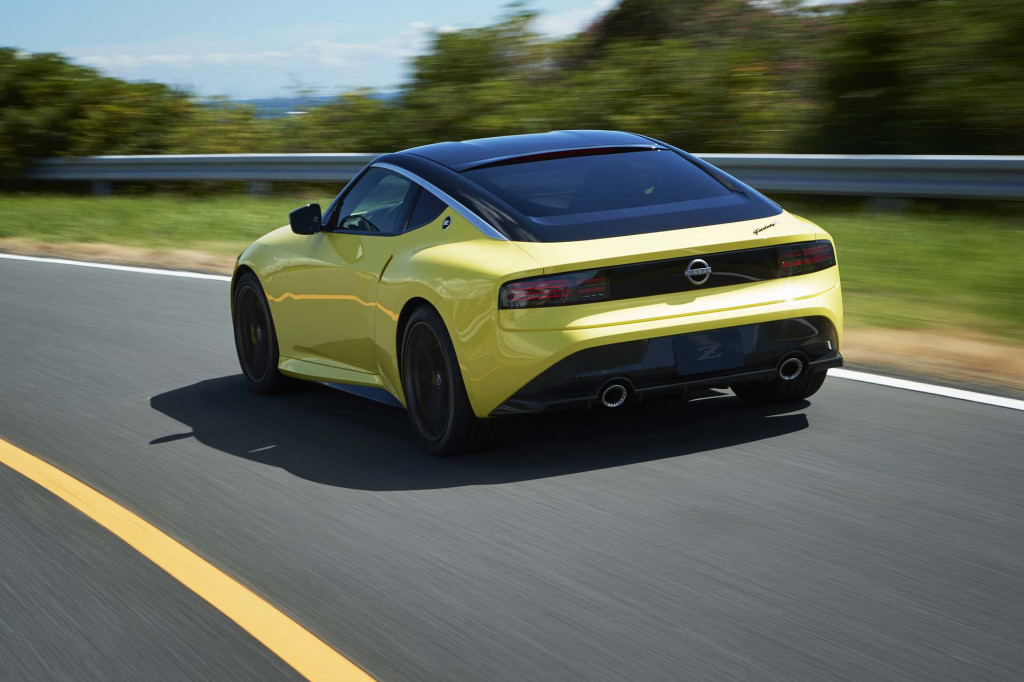
    Nissan Z Proto

    Nissan Z Proto

    But the Z is modern, too. Carbon-fiber trim is used for the side skirts, front lower lip, and rear valance to reduce weight and fit a modern aesthetic.

    The Proto Z is 4.7 inches longer than the current car, likely due to longer overhangs. It’s also marginally taller and wider. It rides on 19-inch wheels, while the current model has 20s. Chief engineer Hiroshi Tamura said the 19s give the car enough tire for a reasonable ride quality.

    Under the long hood sits a twin-turbocharged V-6 hooked to a 6-speed manual transmission in a rear-wheel-drive layout.
    Nissan Z Proto

    Nissan Z Proto

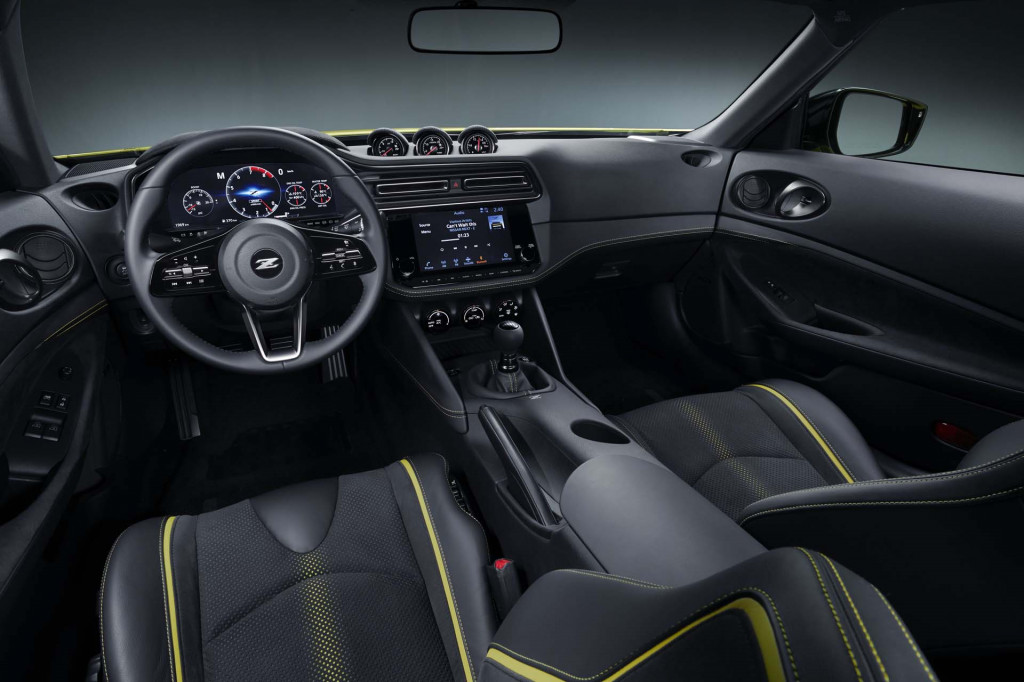
    Inside, the Z Proto features an exclusive dished steering wheel that sits in front of a 12.3-inch digital gauge cluster with the tach in the middle and the 7,000-rpm redline at the 12 o’ clock position. The one picture Nissan shared shows boost and water and oil temperature gauges in the cluster, though analog versions of those gauges also line the top of the dashboard.

    The Z Proto’s black upholstery features yellow contrast stitching on the seats, instrument panel hood, dashboard, and door panels to play off the exterior color. The seats appear to be upholstered in a combination of leather and synthetic suede with yellow stripes. A center screen, likely an 8.0-inch touchscreen, on the dash provides infotainment functions.

    What we don’t know starts with the engine. Nissan hasn’t confirmed how much power it will create or what size it is. Infiniti has a 3.0-liter twin-turbo V-6 that makes 400 horsepower. That’s likely the setup for the next Z. In fact, we expect the car will be called the 400Z.
    Nissan Z Proto

    Nissan Z Proto

    We also don’t know what changes will be made to the structure and suspension, though we suspect not many. Nissan only shared that “work is underway to synchronize the power with the grace and control that has defined the Z for the past 50 years.” It appears that the next Z will use the same platform as the current car and Tamura said it will drive like a dance partner. The switch to 19-inch wheels could also reduce unsprung weight, which improves handling. Tamura told us last year that the next-gen Z might not be much lighter, but its suspension should help it drive like it is.

    In addition, we don’t know what model year the next Z car will be, its trim levels, standard and optional equipment, available safety features, and pricing. Will the new Z offer a higher-performance Nismo model? Will it stay in line with the current model’s roughly $32,000-$48,000 pricing structure? When will it hit the market?

    We’ll learn more about these and other questions as Nissan prepares the next-generation production Z, perhaps by the end of 2021 as a 2022 model.

    Source

  • Preview: 2022 Hyundai Tucson goes long, deep on screens, style

    Far too many crossover SUVs fade into traffic with their cookie cutter-designs. The 2022 Hyundai Tucson won’t be one of them. 

    Hyundai unveiled the 2022 Hyundai Tucson on Monday, and not only does the brand’s global best-seller feature a bold design, but it also gets efficient powertrains, an upscale cabin, and plenty of technology.

    While Hyundai will offer short- and long-wheelbase models, the U.S. market will only offer the longer version. However, the U.S. is scheduled to get all three powertrains: gas, hybrid, and plug-in hybrid. It’s expected to hit U.S. dealers in the first half of 2021 as a 2022 model.

    The new Tucson’s powertrain options start with a 2.5-liter 4-cylinder making 190 horsepower and 182 pound-feet of torque. It is mated to an 8-speed automatic transmission.

    Both the hybrid and plug-in hybrid feature a 1.6-liter turbo-4 that spins up 190 hp and 195 lb-ft of torque. Combined with the hybrid system, output rises to 230 hp and 258 lb-ft of torque. Hyundai did not say how many motors the hybrid system will use or where they will be located. The engine in both hybrids features a new continuously variable valve technology that varies how long the valves are open to improve power, efficiency, and emissions, according to Hyundai.

    Hyundai said it will offer an N-Line model at a later date, possibly with a more-powerful gasoline engine.

    Hyundai will sell the Tucson with front- or all-wheel drive. Drivers will be able to choose from Eco, Comfort, Smart, and Sport driving modes, plus new Mud, Sand, and Snow modes when they choose all-wheel drive.

    The Tucson hybrids get a system Hyundai said improves directional stability and steering response in corners and on slippery roads. We don’t yet know how this system, called E-Handling, will work.

    2022 Hyundai Tucson

    2022 Hyundai Tucson

    The most striking element of the Tucson is its design. It incorporates sports car cues in an SUV shape with geometric lines that hint at the technology that lays within. The sports car traits include short front and rear overhangs and bulging fenders outlined with those angular geometric shapes. Up front, the grille design flows into the headlights and daytime running lights to provide a full-width look. A full-width taillight echoes the front end design.

    For as wild as the look is outside, it’s more traditional and upscale inside. The dash features a hoodless digital instrument cluster and a standard 8.0-inch center screen with Apple CarPlay and Android Auto compatibility. Higher-line models will have dual, vertically stacked 10.3-inch touchscreens for infotainment and climate controls. Soft-touch surfaces adorn the areas the driver is likely to touch, and Hyundai will offer 64 colors of ambient lighting that add to the high-end appeal.

    Drivers will be able to use their smartphone as a key and control some functions remotely, like unlocking the doors and starting the engine to pre-condition the interior. A Bose audio system will be available, and an external calendar app will let buyers see their schedules from inside the vehicle. A car-to-home feature will also allow owners to control smart home appliances from the car.

    In some markets, the dual-zone climate control system will monitor air pollution and purify the air in the vehicle, Hyundai said. The system will also reduce moisture from the evaporator and clean the air-conditioning system to keep it odor-free.

    The three-passenger rear seat moves forward and back to balance passenger comfort with cargo capacity, which tops out at 38.7 cubic feet behind the rear seats.

    The safety features will be extensive. Standard equipment will include forward-collision warnings with pedestrian detection, automatic emergency braking, active lane control, blind-spot cameras and monitors, automatic high beams, a driver-attention monitor, a surround-view camera system, reverse-collision warnings, and an automatic parking feature. Also available will be blind-spot collision avoidance, rear cross-traffic alerts, adaptive cruise control, and an exit warning system.

    Hyundai hasn’t yet announced prices or the model lineup for the fourth-generation Tucson. Look for that information closer to launch.

    Source

  • Bugatti Chiron Pur Sport gets airborne during Nardo testing

    Bugatti on Wednesday released photos of its hardcore Chiron Pur Sport getting a final shakedown at Italy’s Nardo circuit ahead of the start of production later this year.

    A more track-focused version of the Chiron, the Pur Sport was unveiled in March, and the push toward production has continued despite the ongoing coronavirus pandemic.

    Engineers are now fine-tuning the engine control system, transmission, brakes, and running gear, according to a Bugatti press release. Bugatti test driver and 24 Hours of Le Mans winner Andy Wallace also drove the car at Nardo to give his feedback.

    The Pur Sport was designed to emphasize handling rather than top speed. To that end, engineers added carbon fiber stabilizer bars and increased negative camber by 2.5 degrees. This necessitated other suspension modifications, including stiffer springs and harder bushings, all to give the Pur Sport a more precise handling feel.

    Bugatti Chiron Pur Sport testing at Nardo

    Bugatti Chiron Pur Sport testing at Nardo

    Aerodynamic elements were tweaked to produce more downforce. Unlike the standard Chiron, the Pur Sport has a fixed rear wing, as well as a longer diffuser and model-specific wheels. The design of the wheels generates downforce, and also saves 35 pounds of weight, about one third of the total 110-pound weight savings of the Pur Sport over the Chiron. Those wheels are wrapped in Michelin tires with a softer, grippier compound than the standard Chiron’s tires.

    The changes lower the Pur Sport’s top speed to 217 mph, compared to 261 mph for the standard Chiron. Power is still provided by an 8.0-liter quad-turbocharged W-16, which still delivers a peak 1,480 horsepower. However, the power peak is between 6,700 rpm and 6,900 rpm—200 rpm higher than the standard Chiron.

    Production is scheduled to start this fall and just 60 Pur Sports will be built—each priced from 3 million euros (approximately  $3.5 million).

    Bugatti also started delivering the limited-edition Divo hypercar to customers last month. Its development of the world’s fastest car, the Chiron Super Sport 300+, is ongoing, however..

    Source