Category: Highlight

  • Lewis Hamilton no longer drives supercar collection because it hurts the planet

    Six-time Formula One world champion Lewis Hamilton has a collection of supercars that he no longer drives out of concern for the environment, he said last week during a press conference for the Formula One Tuscan Grand Prix (which he ended up winning).

    Hamilton said the only road cars he currently drives are the battery-electric Mercedes-Benz EQC and Smart EQ ForTwo.

    Hamilton also said he requests to be picked up from airports in electric vehicles wherever possible, and that he no longer flies on his own private jet to help reduce his carbon footprint. He actually got rid of the jet last year.

    The reigning F1 champion previously had quite a car collecting habit. In a 2018 interview, Hamilton said he owned two Shelby Cobras, a Ford Mustang Shelby GT500 recreation, a Ferrari 599 SA Aperta, a LaFerrari and LaFerrari Aperta, a McLaren P1, and a Pagani Zonda. At the time, he said the cars were split between Los Angeles and Monaco.

    Lewis Hamilton introduces the Mercedes-AMG Project One at the 2017 Frankfurt Motor Show

    Lewis Hamilton introduces the Mercedes-AMG Project One at the 2017 Frankfurt Motor Show

    In 2015, Hamilton entered the Gumball 3000 Rally, driving a Koenigsegg Agera S.

    Hamilton has also been involved in the development of the Mercedes-AMG One hypercar, which uses the actual engine from Mercedes’ championship-winning F1 cars. That development work is taking longer than expected, delaying the start of deliveries to 2021.

    Hamilton recently announced that he is forming a team for the Extreme E electric off-road racing series, which he sees an opportunity to promote greater environmental awareness.

    In January, organizers released a provisional five-race 2021 calendar with races in remote locations like Greenland and Dakar, Senegal. Races will be held without spectators onsite, which should ensure minimal disturbance to the natural environment, and means Extreme E could launch on schedule despite the coronavirus pandemic.

    Source

  • GM details its Ultium Drive modular EV powertrain offering up to 1,000 horsepower

    General Motors is committed to launching 20 electric vehicles in North America by 2023, and most of these will be powered by a modular battery system branded Ultium and sit atop GM’s third-gen EV platform.

    The electric drive system powering the actual wheels will be branded Ultium Drive, GM said Wednesday.

    Like the batteries, the drive system going into GM’s upcoming electric fleet will be a modular system. Its outputs will range from 235 up to 1,000 horsepower. One of the 1,000-hp EV has already been confirmed as the GMC Hummer EV pickup truck due for a reveal on October 20 and production from fall 2021. It would make sense for the oft-rumored electric Corvette to also feature the 1,000-hp setup.

    The Ultium Drive portfolio will consist of five interchangeable drive units each with a single-speed transmission and power control unit fully integrated. GM will also use three types of electric motors for the drive units.

    GM Ultium Drive family

    GM Ultium Drive family

    Depending on the positioning of the drive units, they will be able to deliver front-, rear- or all-wheel-drive configurations. One of the drive units has been described as an all-wheel-drive assist unit, i.e. it will add traction when slip is detected. This particular setup is expected to feature on an all-wheel-drive Corvette, among other vehicles.

    GM boasts Ultium Drive will deliver better response than comparable internal-combustion engines, along with the ability for highly accurate torque vectoring.

    GM said it is handling the development of the Ultium Drive units and will also manufacture them in-house. GM has developed the Ultium batteries with South Korea’s LG Chem, but will manufacture them at its own plant currently under construction in Lordstown, Ohio.

    So where might we see the Ultium Drive units beyond the Hummer EV and potential Corvette variants? GM has already revealed the identities of 12 of its upcoming EVs that will use the drive units. Two of the 12 are the Hummer EV pickup and a related SUV. Others in the pipeline include the Cadillac Lyriq crossover SUV and Cadillac Celestiq flagship sedan.

    Source

  • Nissan Z Proto previews next-generation sports car with twin-turbo V-6, retro-modern design

    The Nissan Z car has inspired generations of sports car fans since it was released in 1969. It has been an upstart, a disco-era style statement, an upscale sports car, and a long-in-the-tooth coupe just trying to hold on. All the while, it aimed for driver engagement and a sense of style. The Z Proto Nissan showed on Tuesday combines all of those elements, along with elements of design from the car’s six generations.

    The prototype appears to be a thinly disguised version of the Z35-generation production model due in the next 18 months to two years, at least from a design standpoint.

    Nissan provided sparse information, so let’s start with what we know. The Z Proto combines styling elements from past Zs with an eye toward the future.

    Nissan Z Proto

    Nissan Z Proto

    “Our designers made countless studies and sketches as we researched each generation and what made them a success,” said Alfonso Albaisa, Nissan’s head of design. “Ultimately, we decided the Z Proto should travel between the decades, including the future.”

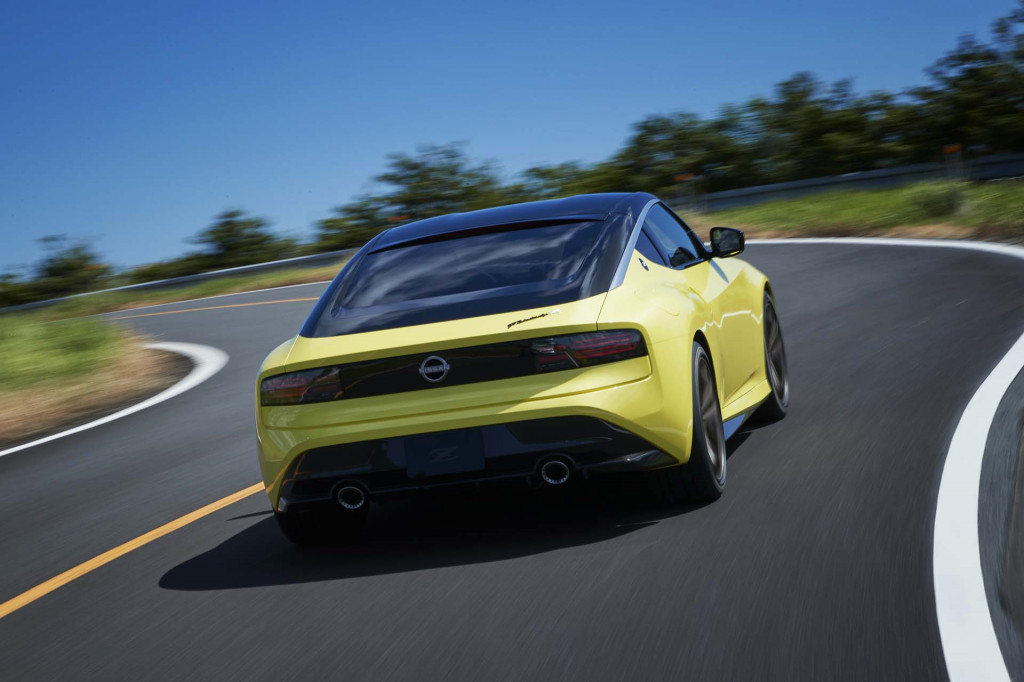
    The first-generation car, the 240Z, inspired the shape of the hood, the canted teardrop LED headlights, and the long-hood, short-deck profile with the cabin pushed back. The current model’s rectangular grille sits up front, and the Z32 300ZX of the 1990s can be seen in the taillights and the shape of the rear end, especially above the rear diffuser. The pearl yellow paint is a tribute to a popular color on both the 240Z and Z32 300ZX generations.

    Nissan Z Proto

    Nissan Z Proto

    But the Z is modern, too. Carbon-fiber trim is used for the side skirts, front lower lip, and rear valance to reduce weight and fit a modern aesthetic.

    The Proto Z is 4.7 inches longer than the current car, likely due to longer overhangs. It’s also marginally taller and wider. It rides on 19-inch wheels, while the current model has 20s. Chief engineer Hiroshi Tamura said the 19s give the car enough tire for a reasonable ride quality.

    Under the long hood sits a twin-turbocharged V-6 hooked to a 6-speed manual transmission in a rear-wheel-drive layout.

    Nissan Z Proto

    Nissan Z Proto

    Inside, the Z Proto features an exclusive dished steering wheel that sits in front of a 12.3-inch digital gauge cluster with the tach in the middle and the 7,000-rpm redline at the 12 o’ clock position. The one picture Nissan shared shows boost and water and oil temperature gauges in the cluster, though analog versions of those gauges also line the top of the dashboard.

    The Z Proto’s black upholstery features yellow contrast stitching on the seats, instrument panel hood, dashboard, and door panels to play off the exterior color. The seats appear to be upholstered in a combination of leather and synthetic suede with yellow stripes. A center screen, likely an 8.0-inch touchscreen, on the dash provides infotainment functions.

    What we don’t know starts with the engine. Nissan hasn’t confirmed how much power it will create or what size it is. Infiniti has a 3.0-liter twin-turbo V-6 that makes 400 horsepower. That’s likely the setup for the next Z. In fact, we expect the car will be called the 400Z.

    Nissan Z Proto

    Nissan Z Proto

    We also don’t know what changes will be made to the structure and suspension, though we suspect not many. Nissan only shared that “work is underway to synchronize the power with the grace and control that has defined the Z for the past 50 years.” It appears that the next Z will use the same platform as the current car and Tamura said it will drive like a dance partner. The switch to 19-inch wheels could also reduce unsprung weight, which improves handling. Tamura told us last year that the next-gen Z might not be much lighter, but its suspension should help it drive like it is.

    In addition, we don’t know what model year the next Z car will be, its trim levels, standard and optional equipment, available safety features, and pricing. Will the new Z offer a higher-performance Nismo model? Will it stay in line with the current model’s roughly $32,000-$48,000 pricing structure? When will it hit the market?

    We’ll learn more about these and other questions as Nissan prepares the next-generation production Z, perhaps by the end of 2021 as a 2022 model.

    Source