
Author: Olly

  • TUNED RENAULT 5 GTT: SMOKING HOT

    Inspired by eighties racers and the nineties scene, this tuned Renault 5 GTT is burning an eternal flame…

    Fast Car magazine. Words: Emma Woodcock. Photos: Jules Truss

    Lighting up is no good for your health. But the motorsport liveries created by tobacco companies? They’re lit and emblazoned on the brains of fans everywhere. Purple and white means shovel-nosed Le Mans Jaguars; blue and yellow says Colin McRae in a sideways Subaru; black and gold is Lotus single seaters. Red with white? We could only be talking Marlboro and a look that accompanied Ayrton Senna and Alain Prost to world championship glory.

    That’s inspiration enough for a stand out show car, but don’t race to conclusions: Rob Hardy didn’t build his tuned Renault 5 GTT to channel mainstream motorsport. Oh no. Instead ,he’s taken inspiration from a scale model. The evocation in question harks back to a real machine that ran on the 1982 Rallye du Var. That might not mean much to some, but the driver’s name will. It was Alain Prost behind the wheel, in his first, last and only stage rallying appearance. And he was driving a Renault 5 Turbo 2.

    Tuned Renault 5 GTT

    “I just fell in love with that car,” Rob confesses. “And I thought that style would look cool on a Renault of my own. If you’re going to modify something, it might as well have your mark on it.”

    This isn’t the Marlboro livery as you’ve seen it before. Painted by Wayne Barnett at GT Turbo Spares, its main coat of Renault Glacier White is counterpointed not by an authentic, full bodied red but with a tangy orange. The explanation is simple: it’s Rob’s favourite colour, so it had to feature. Prominently. Flashes of orange dominate the retrimmed cabin too – and it all started with a pair of two-tone sports seats from FK Automotive. The rear bench has been retrimmed to match, gaining a custom leather look from furniture expert McKay Upholstery, while the leather doorcards were chosen for their orange stitching. Edge speakers, hooked up to a JVC Chameleon stereo, also got the nod thanks to their tangerine highlights. Contrast comes courtesy of a custom black rooflining and carpets, both measured and fitted by Rob himself.

    Tuned Renault 5 GTT: Apricot Assault

    Pop the bonnet latch and the apricot assault continues, thanks to a custom painted cylinder head and a brace of orange silicone hoses. An aftermarket strut brace, finished in the same Glacier White as the exterior and tagged with a Marlboro transfer, provides a striking contrast. Speaking of stickers, the body benefits from a collection of sponsors’ decals which closely mimic those on Prost’s car. Sourced from specialist suppliers I Say Ding Dong, they’ve been placed with exacting reference to schematics of the original rally machine.

    We’re getting ahead of ourselves. Before he could prime the paint guns, Rob had to source and restore the Renault that forms the basis of his build. A lifelong 5 fan, it was the third time he’d hunted for a GT Turbo. The first proved Flinstones floor rusty and the second had a junk engine, so it would be the first time he’d be able to keep the object of his affections. “I was working in Oman when I found this one on eBay,” he remembers, “it was in a scrapyard, it was going to be a track car project and I got it for the princely sum of £350. It was my 30th present to myself!” It sure beats a watch or a night on the town.

    Tuned Renault 5 GTT

    Back in Britain, the birthday boy tore straight into his new purchase. On discovering the oil and water lines were plumbed into the wrong systems, Rob treated the Renault to a full restoration. The two GT Turbo bodykits promptly hit the market, providing valuable funds, while Rob hunted down replacement parts straight from the 90s era. He hit gold, securing a front and rear bumper from a period Prima Racing kit. “I wanted to find something different,” he says, “and these make it look like a much meaner car.”

    Careful searching would eventually uncover the wide wheelarches, grille inserts, side skirts and stubby wing to match, but looks weren’t the only topic on Rob’s mind. Using a range of self-taught fabrication skills, he stripped the Renault back, built a custom rotisserie to rotate the bare shell and set to work on rotten areas. Patching and parts replacement soon got the sills, rear wheel arches and floor looking like they should, allowing focus to switch to suspension and subframe rebuilds which utilise sport-focused Powerflex purple polybushes.

    Never one to shirk a challenge, Rob now embarked on his first ever engine rebuild. Major upgrades include a Scorpion 2.5-inch exhaust system, a Garrett T25 turbocharger from AET Turbos and the front-mount intercooler from a Ford Sierra Sapphire RS Cosworth – chosen for its ability to just fit under the front beam. But the renovation process focused more on dependability than outright power. “It went step by step and nothing was too horrendous,” he says. “And my wife lovingly helped me with lapping the valves, which was one of the hardest tasks.” Rob has used new but original specification parts to replace the cylinder head, cylinder liners and pistons, creating an engine which produces around 170bhp.

    A bodyshop visit came next – and there was bad news in store. “We discovered the bumpers were shot,” says Rob. “So I needed to find new ones overnight.” A 12 and a half hour race to York and back followed, Rob stumbling on a miraculous pair of Prima bumpers so fresh they were still in their original gel coat. With the kit fitted, and accessorised by a pair of DTM Cup mirrors, the tuned Renault 5 GTT could finally take on its pugnacious shape.

    The right rims weren’t the work of an instant either. To fill out the wide Prima arches, any replacement alloys have to wear a tiny offset and measure one inch wider at the rear than the front. It’s an uncommon combination and one that’s fulfilled by a set of Image EV split rim wheels. “It was a bit of a mission,” laughs Rob. “But I eventually managed to find this used set in London.” The vital measurements are ideal: 15 inch diameter all round; 7.5 inches wide with a slim ET10 bump at the front; a neutral ET0 and 8.5 inches of width at the rear.

    Nerve-wracking

    Vital statistics secure, Rob could turn his attentions to style. Inspired once again by the Prost rally car, he’s elected to refinish the face of each wheel in gloss black and keep the outer band in high sheen, hand-polished chrome. Peer a little closer, mind, and you’ll spy some individuality on the inside rim. The little seen surface has been powdercoated in the same citrus shade as the exterior stripes.

    Tuned Renault 5 GTT

    Nerve-wracking. That’s how Rob describes his first miles in his wide-arched wonder. “I knew that I’d replaced or reconstructed every single bolt,” he laughs. “And that feeling lasted for the first 500 miles.” Don’t worry, he’s still made the most of his 1397cc rager. After nothing more than a couple of round the block excursions, car and owner embarked on the eight-hour round trip to Santa Pod Raceway for Retro Show.

    Wait a hot minute: the Marlboro machine isn’t burned out yet. Rob aims to focus on both ends of the car in the coming months, fitting a custom boot install and subwoofer behind the seats and a Piper 285 high lift camshaft in the engine bay. With a little finesse, the result should be earth-shaking bass and a rolling road proven 200bhp. Add those changes to the Renault’s abundant style and you’ve got a retro riot.

    “It’s never being sold,” says Rob, as if we ever needed to ask. “My daughter’s got her eye on it too. Even though she’s only 11.” Three decades after it first hit the scene, the Renault 5 GTT is still smouldering.

    Tuned Renault 5 GTT

    Tech Spec: Tuned Renault 5 GTT

    Styling:

    Prima Racing full wide-arch bodykit with GT Turbo Spares repainted in Renault Glacier White with orange Marlboro livery; I Say Ding Dong replica sponsors’ decals; DTM Cup aero mirrors

    Tuning:

    Fully rebuilt Renault 5 GT Turbo 1.4-litre turbocharged inline four with replacement cylinder head; cylinder linings and pistons; RAMAIR intake cone; Garrett T25 turbocharger by AET Turbos; Ford Sierra Sapphire RS Cosworth front-mount intercooler; Scorpion 2.5in stainless steel exhaust and downpipe; cylinder head repainted orange; orange silicone hoses throughout

    Chassis:

    Image EV split rim cast alloys; 15×7.5in ET10 front and 15×8.5in ET0 rear; powdercoated in gloss black with orange inner rim and polished chrome outer rim; Apex lowering springs; lowered torsion bar; strut brace in Renault Glacier White; Powerflex Purple Series polybushes throughout

    Interior:

    FK Automotive faux-leather white and orange front sports seats; original rear bench retrimmed by McKay Upholstery; leather doorcards with orange stitching; JVC Chameleon headunit; Edge speakers
    Source

  • 2012 Lexus LFA for sale in boring color, but with low mileage

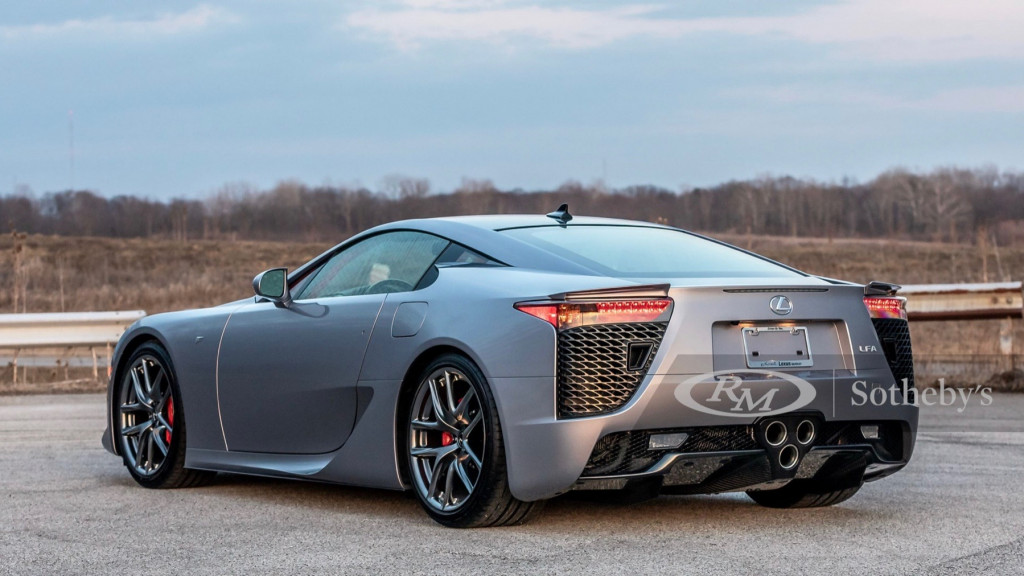
    The 2012 Lexus LFA was a high-water mark for Toyota’s luxury brand. The car never got a direct successor, but a practically untouched example with less than 500 miles is scheduled to cross the block at RM Sotheby’s Amelia Island auction on May 22.

    Finished in Steel Gray, this car isn’t as distinctive as the brown LFA that came up for sale earlier this year, but it’s still quite rare. Number 430 of 500 cars built, it’s one of only 11 finished in this particular hue, according to the listing.

    The LFA was meant as a halo car for Lexus, giving the brand more prestige and using some of parent Toyota’s Formula One experience to do it. It’s powered by a 5.2-liter V-10 that makes 552 hp and 334 lb-ft of torque, with a 9,000-rpm redline. The engine and the LFA’s carbon-fiber body still seem modern today, but the 6-speed single-clutch automated manual transmission gives away the car’s age.

    2012 Lexus LFA (Photo by RM Sotheby's)

    2012 Lexus LFA (Photo by RM Sotheby’s)

    Production of the LFA ended in December 2012, and the last car reached the U.S. in February 2013. The listing claims Lexus imported approximately 190 cars to the U.S., although other sources say 178 cars were imported.

    Either way, the LFA was a slow seller. Five new, unregistered cars remained up for grabs as of January 2020 likely due to the outlandish $375,000 starting price. Some dealerships held onto their LFAs as display pieces to drive showroom traffic.

    It’s unclear if this LFA will meet its pre-auction estimate of $425,000 to $500,000, which is a significant increase over the $388,300 the owner originally paid for it. However, that’s still a lot less than the aforementioned brown LFA, which was listed for sale through an exotic-car dealership earlier this year with a $680,000 asking price.

    Source

  • GROUP S FORD RS200: THE CAR THAT NEVER WAS

    When Group B rallying was cancelled, plans were drafted for a new Group S category. Sadly, those plans never materialised but Ford’s chief rally engineer, John Wheeler, was determined to make the Group S Ford RS200 a reality – so built one of his own. Here it is…

    Feature from Fast Ford. Words and photos: Robb Pritchard

    After spending two-and-a-half years developing the ill-fated rear-wheel-drive Mk3 Escort-based RS1700T, Ford was a little late to the Group B party with the sublime Ford RS200 in the mid 1980s.

    Debuted on the 1986 Swedish Rally (where Stig Blomqvist recorded a third-place finish in what would be the RS200’s best result in world rallying), it was considered technologically superior to many of its rivals. But the short development phase meant – at world championship level, at least – the Ford RS200 only got to shine against the well-established opposition from Peugeot, Lancia and Audi on the Swedish, Acropolis and RAC rallies. At national level it fared somewhat better by winning the British and several European championships. But relegated to history in the same year of its launch, the whole project is filed under the heading ‘What could have been’.

    Group S Ford RS200

    Looking back, it seems obvious that the high-risk nature of Group B was unsustainable but cancelling the entire prototype class in favour of the production-based Group A left every manufacturer – with the notable exception of Lancia – without a competitive model.

    What had been anticipated for 1987 or 1988, albeit only theoretically, was the introduction of a class of cars that would have kept the prototype looks, technology and innovation but would have been powered by production-based engines: the fabled Group S.

    With just ten cars needed for homologation rather than the previous 200, it was an attractive idea for many manufacturers. With several cars in development at the time (such as the Toyota 222D, Lancia ECV and a mid-engined Audi), the sudden change of regulations left lots of projects stillborn. The Group S Ford RS200 was one of them…

    Group S Ford RS200: Becoming a reality

    Engineers, though, have an innate desire to see their creations brought to reality. And John Wheeler, Ford’s chief rally engineer in charge of the original RS200 project, was no different. He knew that with a few modifications – tweaks that never got a chance to be developed on the original programme in the 1980s – he could build a new car that proved the RS200’s potential.

    Group S Ford RS200

    A labour of love in his spare time, John started work making the mythical Group S Ford RS200 a reality way back in 1987, and had the rolling chassis on its wheels in 1990.

    “The original RS200 had a lot of innovations that would have made it an incredible car on the stages, and it always seemed quite a shame to just shelve all of that,” John says. “So I persuaded Ford Motorsport director Stuart Turner to let me pursue the build of the RS200 Evolution Group S design on my own, with the idea that if it proved feasible a further ten or 20 cars could be built for alternative forms of motorsport. He supported me and helped me buy redundant material from the rally programme.”

    The donor vehicle was a crash-damaged chassis that had suffered rear-end injury in a rallycross event. It was ideal, as it came at a healthy discount and he wanted to heavily revise the front and rear structures.

    The original RS200 had front- and rear-beam structures complemented by bolt-on tubular upper framework. This was a legacy of Group C race-car design, and apart from not being very weight-efficient in the rally application, showed structural deficiencies in severe off-road events. It was a good idea on paper, but on the harsh stages of the Acropolis the joints came so loose that the team ended up welding them together.

    John’s new version has the rear upper framework integral with the roll cage structure and the complete lower subframe removable as a unit. As well as providing increased structural integrity it saves a significant amount of weight. With modern composite materials in the bodywork – a blend of FRP, Kevlar and carbon fibre – the Group S version is a significant 150kg lighter.

    Cossie Power

    At the heart is a 2.0-litre YB block, found in the Sierra Cosworth, which dominated touring car championships for many years, as well as being Ford’s first Group A-era rally car. Easily capable of producing upwards of 500bhp depending on turbo spec and boost level, it’s currently set at a very healthy 485bhp, which is enough for John to have fun on the demonstration events he takes the car to. A BorgWarner EFR 6258 turbo with variable boost settings has replaced the original Garrett unit.

    The innovative transmission system, with a front-mounted transaxle that provides the dream front-to-rear weight distribution of 49/51 remains, as does the double shock per corner set-up. The rear suspension, together with the new structure, is significantly redesigned, with the upper wishbones and close-coupled twin dampers now interchangeable with the front units.

    But another significant improvement is the six-speed sequential gearbox developed specifically for the car by Mike Quaife.

    “Back in the day the drivers liked the five-speed dog ‘box as they believed with a sequential it would be impossible to get down from sixth to third. I knew it could be done, though… and I love it. Having the rapid shifting and the spread of six gears transforms the car.”

    As is evident from anyone who remembers, or watches YouTube videos of the era, safety wasn’t exactly the paramount concern of the Group B era. Speed and poor spectator control were part of the problem, but so were the cooling arrangements for mid-mounted engines. With oil coolers installed all over the place to catch air drawn in by the plethora of vents and scoops it necessitated lots of vulnerable piping, and spraying a hot turbo with oil was a recipe for immediate and devastating disaster.

    Cool Runnings

    To remedy this, John came up with an inventive cooling design – although he assures us it’s an old-school solution. “On the front-mounted radiator there’s a small bypass circuit serving the interior heater. The port from the back of the cylinder head, which normally serves the heater circuit, is split into two subsidiary circuits, one of which passes through the Modine oil cooler, and the other through the water-jacket intercooler, before joining back into the return pipe from the radiator.

    Group S Ford RS200

    “Therefore, the charged air from the turbo compressor passes through the water cooler, which is running at between 80°C and 90°C and is sufficient to get the 180°C turbocharged air down to 120°C. The turbocharged air  then goes through an air-to-air cooler and, with the ambient air at around 25-to-30°C, it is enough to reduce the charge-air to 45°C, which is what you need for optimum performance.”

    The engine bay rearrangement meant the intercooler could be mounted lower down in a much better centre of gravity position, with ambient air channelled from a venturi duct on the roof. The sleeker lines then allowed proper airflow over the roof, so an aerofoil-shaped rear wing could be used instead of the previous solid one.

    “If this had been done as an official Ford project, we’d have taken it to a wind tunnel and refined it more, but it’s clearly a more efficient design overall,” John confesses.

    But unless you have a bank account as unlimited as the Group B regulations, building a prototype supercar is not such an easy task. And also having a full-time job with Ford’s continuing rally effort, as well as a stint at Aston Martin, large reserves of cash and spare time were rather limited throughout the ‘90s.

    Group S Ford RS200

    Wanting to do it right meant, for many years, the project proceeded slowly but involved a lot of input from the same people who were part of the original car: ACS undertook all fabrication work; John went to Gordon Spooner Engineering for the vehicle build; FF Developments took charge of the transmission and driveline; mountune looked after the power unit; for the bodywork Steve Gignor in Bourne; the late Mick Jones and Baz Cannon (in his Rally World preparation company in Essex) helped put it together and get it stage-ready.

    Group S Ford RS200: Keeping Active

    Group B monsters are stunning machines to look at – especially true unicorn examples like John’s Group S version – but watching them being blasted around forest tracks at full chat is what really blows the mind. Several non-competitive show events for these monsters take place around Europe, one of the best being the Eifel Rally held in the rolling hills around the little town of Daun in western Germany. And being in the passenger seat adds a whole new element to the thrill…

    The first thing on opening the Sierra-shaped door is an overwhelming sense of sadness about how many families of Smurfs had to die for their blue furry skins to cover the dashboard.

    The second is that I don’t think I need the full five-point harness just for a ride up the road… Or do I?

    “Yes, you do,” John says quietly. John wanted to see if the slight smell of petrol was a leak somewhere in the system… and the test was to put his right foot on the floor and leave it there to see if there was any misfire or if that smell of fuel got any stronger! Old-school solutions for old-school technology.

    Group S Ford RS200

    An airfield with a long strip of wide tarmac seemed a safe enough place for the systems check but with a 0-to-60 of around three seconds, I wasn’t prepared for the visceral brutality of an RS200 in full attack mode and, all of a sudden, the runway didn’t seem that long.

    At just about the moment I was going to point out the rapidly approaching bushes at the end of the tarmac John stomped on the brakes and the deceleration was hard enough to pull out my earphones and yank my glasses off. In the sudden ear-splitting noise and jarring G-forces he somehow managed to do a U-turn and, with arms significantly heavier than the pull of the earth, I didn’t put my glasses back on for fear of impaling my eyeballs.

    So when John decided to use the landing markings as chicanes, the jolting changes of direction turned into a confusing blur, which to the best of my cognitive abilities felt much like an accident – severe enough to conjure up thoughts about what I hadn’t yet achieved in life.

    Group S Ford RS200

    “How was that?” John asked before I realised we’d come to a stop. “All right,” I mumbled. It’s important to keep a veneer of professionalism in situations like this. I had no idea where my earphones had gone. Trying to conceal how much I was shaking, what struck me most was that such trauma was caused in a car that is essentially 35 years old.

    To imagine the ultra-talented drivers who could manhandle the car like that over the testing stages of the WRC, with thick crowds lining the route, almost beggars belief.

    And just as impressive, of course, are the engineers who conceived, designed and built these fire-spitting beasts to make them into the monsters that attracted such crowds and posters that adorned bedroom walls. Mine included. Hats off to John Wheeler and all involved with the mighty Group S Ford RS200 project.

    As John’s unique Group S Ford RS200 proves today, Ford’s Group B rally monster of the mid-’80s definitely had the potential to be a winner if fate hadn’t conspired against it.

    Group S Ford RS200

    But while there’ll only ever be one John Wheeler-built Group S version, John admits that with the unprecedented interest in modern retro performance cars, he thinks that there is still potential for a limited production run.

    And he’s not the only one. RS Retro, a UK company (based in Essex, of course!), is now offering new-build, fully road-legal RS200s, available with a wide range of engine and transmission options. So, have we really seen the last of the mighty Ford RS200…?

    Who is John Wheeler?

    At Ford: 1980 to 2000s
    Career highlights: Team leader on RS1700T project, designed the concept for the RS200 project, chief engineer on rally improvements for Sierra Cosworth, heavily involved in design, development and production of the Escort Cosworth
    Inspired: RS200, Escort Cosworth, Focus RS, Focus RS Mk2

    London-born John Wheeler was always interested in automotive engineering, and came to Ford almost by chance in 1980, after spending years with Porsche. He was a rising star in the chassis area at Porsche (this including work on racing sports cars) when in 1980 he answered an Autosport advert for a job at Boreham.

    Once there, he led the team that designed the stillborn Escort RS1700T and lobbied in vain for a four-wheel-drive version to be developed. Later his concept for the RS200 evolved into the 200-off supercar, after which he became chief engineer on the rally improvement of Sierra RS Cosworth cars and made remarkable detail improvements to the rear-drive rally cars. It was in this time that he also made great strides in improving the Sierra XR4x4 as a competent loose-surface/winter car for rallying.

    From 1988 he was one of the prime movers behind the concept, evolution and progress towards production of the new ACE (Escort RS Cosworth) project.

    In the mid-1990s, a spell as Aston Martin’s chief engineer (the V12-engined DB7 was developed in his time there) then led to his return to Ford’s technical headquarters at Dunton and in Germany, where he spent years in the 2000s running the Focus RS and Focus RS Mk2 design and development projects.

    Now retired and living in Germany, he still enjoys getting behind the wheel of a few fast Fords, including his one-off Group S-spec RS200 in rallying events throughout the summer.

    Tech Spec: Group S Ford RS200

    Engine:

    2.0-litre Cosworth YBB built by mountune, mountune-spec cams, ported head, BorgWarner EFR 6258 turbo reverse-mounted (exhaust towards front of engine) on custom exhaust manifold, custom exhaust system, modified sump to suit mounting angle of engine, modified YB inlet manifold, injection rail and plenum, Aeromotive adjustable fuel pressure regulator, custom cooling package with air-to-water chargecooler, additional custom air-to-air intercooler with roof-mounted carbon venturi air feed, custom oil cooling/breathing system

    Power:

    485bhp (estimate)

    Transmission:

    Quaife six-speed sequential gearbox, four-wheel drive with RS200 Ferguson viscous coupling centre diff, front mounted transaxle and rear diff

    Suspension:

    Revised Group S-spec front and rear tubular subframes, double-wishbone layout with twin dampers and springs per corner, bladed anti-roll bars, fully rose-jointed and fully adjustable throughout

    Brakes:

    AP four-piston callipers, 330x32mm ventilated discs all round

    Wheels & Tyres:

    Speedline 8.75x18in with various assortment of tyres depending on event

    Exterior:  

    Lightweight FRP/carbon fibre/Kevlar RS200 composite body panels, twin fuel tanks (one per side), RS200 rally livery

    Interior:

    RS200 dash and switchgear, Sparco seats

    Source