Author: Olly

  • PERFORMANCE BRAKES GUIDE: SHOULD YOU BUY SOME?

    Why? Because there’s no such thing as brakes that are ‘too good’ is there? Here’s everything you need to know about braking and upgraded performance brakes. 

    Better brakes make your car faster, it’s that simple. I mean, think about it, a braking system that’s more effective means you have to spend less time using it. Less time on the anchors essentially means more time on the throttle, and all that adds up to being real-world quicker through the twisty stuff.

    Of course, that’s not the only reason why a cheeky brake upgrade is one of the most popular chassis mods out there. There’s also the real-world power tuning benefit. Most if the time it’s far more cost effective to upgrade your braking system than the relative amount of engine work needed for the same outcome on the road or track.

    What’s more, there’s nearly always room for improvement because standard braking systems are inevitably built to a budget. They’re also specifically designed to handle a little over the standard power and, depending on the car, in relatively normal driving conditions. Throw a spot of extra tuning into the mix, or any sort of fruity right foot action, and upgrading your brakes becomes pretty essential.

    Of course, better brakes are also safer, and you can’t really put a price on that, can you? So, here’s what you need to know…

    Performance brakesPerformance brakes

    Hardware parameters

    The science

    There’s two things we’re looking for in an effective brake upgrade, the most obvious being improving vehicle stopping power by increasing the force that can be applied. The second, which is all too often overlooked, is simply increasing the amount of heat the system can safely dissipate. In other words, reducing the chance of the hardware overheating.

    Brake fade is the biggest problem when it comes to excess heat, but you still need some for brakes to work. It’s the friction caused by the pad rubbing on the disc (or the shoes the drum) that slows the car by converting the motion energy to heat energy. Obviously, the temperature is increased with how hard and how much the brakes are used, and it’s this which needs to be dissipated effectively. Upgrades are designed to do both.

    Drum brakes

    It’s true that you don’t find drums on many modern cars but, from a pure performance standpoint, drums are pretty effective up to point. The biggest problem they have is longevity because, under hard use, they generate and retain a huge amount of heat. This is why drums are notorious for being effective for a while then, rather suddenly, not being all that effective at all. Drums can be also grabby, going from nothing to total lockup in no time at all. In some cases they can even stay locked on when you let off the pedal.

    There are some lightly uprated drums setups out there, the most common have grooves on the friction surface to help dissipate heat, or shoes with a softer performance compound. To be fair though, in the case of front brakes at least, you only find drums on the seriously old skool classics, and even then many simply choose to upgrade to discs.

    Brake bias

    So, what about drums brakes on the rear? Well, some manufacturers still fit drums on the rear of lower-end cars because they just aren’t needed as much as the big powerful discs found on the front.

    Science tells us that, when you hit the anchors, the momentum of the vehicle will cause most of the weight to shift forwards. This is why the vast majority of cars have far larger brakes on the front than the rear. Of course, from a performance standpoint (and often when it comes to out-and-out looks) many choose to convert rear drums to discs, whether they’re needed or not. In that case the key is always balance, with brakes on the rear that can overpower the front, you could be swapping ends in no time.

    Most of the time the rear brakes are responsible for under 30-percent of the stopping power and used more for stability. In a disc setup, you’ll nearly always find the rear brakes use smaller calipers and smaller, thinner (often solid) discs. Front discs however will usually be far beefier and most often vented in the middle to help with dissipation.

    Performance brakesPerformance brakes

    Disc brakes

    Unless you’re talking about cars of the retro variety, chances are you’ll find a set of discs under your front arches, luckily these have by far the widest range of upgrade options.

    With a disc brake system there are 3 main parts to the hardware; the caliper assembly, disc (or, in American speak, the rotor) and the pads. These all need to work in harmony to stop your car. The idea is actually pretty simple and revolves around hydraulic fluid being forced at high pressure into the caliper.

    Modern ‘power-assisted’ systems, use an in-line brake servo that amplifies the pressure you put on the master cylinder (via the pedal) using vacuum created by the engine. Old skool ‘non-servo’ systems rely more on pedal pressure and these are most commonly found on classic cars, although many race cars have the same simple setup, along with drivers sporting serious leg muscles!

    In both cases, when pressure is put on the middle pedal, the piston (or pistons) inside the caliper are then forced out against the pads which are, in turn, pushed against the disc to produce the friction that slows down and stops the car.

    Upgrading the system revolves around increasing the bite of the pads (through the choice of compound), the clamping force that can be applied by the calipers, the leverage on the disc, and the ability of the whole lot to effectively dissipate the heat produced.

    Performance brakesPerformance brakes

    Disc sizes

    The simple fact of the matter is that bigger discs give better performance. A larger disc has more surface area for the pad to bite and to dissipate heat, you also get more leverage when the caliper clamps down on the outside edge. It’s the same with larger calipers, usually these will be able to produce much more clamping force than smaller items.

    There are a couple of limitations when it comes to fitting larger discs, the first being the size of your wheels. After all, they do need to fit inside them! It’s also worth remembering that, while many OEM upgrades and big brake kits offer lightweight alloy calipers, putting enormous discs on a car that doesn’t need it will inevitably increase weight. As with anything, the key for optimum performance is finding the right balance.

    Performance brakes – disc upgrades

    Direct fit disc upgrades

    The simplest of disc upgrades is a direct-fit (standard-sized) disc with a performance-orientated surface treatment. These provide an effective hike in braking performance for minimum outlay, and are exactly as simple to install as standard items. The important thing here, apart from ease of fitment, is the surface treatment, here’s the most common ones you’ll find…

    Grooved discs

    These have a number of grooves machined into the face designed to clean off the glaze that builds up on the pads under heavy breaking. This increases the ‘bite’ of the pads and, to some extent, also provides channels to vent gases produced between the disc and pad. There’s a whole load of different designs, but the principle is always the same.

    Cross drilled discs

    In this case, a number of drilled holes in the friction surface help expel the gases and dust through the disc and out of vents in the middle. They also offer a varied surface for the pads to bite to. Although these aren’t common on standard road cars, a few modern performance models and plenty of supercars will come with these from the factory. They’ve been common in motorsport since the ‘60s too, and a popular choice for upgrades ever since.

    Dimpled and combi discs

    Unlike cross drilled items, dimpled discs have holes that don’t pass all the way through. This type of surface treatment is chiefly to prevent the stress fracturing often associated with the extreme use of cross drilled discs, but also helps with gas dispersal by giving gases a temporary place to go while under the pad.

    Combi discs, often referred to as ‘drilled and grooved’, take the benefits from both grooves and either dimpling or drilling (or sometimes both).

    Performance brakesPerformance brakes

    Ceramic discs

    Many high-end performance cars come with ceramic (or more accurately; carbon fibre composite-reinforced) brake discs. What you may not know is that the process of producing these was initially developed here in the UK to make train axles lighter. True story.

    Anyway, ceramic discs offer up to a 50-percent weight saving over normal cast-iron items and tend to last significantly longer. The only downside is the cost, even aftermarket ceramic discs can come in at around 2-grand a pop… and that’s per disc. Ouch!

    Performance brakesPerformance brakes

    Big disc conversions

    Aside from standard-sized discs with various surface treatments, the most common brake upgrade is fitting thicker, larger diameter discs. Obviously this is a little more involved but the idea is to give greater leverage (to improve stopping power) while helping to prevent fade and warping.

    There’s a few different approaches here. Some simply fit the larger discs and calipers from a higher spec’d model. Very often, these will bolt straight on too. Beware though, some of these OEM+ upgrades may require a hub or suspension knuckle swap, so it always pays to do your research first.

    Others prefer a specialist aftermarket kit with larger multi-piston calipers that’s designed specifically to do the job. While these big brake kits (BBKs) are rarely cheap, they do tend to offer the ultimate in performance and will come with everything you need to get them on the car without the need for any fabrication. There’s also quite a few kits available that are somewhere in-between, offering larger discs but with special spacers to relocate the stock calipers.

    As I’ve already said, the only real limiting factor with running any big brake setup is the size of your wheels. But, although there are plenty of ‘lightweight’ versions with separate alloy bells and calipers, it’s also worth remembering that bigger one-piece discs will often be heavier. There’s no such thing as brakes that are ‘too’ good and that’s true, but there is such a thing as overkill. Adding masses of weight, especially when it’s not needed, won’t do anything for overall performance. Once again, and I know I bang on about this a lot, but it really is all about balance.

    Brake calipers

    Floating calipers

    A floating caliper system comes in two parts; the caliper body which is designed to move and the slider that stays firmly bolted to the chassis. These commonly have their piston (or multiple pistons) mounted to the back of the disc and, when you hit the stoppers, these first push the inner pad against the disc and then pulls the caliper body and outer pad back against the other side. It’s a simple, effective design and relatively cheap to produce. It’s also by far the most common on road cars.

    Fixed calipers

    As the name suggests fixed calipers don’t move in relation to the disc, instead they use one or more pairs of opposing pistons to clamp the pads against it. As standard, these are only fitted to high performance motors (you’ll find them on plenty of 350Zs, Subarus and the like) and they’re also what you’ll find in a BBK.

    These calipers are often machined from lightweight aluminium and come with the added advantage that they’ll often take a bigger pad. The number of pistons and size of these varies between 2-pot calipers right up to rather crazy 16-pot items, and the rule of thumb is that more pistons enables a greater, and more even, clamping force. Although admittedly, some of the larger units go well into the realms of overkill, 4-8 pots is more than enough!

    Performance brakesPerformance brakes

    Uprated pads

    Brake pads come in all shapes and sizes, but they will always be specific to your vehicle (or aftermarket calipers). What makes uprated pads different to standard is simply the makeup of the friction surface, this is what’s known as the compound.

    Different compounds, containing everything from semi-metallic, ceramic and organic materials, give different braking characteristics and are susceptible to different operating temperatures and durability. That means finding the right one is dependent on not just the weight of the car, but also how it’s being used.

    Arguably the most important characteristic of any compound is its hardness. A soft compound will be suited to aggressive track driving but will wear out pretty quickly. A hard compound on the other hand, will be more likely to succumb to fade under extreme use.

    As we’ve already said heat is both good and bad for braking, pads need some to work and, in some cases, not enough can be just as devastating as too much. Many hardcore race pads don’t bite effectively until they’ve been suitably warmed up. Obviously this doesn’t lend itself too well to normal road driving on a cold winter morning!

    Brake hoses

    These are the flexible pipes that carry the hydraulic fluid to the calipers from the solid ‘hard lines’ that snake from the master cylinder to all four corners of the car. On most standard vehicles, these hoses are made from durable rubber, but this comes with one inherent problem – they can often flex or bulge under the immense fluid pressure caused by constant heavy breaking. This is why many track or fast road drivers choose to replace them with a set of aftermarket braided steel lines. Steel hoses are designed to resist much higher pressures, give you a less ‘spongy’ feel, and tend to be much more resilient to knocks and scrapes.

    Brake fluid

    It’s a common misconception that any old brake fluid will do, and that you can leave it in there forever. In reality though, brake fluid is a hygroscopic liquid which means it absorbs moisture from the atmosphere over time. This moisture eventually lowers its effective boiling point so (as it’s a part of the system that needs to be ultra-resilient to the high temperatures transferred from the disc, pads and calipers), fluid that’s been working its way around the system for a long time obviously isn’t ideal for performance. This is the reason that regular testing and fluid changes are essential to keep stopping power at an optimum.

    Brake fluid temperature resistance is rated on the ‘DOT’ scale, and the higher the number on the bottle, the higher its effective boiling point. Standard spec fluids all come in at around DOT 3 or 4 nowadays but, as you’d imagine, the many performance formulas on the market designed for more extreme use generally have a higher DOT number. DOT 5 fluids have become a common upgrade in recent years and there’s even a few hardcore DOT 6 racing fluids out there now too.

    Handbrakes

    The handbrake is a system that activates the rear brakes via a lever or button. It has two uses – a parking brake and an emergency brake, just in case the hydraulic system fails. The second function is the reason that you need a separate item for a UK MoT. Rear BBKs often need a separate non-hydraulic ‘spot caliper’ just to keep everything road legal.

    There are a couple of handbrake upgrades starting with the ‘drift knob’. This replaces the standard sprung handbrake button with a knob that you have to physically pull out to lock. Unlike with the standard item the handbrake won’t stay on when you let go, giving a rally-style fly-off item.

    There’s also hydraulic handbrake systems. These simply plumb into the rear brake lines meaning you can lock up the rear wheels at just about any speed. The downside is you’ll still need an extra cable/electrically-operated item if you need to pass an MoT.
    Source

  • Preview: 2021 BMW 4-Series Convertible is a conspicuous drop-top

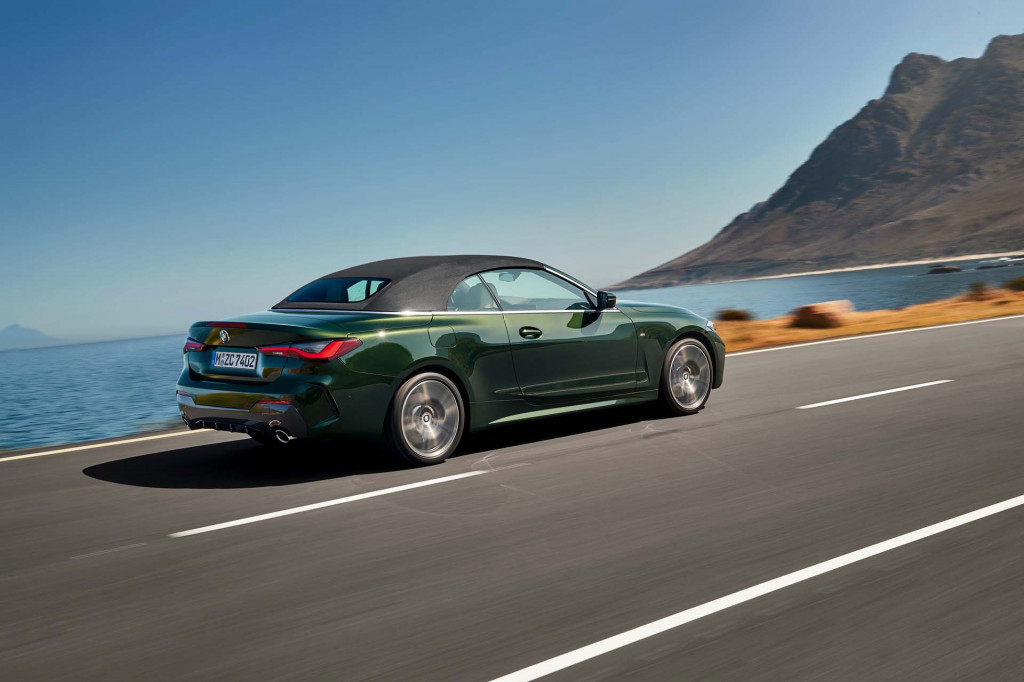
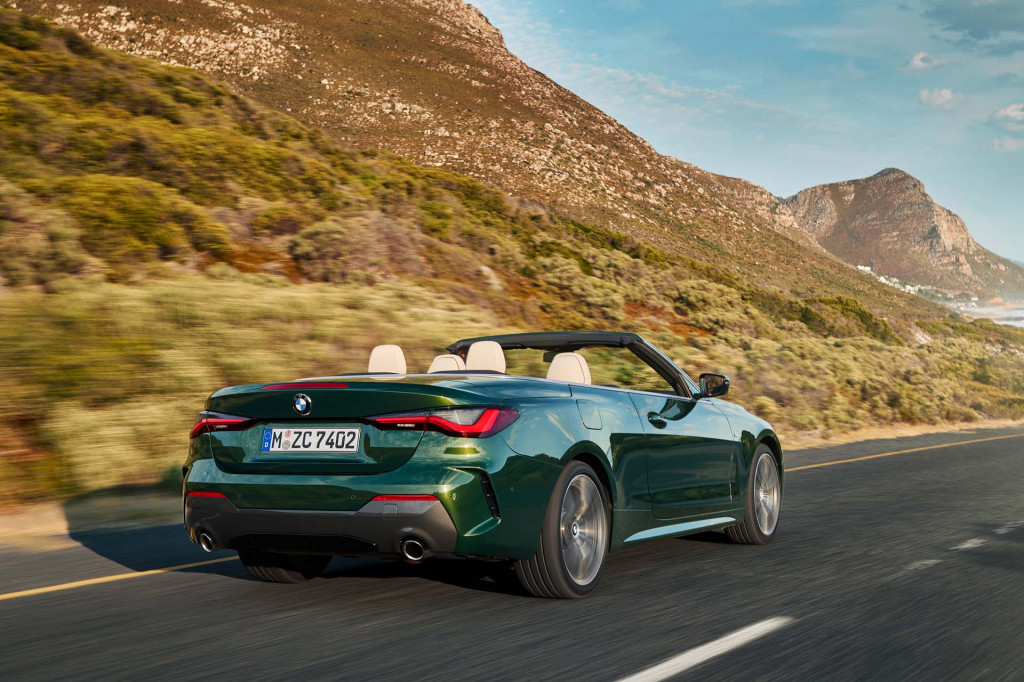
    The reveal of the redesigned 2021 BMW 4-Series coupe in June was, for lack of a better word, a bit jarring due to the radical new look introduced for the car’s grille. (BMW also shook things up by making the 4-Series longer than the 3-Series sedan, with which it shares a platform and powertrains.)

    Now that the same look has been applied to the redesigned 2021 BMW M3 sedan and M4 coupe, we’re starting to become accustomed to it, so much so that it almost looks entirely normal on the redesigned 2021 BMW 4-Series Convertible unveiled late on Tuesday. The new drop-top is due at dealerships in March 2021.

    2021 BMW 4-Series Convertible

    2021 BMW 4-Series Convertible

    2021 BMW 4-Series Convertible

    2021 BMW 4-Series Convertible

    2021 BMW 4-Series Convertible

    2021 BMW 4-Series Convertible

    2021 BMW 4-Series Convertible

    2021 BMW 4-Series Convertible

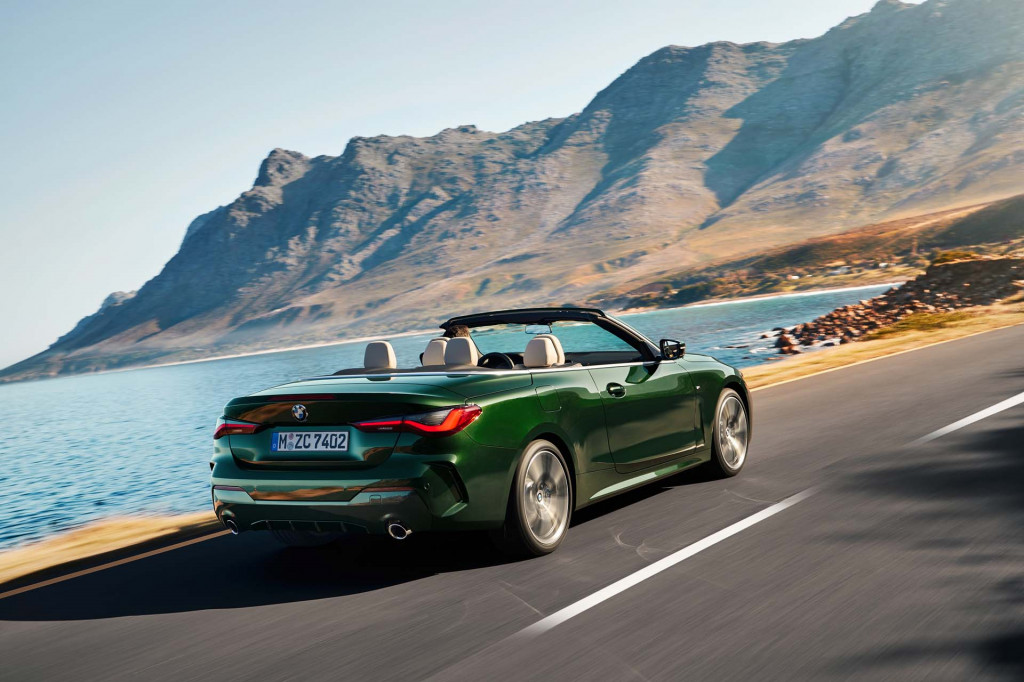
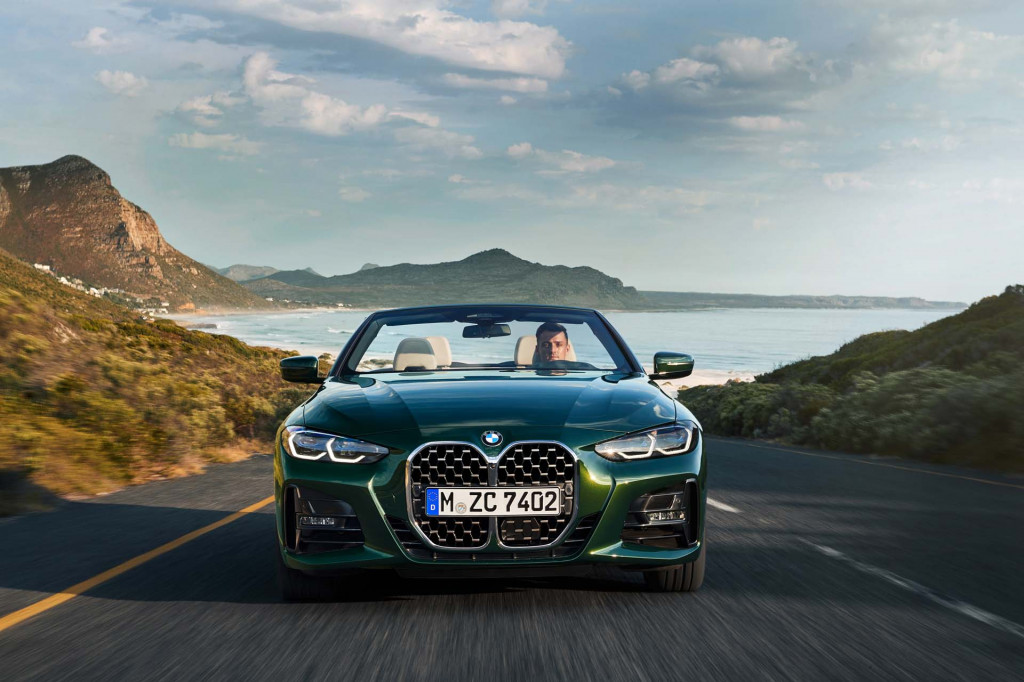
    BMW has gone with an evolutionary look for most of the vehicle, though up front is that now familiar oversized grille with the iconic kidneys stretched vertically instead of horizontally. The design actually links the 4-Series with sporting BMWs of the past like the pre-war 328 and 3.0 CSi of the 1970s.

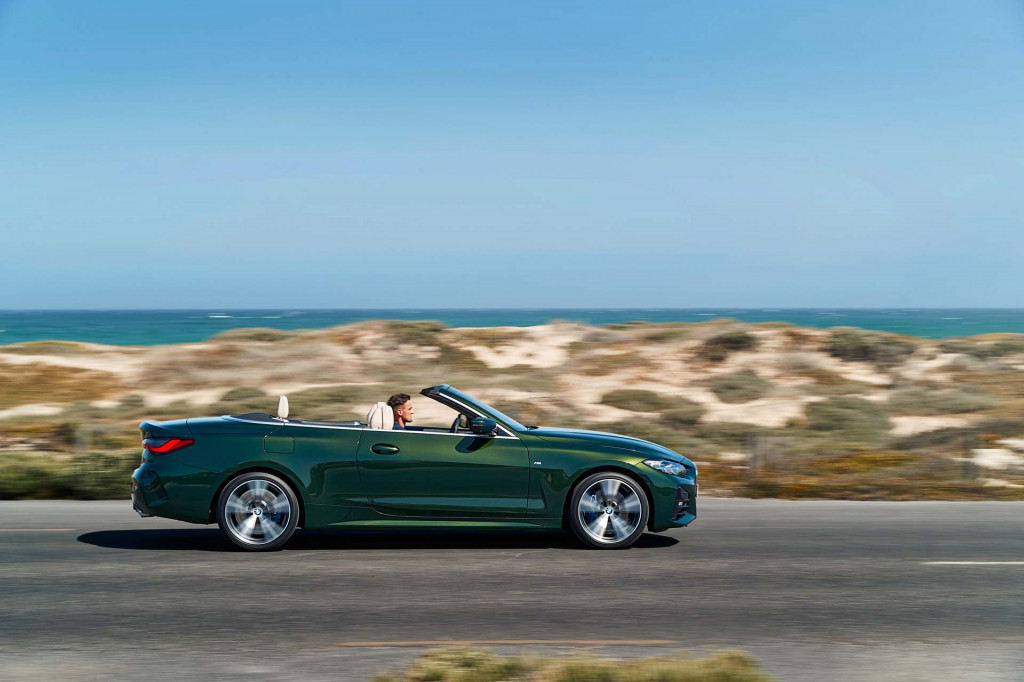
    The new looks extend to the roof which is now a soft-top instead of a retractable hard-top like on the previous generation. The simpler, sleeker soft-top not only improves the way the 4-Series Convertible looks but also makes it lighter and takes up less space both when stretched over the cabin and folded in the trunk. BMW said the soft-top is approximately 40% lighter than the previous generation’s hard-top. It also results in 0.2 inches of extra headroom in the cabin when up, and 1.2 cubic feet of extra storage in the trunk when folded.

    2021 BMW 4-Series Convertible

    2021 BMW 4-Series Convertible

    2021 BMW 4-Series Convertible

    2021 BMW 4-Series Convertible

    2021 BMW 4-Series Convertible

    2021 BMW 4-Series Convertible

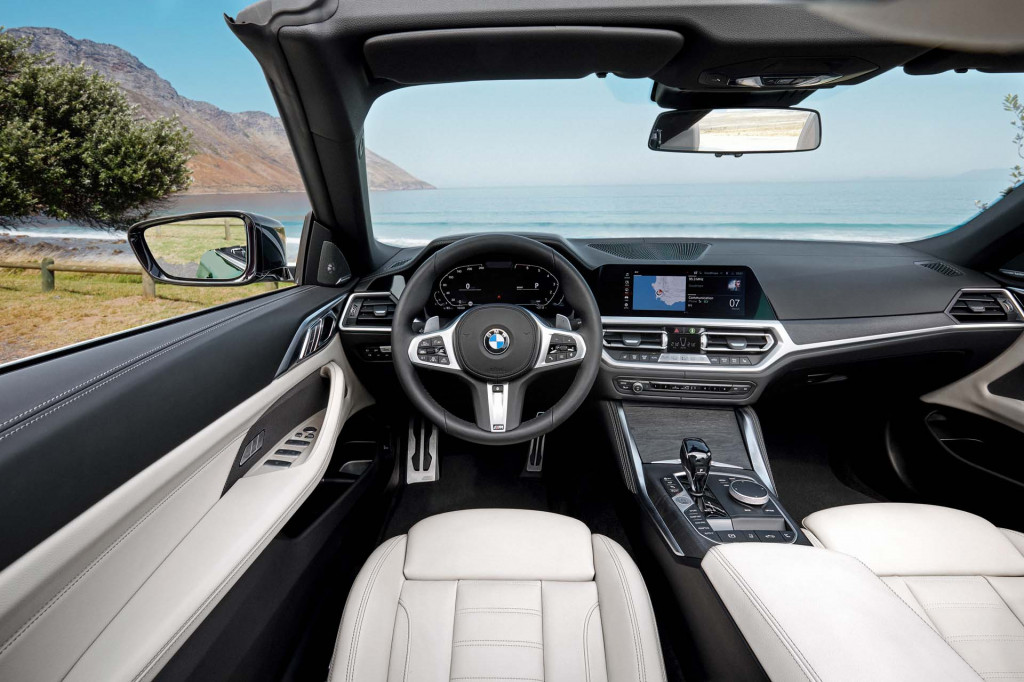
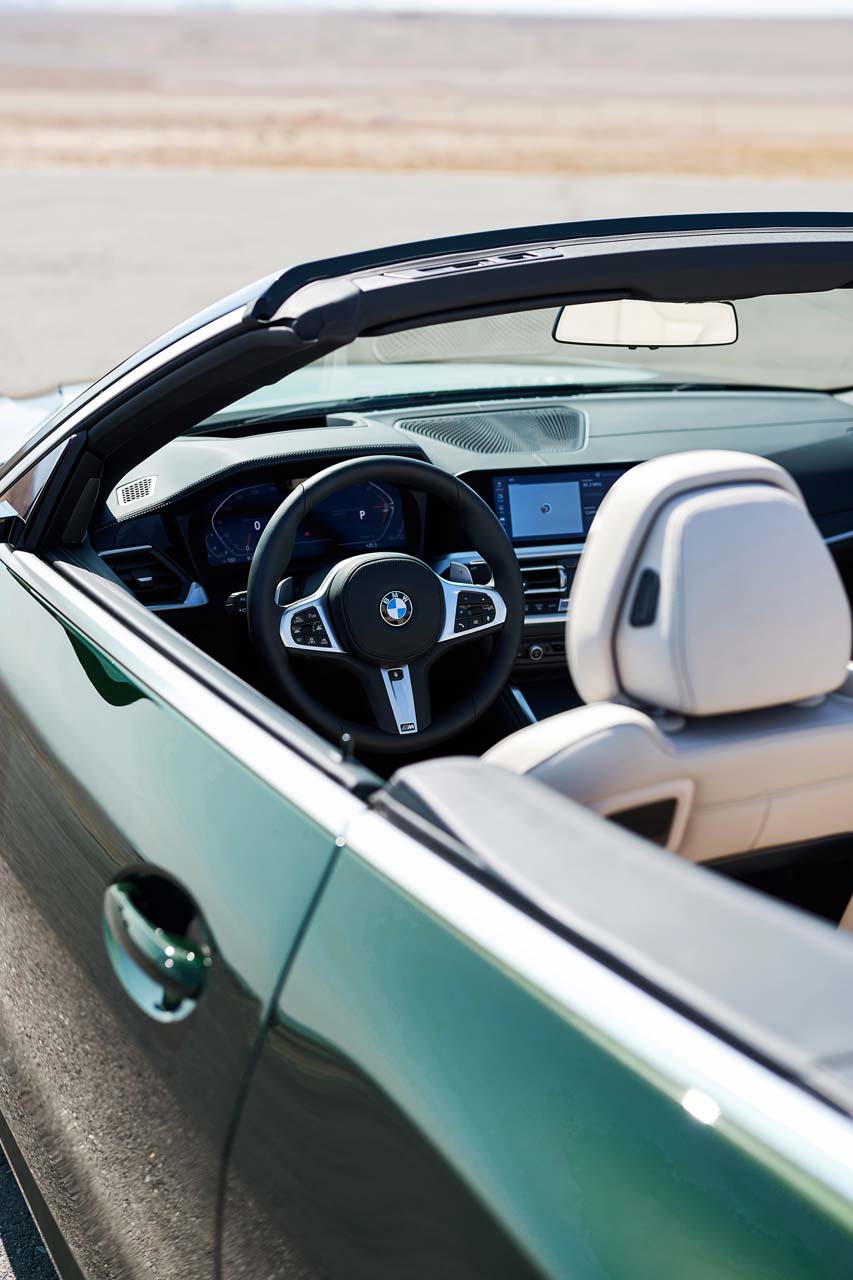
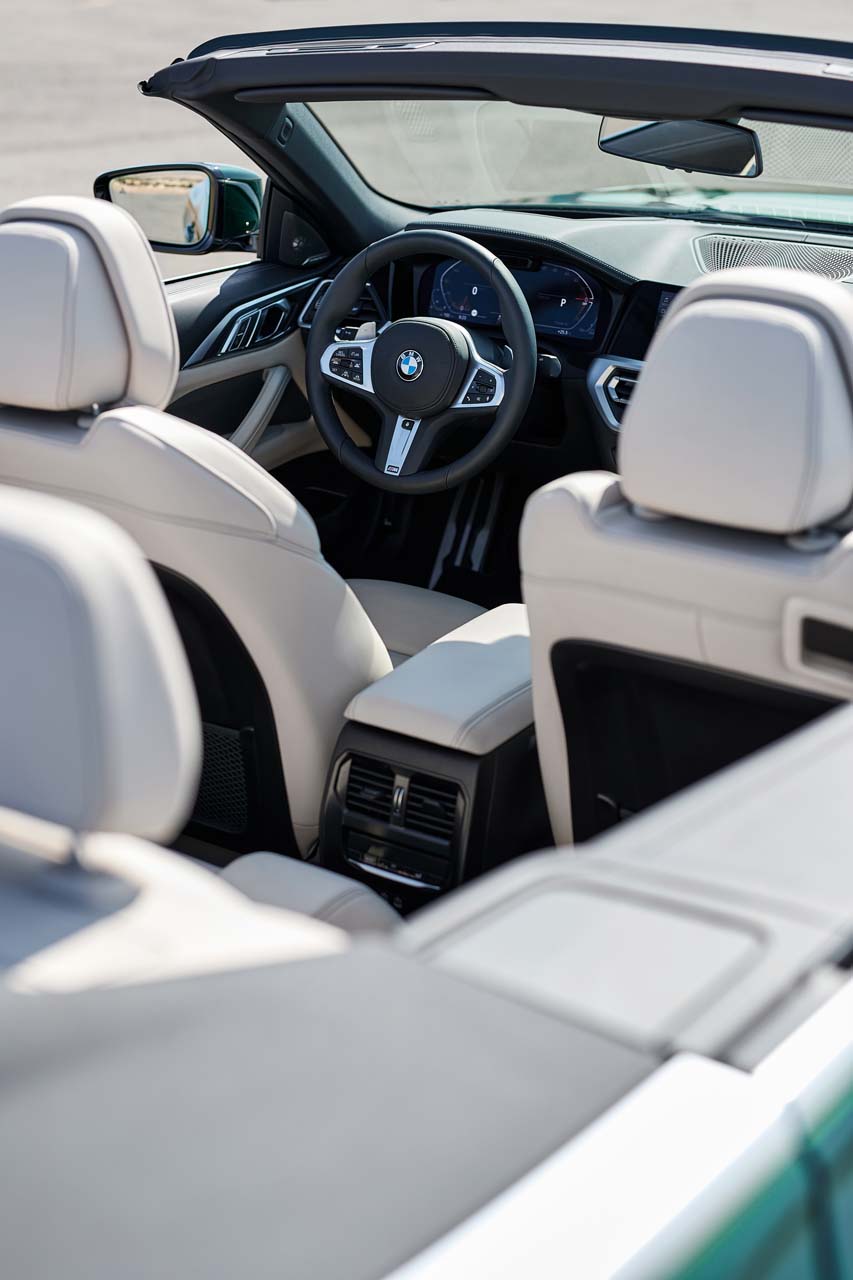
    The interior will be familiar to anyone who’s been in a modern BMW. A fully digital instrument cluster with a 12.3-inch screen is available (an analog cluster with an integrated 5.1-inch screen is still standard), and next to this sits a large infotainment screen (8.8 inches standard and 10.25 inches available). Sport seats and a leather-lined sport steering wheel are standard.

    Standard electronic driver-assist features include forward collision warning with pedestrian detection, lane departure warning with steering correction, blind spot warning, and rear cross traffic alert. A worthy option is the parking assistance package which adds a surround-view camera.

    At launch there will be 430i and M440i variants, with rear-wheel drive standard and all-wheel drive available from July 2021. The sole transmission is an 8-speed automatic.

    2021 BMW 4-Series Convertible

    2021 BMW 4-Series Convertible

    The 430i packs a 2.0-liter turbocharged inline-4 delivering 255 horsepower and 294 pound-feet of torque. The M440i has a 3.0-liter turbocharged inline-6 and mild-hybrid system good for 382 hp and 364 lb-ft. The mild-hybrid system temporarily boosts output by 11 hp. It consists of an integrated starter motor and generator that is able to recover energy under braking.

    The M440i is the quickest of the bunch, needing 5.0 seconds to reach 60 mph and topping out at 155 mph (electronically limited). Performance fans can look forward to an M4 Convertible which will have a 3.0-liter twin-turbocharged inline-6 with as much as 503 hp.

    Pricing starts at $54,095 for the 430i Convertible, and at $64,995 for the M440i Convertible. All-wheel drive is a $2,000 premium. Sport-tuned suspension and adjustable dampers can also be added at extra cost.

    The expansion of BMW’s 4-Series family isn’t over. A redesigned 4-Series Gran Coupe is in the works, and it may spawn an M4 variant this time around. There will also be a new battery-electric sedan dubbed the i4, and it will offer up to 523 hp. Both of these 4-Series members are due in 2021.

    For more on the BMW 4-Series, read the in-depth reviews at The Car Connection.

    Source

  • RB20DET POWERED MAZDA B2500: TIME MACHINE

    Phil Randall’s built a lot of cool cars over the years, taking his time to make each one perfect. But when his father fell ill, time became the most important factor in his Mazda B2500 build…

    Feature taken from Fast Car. Words Dan Bevis Photography Jules Truss

    Forward planning and long-term strategising are the key to success in a well-played game of chess. Well, that’s what we’re told, anyway. We have no idea how to play chess, that’s probably a bad example. Risk, then. If you want to win at Risk, you need to throw a cursory showing of armies into Kamchatka and Irkutsk and build up an unassuming power base. Or Australasia – control that, it’s pretty much impenetrable.

    RB20DET POWERED MAZDA B2500 PICK UP TRUCKRB20DET POWERED MAZDA B2500 PICK UP TRUCK

    That said, life loves to throw curveballs at us, and the luxury of long-term planning isn’t always available. Sometimes unexpected things happen and we’re forced to rush. “In this world nothing can be said to be certain,” said Benjamin Franklin, “except death and taxes”. That’s what’s known as an immutable constant. But his scope perhaps isn’t really broad enough; the universe is packed with such generalisations, harnessing received wisdom to propagate the myths of pseudo-truism. Dropped toast always lands butter-side-down, cats always land on their feet, decrepit billionaires always have hot young wives with plastic embellishments… whichever way you slice it though, life comes at you fast, some things can’t be changed, and you don’t always get to plan for things in advance.

    RB20DET POWERED MAZDA B2500 PICK UP TRUCKRB20DET POWERED MAZDA B2500 PICK UP TRUCK

    When fate came knocking on Phil Randall’s door, however, he had both feet on the ground. An expert in the field of expecting the unexpected, he’s been building cool cars. “I’ve been building modified cars since I was sixteen; my first car was a Peugeot 205 XS which I converted to Mi16 power,” he explains. “It was pushing 220bhp; in fact, that was a Fast Car feature car back in the day, and quite well known on the show scene. Nowadays I’m the owner of XDR Motors – it all started on the driveway at home, and now I have a company where I specialise in drift and track cars, but also do all other work such as repairs, MOTs and servicing.”

    RB20DET POWERED MAZDA B2500 PICK UP TRUCKRB20DET POWERED MAZDA B2500 PICK UP TRUCK

    Dabbling with racy machines all day, it’s inevitable that Phil’s own projects would be pretty tasty, and his personal CV following the 205 includes a drift-spec RX-7, a DC5 Integra, a full custom supercharged Honda Accord Type R, and… this Mazda B2500 pickup truck. Yep, bit of a random addition to the line-up, isn’t it?

    RB20DET POWERED MAZDA B2500 PICK UP TRUCKRB20DET POWERED MAZDA B2500 PICK UP TRUCK

    “I’ve just always wanted to build one,” he shrugs. “It came up as a swap on my Accord, and I guess it was the kid in me who’d always wanted a truck, I just said yes! It came as a stock nat-asp derv with a block lowering kit, that was it – but it was tidy enough. And I had an RB20DET motor in stock, so…”

    RB20DET POWERED MAZDA B2500 PICK UP TRUCKRB20DET POWERED MAZDA B2500 PICK UP TRUCK

    Yes, you can see where this was going – and it’s fair to say the B2500’s changed quite a bit since that fateful day. It’s interesting, the perennial enthusiasm for pickup trucks is often something that taps into a very special combination of automotive fancies: restoration, modification, unexpected horsepower, the cultural phenomenon of stance, and a fastidious attention to detail that borders on the obsessive. Much of this is fed by the factors of rarity and unusualness – utility vehicles are, by their very nature, quite tricky to find in straight and solid nick after years or even decades of hardcore commercial use; the function of their being means that they get used hard until they break. Pickups that you see in use today are invariably either knackered or pristine, with the latter group having had countless hours of work and untold quantities of love poured into their rejuvenation. There’s no middle ground. And if Phil wanted to shove a turbocharged Nissan straight-six into this unsuspecting Mazda, well, we’re all for that sort of measured mayhem.

    RB20DET POWERED MAZDA B2500 PICK UP TRUCKRB20DET POWERED MAZDA B2500 PICK UP TRUCK

    “The first move was literally just to fit the RB20 into the Mazda on the stock setup and gearbox, and see what would happen,” he grins. “Basically, it was great fun in a straight line – bearing in mind that it was on a leaf spring rear and torsion bar front. We did some drift displays for Castle Combe in it last year, and quickly realised it needed some work! And so a plan came about.”

    RB20DET POWERED MAZDA B2500 PICK UP TRUCKRB20DET POWERED MAZDA B2500 PICK UP TRUCK

    Said plan involved building the truck up in full over the course of this year, and so it sat for a while awaiting its turn. However, this was the time when fate decided to roll her cruel dice and shatter Phil’s world to smithereens.

    RB20DET POWERED MAZDA B2500 PICK UP TRUCKRB20DET POWERED MAZDA B2500 PICK UP TRUCK

    “A week before Christmas, my dad was diagnosed with three brain tumours,” he tells us. “He was given 3-to-6 months. One thing I’d never done was to take my dad around a track; he’d been and watched me compete in the BDC and other events, but never sat by my side. So I knew what I wanted to do with this truck. It had to get done so I could take my dad out in it.”

    RB20DET POWERED MAZDA B2500 PICK UP TRUCKRB20DET POWERED MAZDA B2500 PICK UP TRUCK

    And thus the heat was unexpectedly on. Naturally this couldn’t be a case of simply throwing the truck together into usable form, as that was never the point and that isn’t Phil’s style; no, this would be finished in the correct way and to the proper specs as originally envisaged – it just had to somehow be done really fast.

    RB20DET POWERED MAZDA B2500 PICK UP TRUCKRB20DET POWERED MAZDA B2500 PICK UP TRUCK

    “At this point, we had already started to cut the truck about to start fitting BMW running gear to the back,” he says. “After a chat with my team, and with time being of the essence, we all decided that the truck was to take priority over all the sponsor cars and other cars I look after. And so began the 200-hour job of taking a near-stock truck and turning it into what we have now. We worked from 6pm to 2am, night after night.”

    RB20DET POWERED MAZDA B2500 PICK UP TRUCKRB20DET POWERED MAZDA B2500 PICK UP TRUCK

    The scale of the endeavour really is incredible; the Mazda was stripped right back to a bare chassis, with all the original suspension components removed, mounting brackets, housings, brakes, the lot. Then the team fitted the complete front and rear subframes from a BMW E36 Compact, with an eye-watering amount of custom fabrication to get everything located and able to mate BMW to Mazda to Nissan. It’s a real Frankentruck, this one. All of the original mounting points and bolts from the BMW were meshed into the pickup to ensure that future repairs and upgrades would be as simple as possible, and once the frame and suspension were sorted it was all taken to Trig Bishop at Bishop’s Bespoke Builds to fabricate a tubular front end with custom adjustable suspension top mounts. The brakes are E36 units working with custom braided lines and an OBP pedal box, while custom brackets aid the relationship between BMW steering rack and Mazda shaft. It really is fiendishly clever.

    RB20DET POWERED MAZDA B2500 PICK UP TRUCKRB20DET POWERED MAZDA B2500 PICK UP TRUCK

    “Then it was back to the shop for a complete stripdown, and off to Elite Panelcraft to be painted by Liam Musselwhite,” Phil continues. “With its fresh new Sunburst Yellow laid down, it was then time for the frantic reassembly, with the build-up finished the day before Spring Action Day at Castle Combe. That’s where we unveiled the finished truck, alongside our S13 for the 2019 Retro Drift Championship. And with that show out of the way, we then returned to Combe the following Wednesday. The entire team and family came. And I finally took my dad out on track – for what was the first and sadly the last time.”

    RB20DET POWERED MAZDA B2500 PICK UP TRUCKRB20DET POWERED MAZDA B2500 PICK UP TRUCK

    The tightened deadline, the endless late nights, the blood, sweat and tears, it all swelled to a glorious crescendo on that day. They’d made it. Phil and his dad, side by side, out on track at last.

    RB20DET POWERED MAZDA B2500 PICK UP TRUCKRB20DET POWERED MAZDA B2500 PICK UP TRUCK

    “We were spotted at Spring Action Day by the Retro Rides crew, and invited to Goodwood with them, with dad taking a turn,” Phil continues. “He told me to go to Goodwood and do the show. And sadly he passed on that Saturday. I need to give Goodwood and Retro Rides a massive shout-out; when the news spread around the paddock, they quickly came and offered their condolences, and squeezed me in to an already hectic Sunday track schedule to let me honour my dad on the Sunday. And I cannot thank them enough for that. So the truck now sits shining ready for shows or displays where required, in honour of dad. One XDR car that will never leave me.”

    RB20DET POWERED MAZDA B2500 PICK UP TRUCKRB20DET POWERED MAZDA B2500 PICK UP TRUCK

    Forward planning, you see, only gets you so far. When life kicks sand in your eyes, it’s friends and family pulling together that makes great stuff happen. This truck build was more important than money, more important than Insta-likes – this was about one man’s tribute to his father. And that’s what it shall forever remain.

    Photo: M.Hepper Photography

    TECH SPEC: MAZDA B2500

    Styling:
    Sunburst Yellow paint, body prepped and painted by Liam Musselwhite, XDR Motors livery

    Tuning:
    RB20DET 2.0-litre straight-six turbo, ACL internals, Cosworth head gasket, head drain kit, Plazmaman front-face inlet manifold, 550cc Bosch injectors, HY35 turbo with welded internal wastegate, 55mm Tial external wastegate with screamer pipe, Spec tubular manifold, water pump removed and thermostat modified, rear-mount radiator setup with full Davies Craig water management system inc. control ECU and fan set, custom front-to-rear radiator pipe setup, XDR custom radiator mount, XDR custom front-mount intercooler and pipework, full custom wiring harness with standalone electrics for ECU, water system, boost control and management with custom fusebox (all by Phoenix Engine Management), PMC Motorsport gearbox adaptor with custom flywheel, 6-paddle clutch and race pressure plate, E36 M3 gearbox, E36 2.8 rear diff, custom propshaft designed by XDR and built by Firow Propshafts, A’PEXi Power FC – mapped by Richard Bell, custom intake system and exhaust system by XDR, Cooling Mist meth kit
    Power: 390bhp

    Chassis:
    BMW E39 wheels – painted black, custom-fitted E36 Compact front and rear subframes, wideboy Z3 rear hub set, custom steering rack brackets to mate BMW rack to Mazda shaft, BMW E36 brakes, custom braided brake lines by Proline Motorsport, OBP pedal box countersunk into floor, custom tubular front end inc. caster-adjustable top mounting plates (by XDR and Bishop’s Bespoke Builds), chassis treated and painted, custom rear bed frame to house radiator setup and internal fuel tank within bed – with split alloy top plates powdercoated black

    Interior:
    Custom black carpet and panel covering by XDR – inc. doorcards and headlining, side-mount Cobra Monaco seats on custom frames, green TRS 5-point Magnum harnesses, E36 328i dials, custom dash insert for boost and AFR gauges, boost controller and meth kit switches, fusebox and water control mounted on rear plate, race battery behind passenger, electrical cutoffs and fire extinguisher system, custom gearstick, hydraulic handbrake, OMP steering wheel and boss

    The support crew
    “There are a number of people I need to thank for helping this build come to life,” says Phil. “A massive thank you has to go out to Kieron Browne – he helps me after work, he’s my welder and has an amazing ability to fit things where they shouldn’t go. Without him the truck would never have been completed in time. Liam Musselwhite for painting the truck on such short notice and doing an amazing job. Trig Bishop at Bishop’s Bespoke Builds – a long-time friend who again dropped his workload to get me in at a moment’s notice. Robin at Raw Motorsport for advice and general help and piss-taking. Mitch at Proline for sorting custom brake lines onto my pedal box at a moment’s notice. Team XDR, of course – without the constant support, help and general presence of my team, I’d not be where I am today; that includes my wife, Sam, and my girls, Sofia and Elsie. And finally my mum and dad. Mum for being so strong through the hard times and looking after dad through thick and thin. And my dad. Just for being my dad.”

    Source