Author: Olly

  • LEXUS RC F TRACK PACK (2020) REVIEW

    With a stonking 5.0-litre V8 at its heart and 457bhp to play with, can the Lexus RC F Track Pack take the fight to the Germans?

    Leftfield, muscular, intriguing, these are all words you could use to describe the Lexus RC F. In a world of turbocharging, hybrids and electric motors, even from inhouse, a stonking 5.0-litre V8 sticks out like a sore thumb and is partly why people refer to the Lexus RC F as a bit of an oddball.

    Let’s start with the motor. Yes, Lexus isn’t the only marque utilising a naturally aspirated V8 to power its cars, Ford is of course doing the same with the Mustang, which is where the muscular aspect comes in. From behind the wheel, there is a whiff of muscle car about it, not from anything inside of the cabin, which we’ll get on to, but just feathering the throttle lets off a deep grumble that just feels right in a big car such as this.

    Lexus RC F Track Pack

    It’s main rivals, the BMW M4, Mercedes-AMG C63 and Audi RS5, all have turbocharged motors either in six-cylinder format (M4 and RS5) or eight-pot in the Merc and sadly this is where the RC F’s pitfalls partly lie. While it has a healthy 457bhp on tap, the nature of a naturally aspirated engine means that you’re only making that peak power at over 7100rpm, and with peak torque of 383lb ft coming in at 4800rpm, there’s a very real feeling that this car is a touch lethargic and dare I say underpowered anything below 4,800rpm. Take one of the turbocharged engines from its German rivals and you’ll see that peak torque power comes in at just over 2,000rpm on all three cars, which translates to three cars that ultimately not only feel more eager to press on, but overall feel entirely faster.

    That being said, what it loses out on in terms of straight-line performance, it more than makes up for in soundtrack. The V8 snarls all the way up to its redline at 7,500rpm and you get there with a beaming smile on your face. While before I criticised the V8 engine for some signs of lethargy, its turn of pace past around 4krpm helps you to realise this isn’t a slouch. Official figures have the 1825kg Lexus RC F Track Pack accelerating from 0-62mph in just 4.3 seconds and going on to a limited 168mph. The way in which you extract the performance from the engine is very different to that in the aforementioned rivals. In those cars you can just pin the throttle in any gear and you’ll get bucket loads of performance. Here, though, you need to think about your gearing and work for the performance that bit more.

    Lexus RC F Track Pack

    Connected to that V8 engine is an 8-speed automatic gearbox with paddles. Having previously driven the earlier Lexus RC F, one of the criticisms was just how slow the gearbox reacted to inputs. Thankfully the updated RC F feels as if it’s had some revisions to the gearbox; sadly, however, it still doesn’t feel quite enough. It still feels slower than rivals and still has issues particularly with downshifting in even its most optimum setting. It’s a real shame because when it comes to city driving, it delivers smooth, effortless changes that resonates with a big, luxury GT car. But this is a sports car and with that it should also behave like one. The M-DCT (M4), 7G-DCT (C63) and DSG (RS5) are all much faster in carrying out their instructions.

    The Lexus RC F we’re driving here was treated to the Track Pack, which aims to bring about some sharper dynamism and out-right performance. Truth be told, though, the RC F never feels like a track car and even in its partial weight saving guise of Track Pack, it still sits at almost 200kg heavier than the BMW M4 and you do feel that, not only when pinning the throttle but also when focusing on its agility. It’s ability to transition its weight from corner to corner isn’t as fluid as it is in say the M4, you feel the mass being forced left and right while the chassis does its best to keep you on the straight and narrow.

    Lexus RC F Track Pack

    As part of the Track Pack you also get the addition of a torque-vectoring differential. Sadly, though, it isn’t an upgrade we noticed on the road if we’re being brutally honest. That may translate differently on track, however.

    The other addition you get as part of the pack are the carbon ceramic brakes. Normally right about now is when we’ll pipe up and argue whether carbon ceramic brakes are ever needed on a road car, but in the RC F it’s a welcomed addition. Not only do you have 1800kg of weight to slow down and constant use would see the brakes faded in seconds, but the pedal feel in comparison to the standard steel setup is night and day, offering much more pedal feel and resulting confidence.

    Inside it’s business as usual for Lexus. Scratchy plastics aren’t welcome around here, with soft touch finishes dotted about the cabin to make you feel welcome. For me, the Lexus does the day-to-day stuff better than any of its rivals. While some criticise the seating for being a touch too high, at 5ft11 I found it just about right on its lowest setting. The seats themselves are beautifully supportive and curve around you. Long journeys and day-to-day commuting becomes a doddle.

    For some, criticisms lay solely with the car’s infotainment system, which uses a curser style mouse pad to help navigate the menus. For the first few days it takes some getting used to simply due to its stark contrast to its rivals. But, give it a chance and you start to get your head around how to quickly switch through menus without having to look at the pad. Yes, a rotary control wheel is easier to use, but I like that Lexus didn’t just copy the Germans and applied its own method. For some that method is madness, for me its quirky.

    Verdict

    While the Lexus RC F Track Pack adds in a touch more agility and urgency, it still feels a little way behind its rivals in the sports car department. That being said, its old-fashioned way of thinking when it comes to internal combustion resonates massively with this petrolhead. Yes, it’s ultimately slower, but the climb towards the redline feels much more rewarding. It’s a muscle car at heart with a touch of class. That V8 soundtrack ain’t half bad either, after all, it won’t be long before V8s will be a thing of the past…

    Tech Spec: Lexus RC F Track Pack

    Engine: 4,969cc V8
    Transmission: 8-speed automatic, rear-wheel drive
    Power (hp): 457@7,100rpm
    Torque (lb ft): 384@4,800rpm
    0-62mph: 4.3sec
    Top speed: 168mph (limited)
    Weight: 1,825kg
    MPG: 23.9mpg
    CO2: 258g/km
    Price: From £63,240

    Source

  • PANDEM FC RX-7: DEADLY SINS

    When GReddy Performance Products put together a show car, they don’t mess about. Pride, lust, envy, this Pandem FC RX-7 has got the lot…

    Feature first appeared in Fast Car Japanese. Words: Dan Bevis. Photos: Larry Chen

    Count up your deadly sins, boys and girls, you’ll find them all coursing through the injectors and oilways of this firebrand RX-7. Lust? Well, that’s a gimme. Don’t pretend your brain is the only organ that’s suddenly on high alert. You can’t process the primal emotions you’re feeling, but that’s totally okay. Envy? Of course, how could you not feel painfully, gut-wrenchingly envious that such a car exists and it belongs to somebody else? Fate is a cruel, cruel mistress. Greed? Sure, that goes hand-in-hand with gluttony, the quest for more, more, more is what’s led to all this horsepower, all this girth, everything bigger than everything else. Pride is an inevitable consequence too, the sheer visceral spectacularity that we’re part of a species that’s able to achieve such awe-inspiring creativity. Does sloth fit into the picture? Weirdly, yes – see, this car isn’t just about hardcore canyon running; it’s such a savage looker that when the mood comes to laze around and achieve nothing, it looks damn good doing so. Oh, and wrath. All the wrath, that’s what this car is essentially made of – an uncompromising, flame-spitting distillation of all mankind’s anger, refracted through a Japanese prism and catapulted into North America to stalk the streets in search of fresh prey.

    Pandem FC RX-7

    All of this extravagant sinning feels particularly naughty when we consider that an FC RX-7 is the base. After all, aside from the fact that it runs a Wankel rotary engine (and heaven knows these things can bite you if you don’t look after them), it’s always been – on paper, at least – a fundamentally sensible sort of car. Well, that was the case at the outset, anyway. The second-generation RX-7, designated ‘FC’, was a big seller in Japan due to the country’s stringent taxation system; cars with engines displacing under 1,500cc were significantly cheaper to tax, and the RX-7 crept well under the bar with its 1.3-litre displacement. The truth of it is that describing it in such terms is a nonsense, obviously – rotary engines and traditional piston engines aren’t directly comparable in that way, their technical function is so different. But rules are rules. Anyway, while the original RX-7, the FB, was a pure sports car, the FC was more of a grand tourer, softened up to tap into the lucrative global GT market – which allowed it to clean up in the USA too. It was light years ahead of the model it replaced in terms of technology; the old recirculating ball steering was replaced with a rack-and-pinion setup, and the live axle was junked for an independent rear. It also had anti-dive/anti-squat suspension and passive rear-steer, and was even available as a convertible if that sort of thing flicks your switch. Conceptually-speaking, this is a sensible and grown-up machine. Naturally, however, you can’t really expect anything with a Wankel to be totally sensible, and Mazda knew this – that’s why, as well as a 150bhp nat-asp base model, they offered a 185bhp turbocharged version as well. This hedonistic hellraiser was amped up to the tune of 215bhp with the evolved Turbo II model, and it’s this very hedonism which the car you see here seeks further to exploit.

    Yes, as you’ve no doubt deduced, this 1990 Turbo II is no ordinary 1990 Turbo II. In fact, this is a car which pulls together a number of big names to create something unparalleled in its awesomeness: built by GReddy Performance Products Inc. for TRA Kyoto boss-man Kei Miura, to be a SEMA showpiece. So you can imagine the quality that was demanded right from the start.

    As GReddy chief Kenji Sumino explains, the idea from the off was to build a car for the event to showcase the latest Pandem wide-body creation. “Mr Miura had the kit designed before he even had the car,” he recalls. “The original idea was that after SEMA he would take this RX-7 back to Japan, although he then decided to build another one for Tokyo Auto Salon, so he told us to keep this one.”

    Not a bad situation to find themselves in, as this really is a stellar build. Every inch of it is flawless, and this is no easy thing to achieve when you’re talking about building a project car using a platform of this age. Kenji and his team scoured the classifieds across North America to find a suitable starting point, asking many searching questions of owners until eventually a guy by the name of Massi Tawakali in Northern California presented the ideal candidate – and even offered to trailer the FC RX-7 to GReddy HQ in Irvine too!

    “We were keen to go with a period-correct theme,” Kenji says. “Fortunately the chassis was very clean, and we wanted to make sure everything under the hood was clean as well, but with proper performance upgrades to represent GReddy since it was all built here at GPP. Interestingly the RX-7 already had one of our old GReddy turbo kits on it.” Strong provenance then, but of course all of this was ripe for fresh upgrades if the car was to become a SEMA star. So the engine was pulled out, and the mechanical rejuvenation began in earnest. “As we don’t work on rotary engines much, we had to bring in a few experts,” he continues. “Nate Tasukon helped us sort the wiring harness, which was in a very bad way, and Ben Schwartz took all the original engine parts, such as the corroded intake manifold and throttle body, and restored them to look brand new.” The cast GReddy turbo manifold that was already on the car was refurbished and ceramic-coated, and this really suits the period-correct ethos as it’s a discontinued item that was cast twenty-five years ago! To this was added a GReddy TD06H-25G turbo, working with a Type 24 intercooler and cast aluminium compression tube; with a full custom 76mm exhaust system and an uprated fuelling system featuring a billet fuel rail with RC injectors, a piggyback ECU corrals all of the digits to a robust 356bhp. And that’s more than enough to keep things entertaining in a car that weighs little more than a tonne…

    Pandem FC RX-7

    So the oily bits are pretty hilarious, but this Mazda’s key impact comes from its imposing aesthetic. It just looks so damn mean, doesn’t it? The Pandem widebody aero kit comprises the full set of beefy overfenders, the ducktail wing, front bumper, sideskirts, door extensions and, perhaps the coolest part of all, those rally-style quad driving lights. UK readers may be interested to note that the full kit is actually available over here via Torqen. Looks pretty spectacular in that crisp shade of white too, doesn’t it? Funnily enough, Kenji’s original plan was to finish the RX-7 in a sort of old-school Mazda Racing style, with a livery painted in purple, yellow and white – and even tested out a few renders on the GReddy social channels, to widespread adulation. “However, when we showed Mr Miura the car once the kit was fitted, he suggested we keep it all white, and I think that was definitely the right call,” he says. “This was, after all, the car’s original colour… although the paint wasn’t in great shape, it was peeling away, so we still had to strip the car right down to a bare shell and paint it inside and out.”

    Pandem FC RX-7

    It was absolutely the right choice, and it works just as well on the interior as the outside. The freshly painted innards have been treated to a new custom rollcage along with a set of carbon Pandem bucket seats and assorted other race-inspired accoutrements, and it looks every inch the period race car. This vibe really resonates in profile too, with the brutal ducktail neatly complemented by those aggressively wide TRA Kyoto 6666 wheels. The thing’s just begging to be spanked around Laguna Seca or Willow Springs, kicking up dust and making a nuisance of itself. And of course it was a massive hit at SEMA, just as it deserved to be – one of the most talked-about builds there, and winner of the Super Street SEMA Ultimate Award: Best of Show.

    “We love building cars like this, keeping everything clean and really showcasing the GReddy performance upgrades,” Kenji grins. And he’s right to be proud of the creation, the whole team deserves to be. It’s a fabulous combination of show and go, a beautifully resolved and restomodded custom classic, representing every single one of those deadly sins: lust, pride, wrath, envy, Happy, Grumpy, Bashful, Beaky, Mick and Tich – they’re all bouncing around inside this street weapon.

    Pandem FC RX-7

    Tech Spec: Pandem FC RX-7

    Styling:

    Full respray in white (inside and out), Pandem widebody kit inc. front bumper, quad driving lights, front and rear wide arches, rear ducktail wing, rear diffuser

    Tuning:

    13B rotary, GReddy TD06H-25G turbo, refurbished and ceramic-coated period GReddy turbo manifold, Greddy Type 24 intercooler, custom GReddy intercooler piping, GReddy cast aluminium compression tube, 76mm downpipe, 76mm stainless exhaust system with 115mm pie-cut titanium tail, Koyo aluminium radiator, aluminium radiator fan shroud, 19-row oil cooler, billet fuel rail with RC injectors, Aeromotive in-tank fuel pump, fuel pressure regulator, piggyback ECU, five-speed manual transmission

    Chassis:

    9.5×17-inch (front) and 10.5×17-inch (rear) TRA Kyoto 6666 Mesh wheels – with gold faces and polished lips, 235/40 (f) and 255/40 (r) Toyo Proxes R1-R tyres, TRA Kyoto nuts, custom coilovers with KW Hydraulic Lift System, uprated brake discs with high-friction pads and Wilwood fluid

    Interior:

    Half-stripped with sound deadening removed, Pandem carbon fibre bucket seats on Planted brackets, 6-point harnesses, custom GPP four-point rollcage, GReddy turbo timer, polished gearknob, GPP leather steering wheel, custom aluminium foot panels, blue trim converted to black

    Source

  • Preview: 2022 Infiniti QX55 crossover brings coupe-like styling, CVT for $47,525

    Infiniti on November took the covers off the QX55, a coupe-like crossover SUV due in showrooms in spring as a 2022 model.

    On Tuesday, Infiniti announced the stylish crossover will cost $47,525, including a mandatory $1,025 destination charge. That’s $7,000 more than the standard QX50 crossover SUV upon which it’s based.

    The QX55 targets vehicles like the Audi Q5 Sportback and BMW X4. Only one powertrain is on offer, a 2.0-liter turbo-4 good for 268 hp and 280 lb-ft of torque. It’s mated to a continuously variable transmission, and all-wheel drive is standard.

    2022 Infiniti QX55

    2022 Infiniti QX55

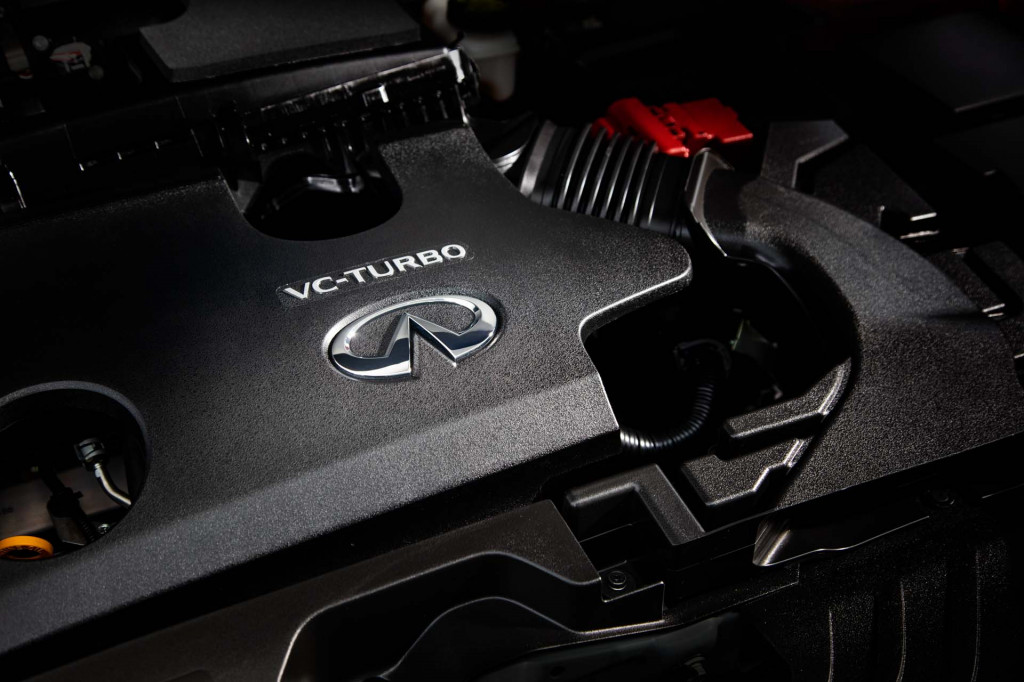
    The engine features Nissan’s variable-compression technology designed to save fuel. It does so by altering the compression ratio between 8:1 (typical for high performance engines) and 14:1 (used by many manufacturers for high efficiency), depending on the driving style.

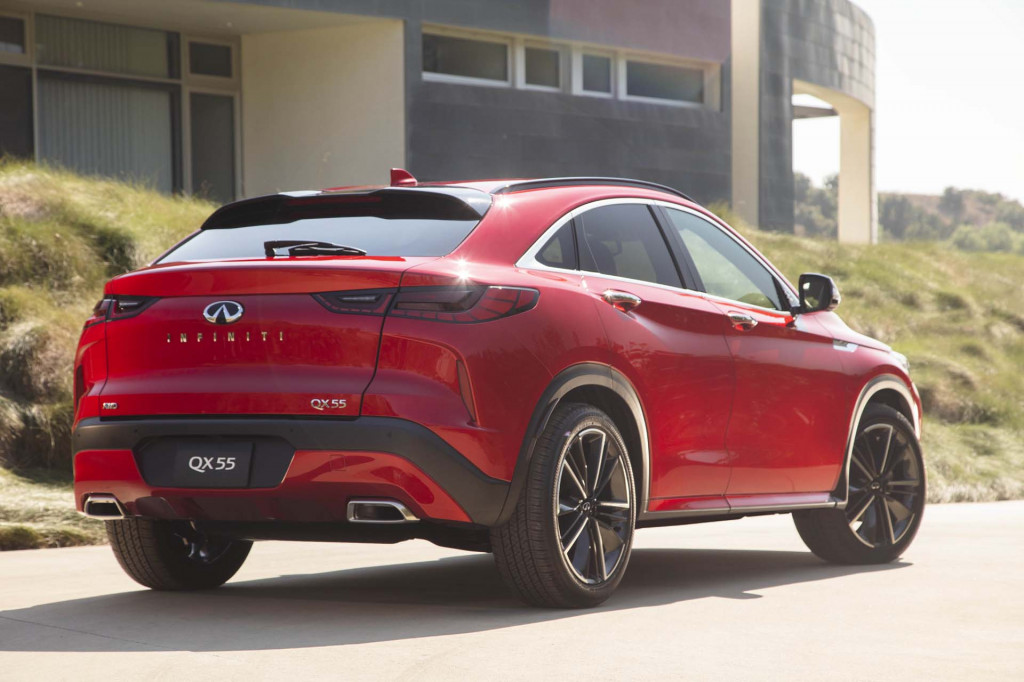
    The QX55’s styling up front is an almost exact match to the QX50, though things have been made bolder with a full-chrome grille and more aggressive designs for the side intakes. The real styling action is at the rear where a sloping roof leads down into a wide rump flanked by wraparound taillights. The taillights sport Infiniti’s new “piano key” graphic formed by 45 individual LEDs in each light cluster. The design was first shown on September’s QX60 Monograph concept.

    2022 Infiniti QX55

    2022 Infiniti QX55

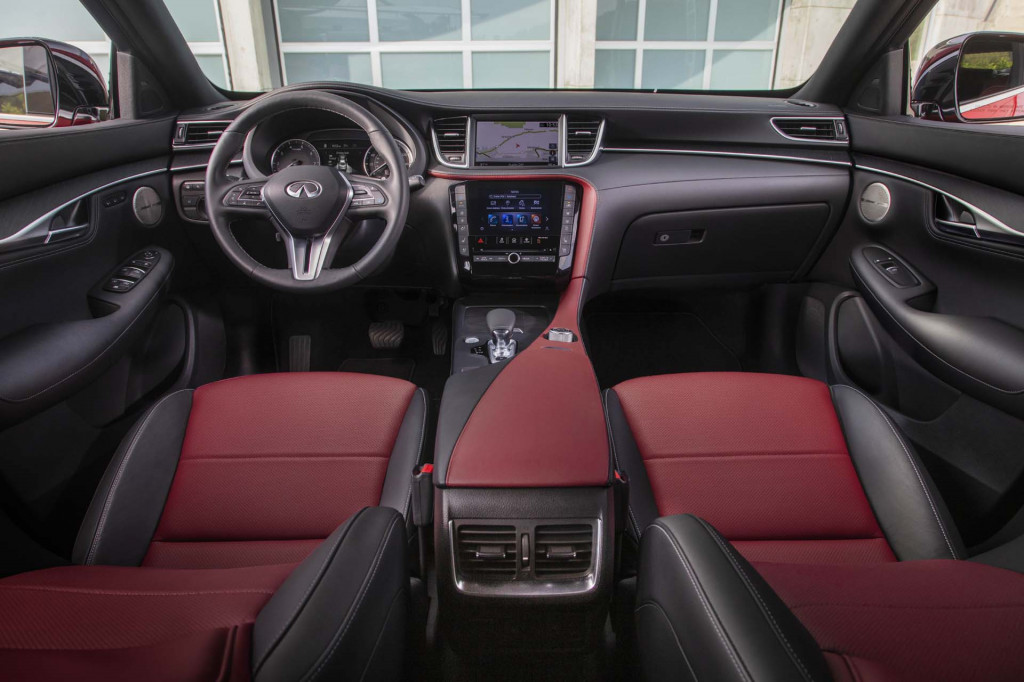
    The interior design is also a match to the QX50, though naturally the QX55 has less storage due to its sloped roof. With the rear seats folded, you’re looking at 54.1 cubic feet versus 60 in the QX50.

    Buyers will be able to choose from Luxe, Essential and Sensory grades, with even the base Luxe grade coming with plenty of standard equipment. The list includes 20-inch wheels, aluminum dash accents, active noise cancellation, twin touchscreen displays, Apple CarPlay and Android Auto, and multiple electronic driver-assist features. Just some of these assist features include blind spot warning and forward collision warning with pedestrian detection and automatic emergency braking. Nissan’s ProPilot system that can control a vehicle in a single lane is an available feature.

    2022 Infiniti QX55

    2022 Infiniti QX55

    Infiniti was a pioneer of the coupe-like crossover when it launched the original FX back in 2003, but surprisingly the automaker never expanded the concept to other segments. The key question is whether a new coupe-like crossover will propel Infiniti out of its recent slump and generate some hype. Infiniti’s lineup is now down to just six models, and the automaker’s future looks to be hinged on a range of models based on Nissan platforms. Time will tell if it’s a winning strategy.

    Source