
Right, let’s cut through the noise. The EV versus ICE debate has been hijacked by two camps: the smug early adopters who think petrol heads are dinosaurs, and the old guard who won’t accept that something without a cambelt can be genuinely exciting. Both sides are doing it wrong. The real EV vs ICE driving experience question deserves a proper, nerdy look at the physics, the feel, and the practicalities. So here it is.
I’ve spent time behind the wheel of everything from a base-spec Cupra Born to a Porsche Taycan Turbo S, and on the other side, a Honda Civic Type R to a Lotus Emira. This isn’t a press release. It’s an honest assessment of what each powertrain actually delivers when you’re the one gripping the wheel.
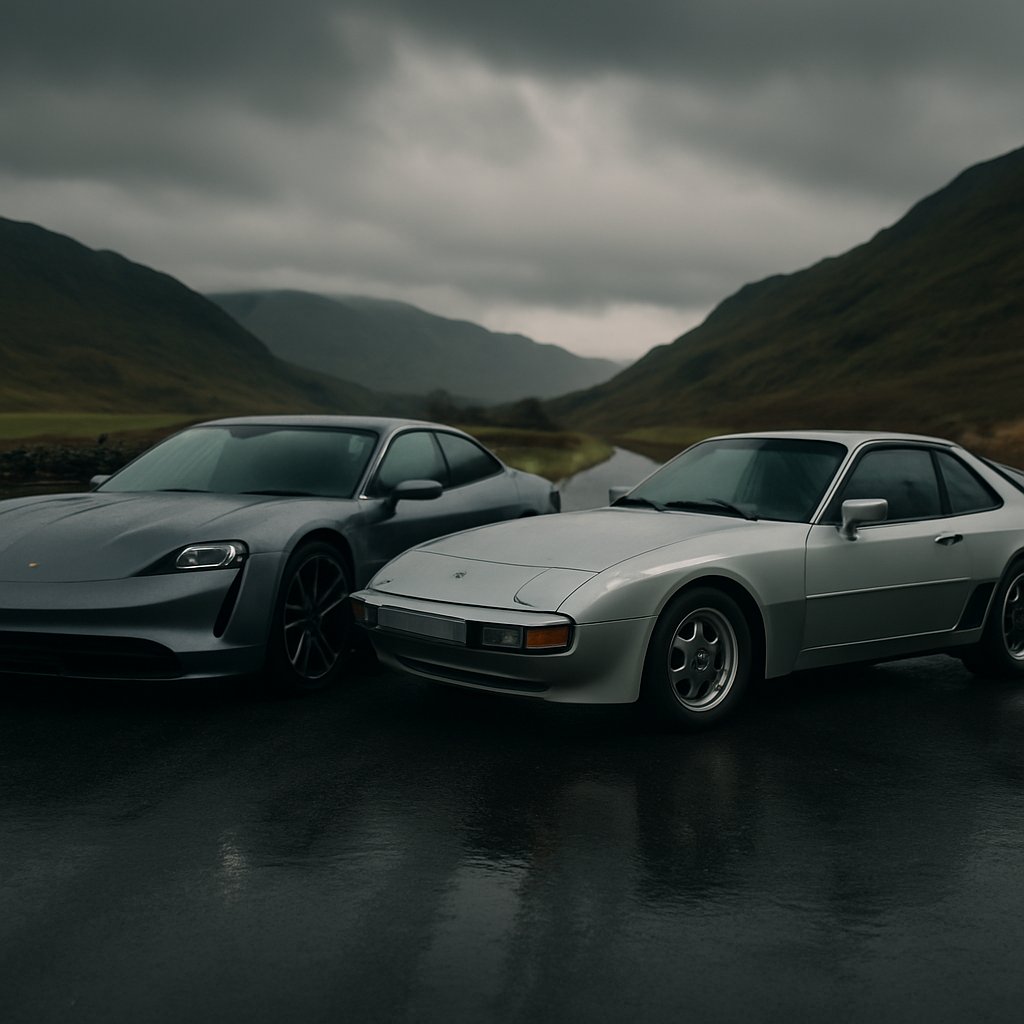
Torque Feel: The Instant Hit vs the Building Wave
Here’s where EVs genuinely win, and there’s no arguing with physics. An electric motor delivers maximum torque from zero RPM. Full stop. When you bury the throttle in something like a Tesla Model 3 Performance or a BMW i4 M50, the response is immediate, linear, and relentless. There’s no torque curve to speak of, just a wall of pull.
ICE cars, even with forced induction, build their torque across an RPM band. And for a lot of car people, that’s actually the point. There’s drama in a turbocharged engine spooling up, or in a naturally aspirated unit screaming toward its redline. The Honda Civic Type R’s K20C1 doesn’t feel truly alive until 4,500 RPM. That anticipation, that chase up the rev range, is something EVs simply cannot replicate.
On paper, EV torque wins. In terms of driver engagement, it depends entirely on what you’re after. A drag race from a standstill? Electric, every time. A mountain road where you’re managing throttle inputs and using the gearbox as a tool? ICE has the edge for most enthusiasts.
Sound: The Emotional Frequency
Sound is not a minor thing for car people. It is a core part of the driving experience. A flat-six Porsche 911 at 8,000 RPM, a Subaru Impreza’s boxer rumble at idle, the bark of a tuned exhaust on a cold morning. These sounds trigger genuine emotional responses, and no EV engineer has cracked this yet.
Manufacturers have tried. Audi plays synthesised noise through the speakers in some of its e-tron models. BMW did the same with the i4, using Hans Zimmer to design the sound profile. My honest take? It’s like watching a film score through a television speaker when you’ve heard it in a cinema. You know what it’s supposed to feel like, but something is missing.
EVs have their own acoustic character. At low speeds there’s near-silence with a faint electric whine, and at motorway speeds wind and tyre noise dominate in ways that a well-insulated ICE car often suppresses better. Neither is objectively better. But if you grew up obsessing over exhaust notes and intake sounds, EVs will feel like a fundamental part of the experience has been removed.
Handling Dynamics: Weight, Balance, and the Physics Problem
This is where it gets complicated. EVs are heavy. A Volkswagen ID.4 weighs around 2,100 kg. A standard Golf GTI comes in at roughly 1,400 kg. Physics doesn’t care about your battery range claims. That extra mass affects everything: turn-in response, mid-corner balance, braking distances, and the way a car feels over an imperfect British B-road.
The counterargument from EV advocates is dual-motor all-wheel drive torque vectoring. And it’s a fair one. A Porsche Taycan or a Hyundai Ioniq 5 N (which, at 2,232 kg, is genuinely extraordinary for what it does) can deploy power with surgical precision between axles in ways a conventional mechanical differential can’t match. The result is cornering grip that feels almost unfair.
But grip and engagement aren’t the same thing. When a rear-wheel-drive ICE car steps out gently at the limit, you feel it through the seat, the steering, your fingertips. You manage it. That feedback loop between driver and machine is thinner in most EVs. It’s not absent, particularly in sportier models, but it’s filtered. The car is doing more of the work.
There are exceptions. The Lotus Eletre RS, for instance, weighs a lot but has been tuned with Lotus’s genuine chassis knowledge behind it. And the upcoming Alpine A290 GTS is showing that the industry is taking driver feel seriously in smaller EVs. But as a general rule, if you want a car that communicates with you rather than one that manages the situation for you, ICE platforms still have a structural advantage rooted in their lower kerb weight.
Long-Distance Usability: The Honest Reality in 2026
The charging infrastructure argument has shifted significantly. According to government data, the UK had over 70,000 public EV charging points by early 2026. That’s a real improvement from three years ago. But the experience remains inconsistent.
On a planned motorway run with a modern EV boasting a 300-mile real-world range, charging at 150 kW rapid points along the way, a London to Edinburgh trip is genuinely viable. You might add 25 to 30 minutes versus an ICE equivalent. Manageable. But venture off the main arteries onto a touring route through Wales or the Scottish Highlands, and you’re planning around charging in a way an ICE driver simply isn’t.
Petrol cars win on refuelling time and network ubiquity. Full stop. The question is whether that matters for how you actually use the car. If 90% of your driving is commuting and the odd weekend blast, the EV vs ICE driving experience calculus changes completely. Home charging overnight makes the daily usage argument irrelevant. For long-haul touring in unfamiliar territory, ICE remains less mentally taxing.
Which One Is Actually More Fun?
The honest answer is: it depends on what fun means to you. If fun is raw acceleration, torque you can feel in your sternum, and effortless motorway overtakes, a decent EV is astonishing. If fun is revving a naturally aspirated engine, feeling gear shifts, hearing an exhaust pop on the overrun, and managing a car at the limit with your hands and feet, ICE is still the answer.
For a broader look at performance parts and upgrades across both powertrains, Maxx Directory is worth bookmarking. It covers the scene properly.
The real problem with the EV vs ICE driving experience debate is that it’s treated as binary. It isn’t. The Ioniq 5 N proves EVs can be genuinely exciting. The Caterham Seven proves ICE can be utterly thrilling with minimal power. The best driver’s car is still the one that makes you look for an excuse to go for a drive. In 2026, both powertrains can do that. It just depends which language of fun you speak.
Frequently Asked Questions
Do electric cars actually feel faster than petrol cars?
In terms of instant throttle response and 0-60 mph times, many electric cars feel brutally quick because they deliver maximum torque immediately from standstill. However, petrol cars with high-revving engines can feel more exciting through the mid-range and at the top end, where the drama of building revs and gear changes creates a different kind of engagement.
Is the EV vs ICE driving experience really that different on a B-road?
Yes, noticeably so. Most EVs are heavier than comparable ICE cars, which affects how they move through corners and how much feedback you get through the steering and seat. Some performance EVs use torque vectoring to compensate, but most enthusiasts still find ICE cars communicate more directly on twisty roads.
Can you take an electric car on a long road trip in the UK in 2026?
Generally yes, particularly on major routes. The UK now has over 70,000 public charging points, and modern EVs with 250-plus miles of real-world range can handle motorway trips with planned charging stops. Remote areas of Scotland, Wales, and parts of northern England can still be tricky, so route planning remains more involved than with a petrol car.
Do any electric cars have good driver feedback and handling?
A handful stand out. The Hyundai Ioniq 5 N, Porsche Taycan GTS, and Lotus Eletre RS all offer genuine driver engagement alongside EV performance. The Alpine A290 GTS is also generating strong interest in 2026. These are the exception rather than the rule, but they prove the technology can be tuned for enthusiasts.
Will ICE cars become harder to modify and tune as regulations tighten?
It’s a genuine concern for the tuning scene. UK and EU emissions regulations are becoming stricter, and some aftermarket modifications that affect emissions outputs are already facing tighter scrutiny. That said, the existing stock of ICE cars won’t disappear overnight, and the tuning aftermarket remains active for now, particularly for track and motorsport use.