The S-Class has been the flagship model of the Mercedes-Benz lineup for decades, but in the shift to electric cars it’s about to at least share that top pedestal with the EQS.
Last week, the German automaker revealed the interior of the Mercedes-Benz EQS electric sedan and provided new details regarding the car’s design, while confirming some new specifications. On Friday, Mercedes released more information about the EQS’s electric powertrain, range, aerodynamics, charging capabilities, and navigation functions.
The EQS is set to be a rolling technological tour de force, with an interior set to shame the Tesla Model S into mainstream status while possibly setting a new benchmark by which vehicle interiors will be judged. In short, it just might become this generation’s W126, the template of luxury cars for a generation.
2022 Mercedes-Benz EQS
2022 Mercedes-Benz EQS
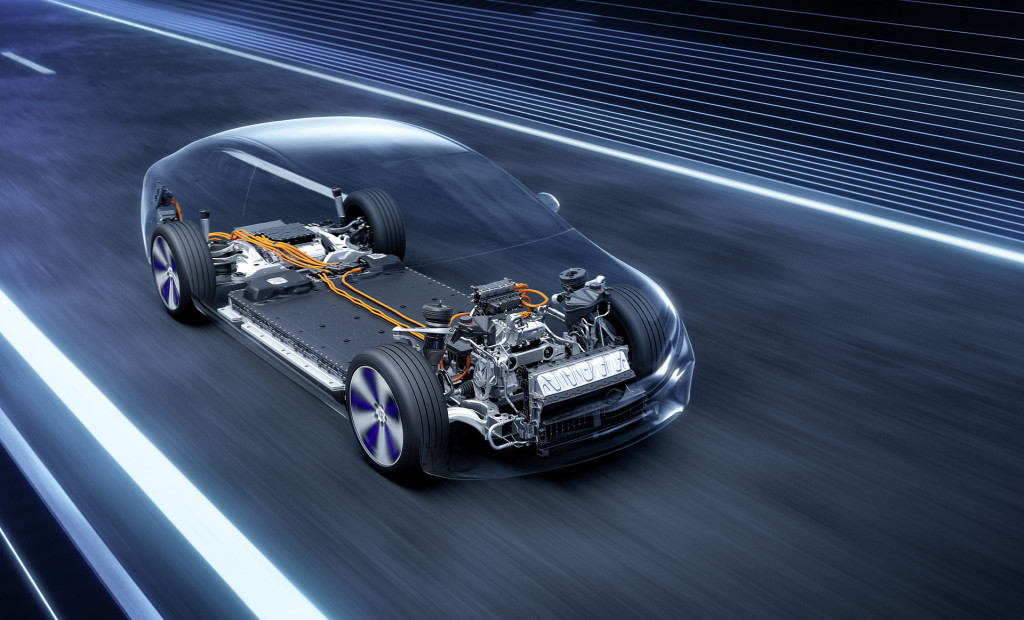
Teaser for 2022 Mercedes-Benz EQS debuting on April 15, 2021
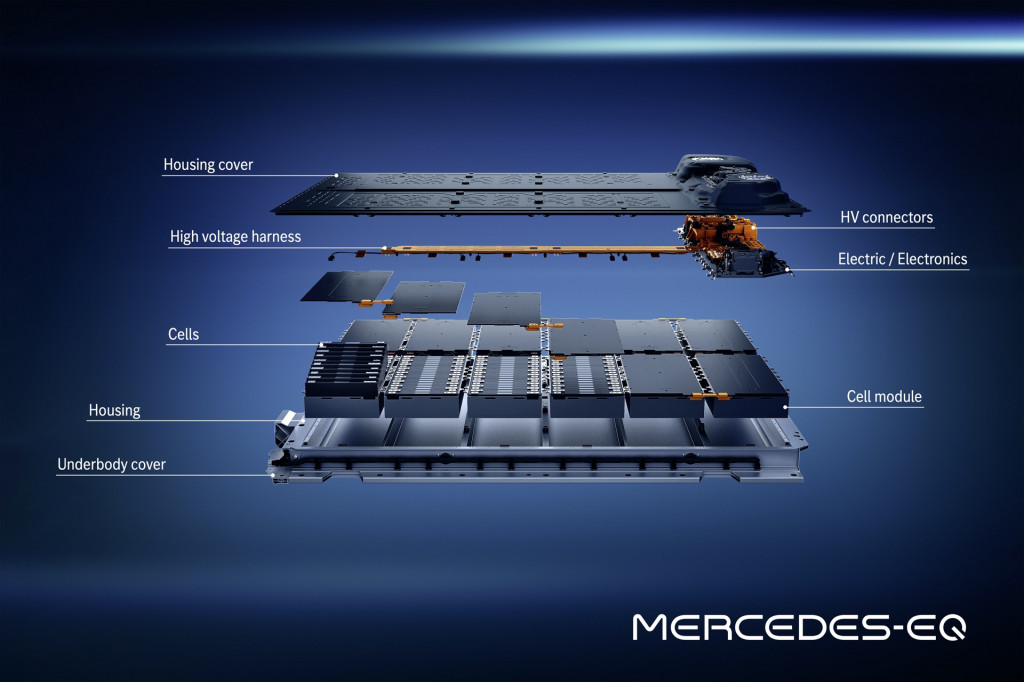
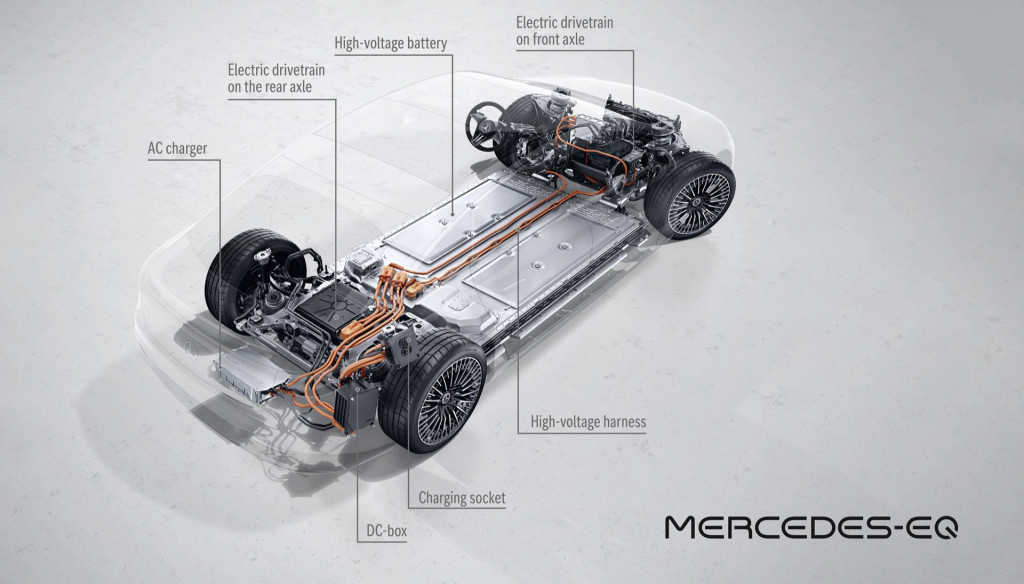
Riding on the new modular EVA platform, the EQS will be powered by a choice of two modular, liquid-cooled, lithium-ion battery packs running on a 400-volt architecture; the larger 108-kwh battery pack is already in production in Germany. Mercedes-Benz hasn’t said how large the smaller pack is, but with the large pack the automaker said the EQS will have a range of up to 770 kilometers (just under 478 miles) on the European WLTP testing cycle. That should translate to an EPA range rating of more than 400 miles.
The EQS will offer rear-wheel drive or a dual-motor (front and rear) option for all-wheel drive. Mercedes-Benz said output will range from 329 to 516 hp and at least 406 lb-ft of torque, though a more powerful performance version is in the cards. The top speed will be limited to 130 mph. It will also come with three levels of regenerative braking chosen via shift paddles on the steering wheel.
EQS hatchbacks will be capable of DC fast-charging rates of up to 200 kw that will allow it to gain about 150 miles of charge in 15 minutes. The optional on-board charger will have up to 9.6 kw of charging capacity, though Mercedes-Benz hasn’t stated the standard charger’s rate yet.
Compared to the Tesla Model S and other ground-up electric cars, the EQS will feature a smaller front trunk as some of that area is taken up by the air conditioning components.
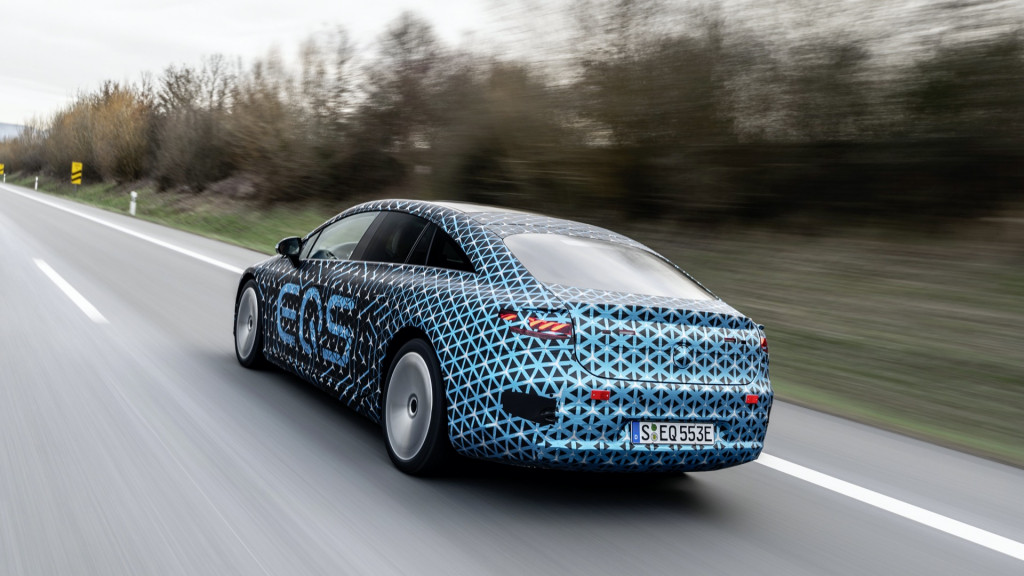
2022 Mercedes-Benz EQS
EQS owners will be able to choose how their electric luxury sedan sounds. Two standard soundscapes dubbed Silver Waves and Vivid Flux will come standard on the EQS; the former is said to be sensuous and clean, while the latter is aimed at EV enthusiasts with a crystalline, synthetic sound. A third sound, called Roaring Pulse, will be an over-the-air update that can be downloaded and is said to be reminiscent of powerful machines.
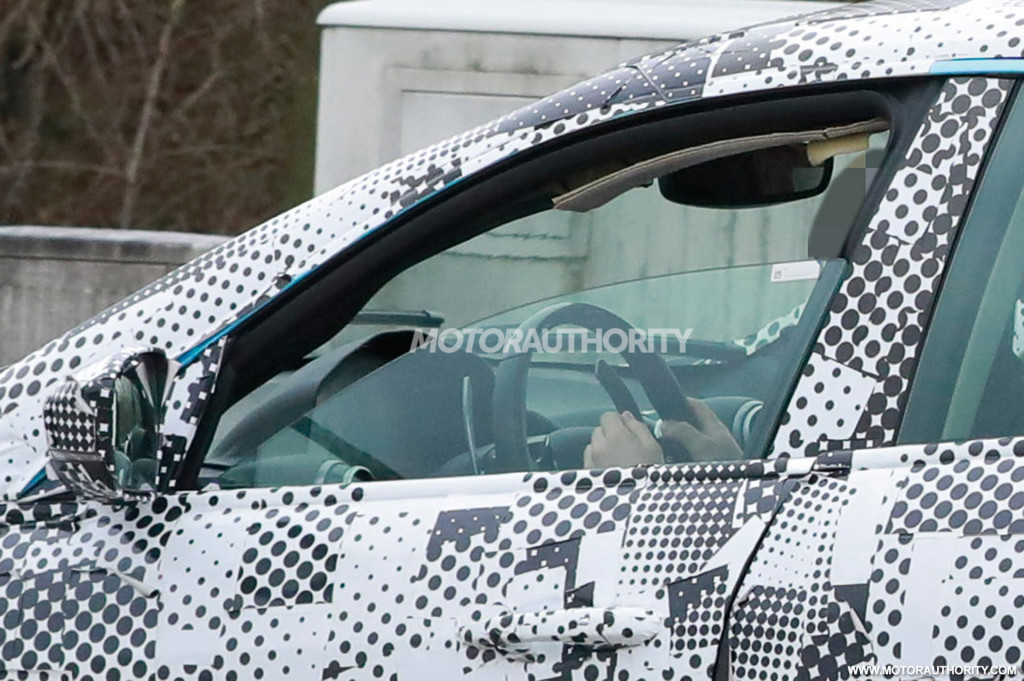
We’ve seen spy shots of the EQS sedan, and there won’t be a lot of surprises when the covers come off on April 15. It will have a coupe-like roofline and a smooth, seamless body design devoid of sharp lines and creases. A clamshell-like hood will overlap the fenders, and the front will feature a panel instead of a traditional grille to give the EQS a “face,” according to head of exterior design Robert Lesnik.
Mercedes-Benz confirmed the electric car’s cab-forward design is extremely aerodynamic with a coefficient of drag of 0.20. Details also help the car cut through the wind, including the arrow-shaped front and rear wheel spoilers and a rear spoiler optimized for lift and drag. Three aero wheel sizes, ranging from 19 to 21 inches, will be offered and they will likely be wrapped in low rolling-resistance tires. Mercedes will also offer 22s without such an aero-focused design. The 0.20 coefficient of drag makes the EQS slipperier than the Tesla Model S and Lucid Air, giving it the title of slipperiest regular production car in the world.
In January, Mercedes-Benz revealed the EQS’s Hyperscreen infotainment system, which consists of a 56-inch-wide screen with three control zones, including one just for the front passenger with seven profiles. The interior of the EQS will feel familiar, yet new, for those having spent time in a recent Mercedes-Benz.
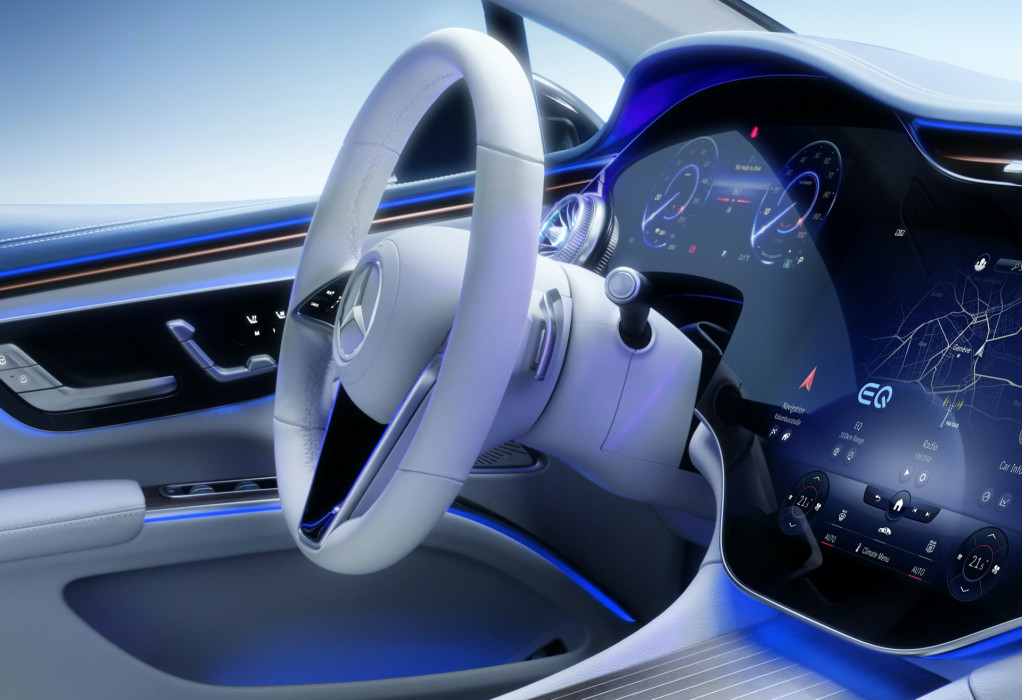
Mercedes-Benz EQS interior
The dashboard of the EQS flows into the door panels as if it’s one seamless piece, with a thin ribbon of LED lighting. Intricately detailed metal turbine-like air vents sit on either side of the dashboard, while the central air vents above the touchscreen display blend into the trim. The dashboard has a minimalist feel, but unlike a Tesla or other recent Mercedes-Benz models, it all appears integrated rather than tacked-on.
With no central drive tunnel or transmission housing to package around, the EQS employs some creative packaging solutions including a large open bin under the center console for a bag.
Quilted leather sport seats, shiny piano black plastic, real wood, metal speaker grilles, and enough LED lighting to throw a rave for five all add up to what one expects of a flagship luxury vehicle in 2021.
Certain bits, including the rear-seat entertainment screens, door handles, and door-mounted seat controls, appear to be shared with the new 2021 S-Class. That also means carrying over the 12.3-inch digital gauge cluster and 12.8-inch center touchscreen on EQS sedans without Hyperscreen, but that’s not a bad thing. Flagships can share.
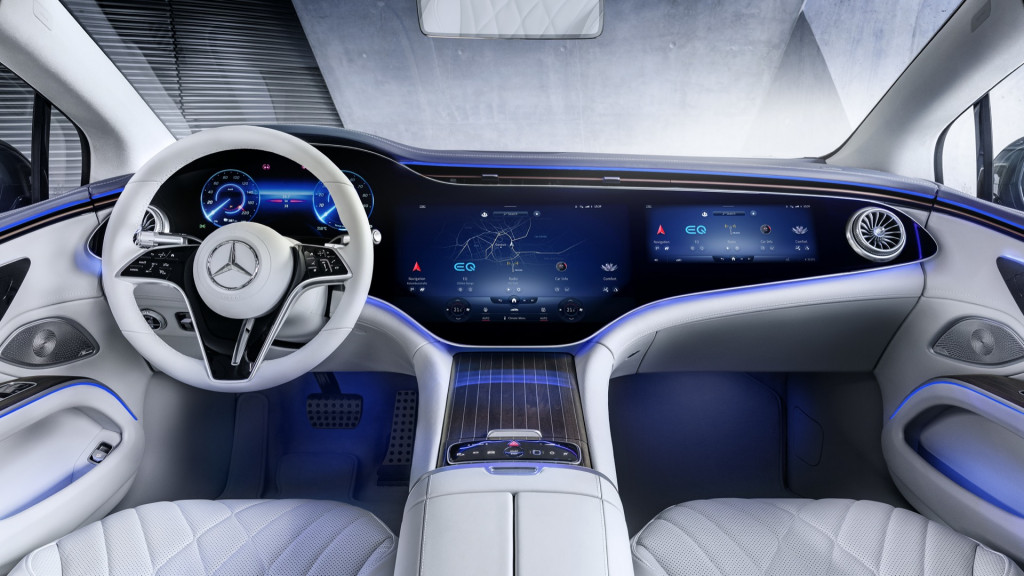
Mercedes-Benz EQS interior
The Hyperscreen infotainment system runs off 8 CPU cores, 24 GB of RAM, and 12 actuators under the touchscreen itself to trigger tangible vibrations when a finger touches the screen. Up to 350 sensors inside the EQS monitor its functions, vehicle surroundings, and passengers, including both body movement and spoken language. Artificial intelligence is also integrated. Mercedes-Benz said the EQS is capable of over-the-air software updates for the life of the vehicle.
The navigation system is intelligent enough to plan the fastest and most convenient route, including charging stops, while accounting for energy demand based on topography, route, ambient temperature, speed, and vehicle system demands. The system will utilize on-board data along with cloud computing to make calculations and respond to situations including but not limited to traffic, changes in energy demand, and the number of charging stations available, their charging capacity, and payment functions.
The available Burmester surround sound system in the EQS will feature 15 speakers and 710 watts of power. The 2021 S-Class can be ordered with a Burmester audio system with twice the number of speakers (30), and over double the power output (1,750 watts), but it runs on gas.
The Mercedes-Benz EQS sedan will be unveiled on April 15 and is due to arrive in the U.S. later in 2021.